


Controlling molten iron composition is one of the most important steps in producing consistent castings. Foundries commonly use thermal analysis and spectrometer analysis to evaluate molten cast iron, but these two methods do not provide exactly the same information.
So, which one should you use?
Thermal analysis is particularly useful for rapid melt control and understanding solidification behavior, while a spectrometer is better suited to detailed elemental composition analysis. In many foundries, the two methods work best together rather than as alternatives.
Understanding the difference can help foundries choose the right testing method for routine melt control, alloy verification, and process adjustment.

Thermal Analysis vs. Spectrometer: Quick Comparison
| Factor | Thermal Analysis | Spectrometer |
|---|---|---|
| Main purpose | Evaluate solidification behavior and melt condition | Analyze elemental composition |
| Carbon equivalent (CE) | Yes, depending on system | Can be calculated from measured elements |
| Carbon (C) | Can be estimated by thermal-analysis system | Direct elemental measurement |
| Silicon (Si) | Can be estimated by thermal-analysis system | Direct elemental measurement |
| Other alloying elements | Limited, depending on system | Strong capability |
| Cooling curve | Yes | No |
| Solidification behavior | Yes | Not directly |
| Undercooling / recalescence | Can provide information | No |
| Inoculation response | Can help evaluate | Not directly |
| Speed for routine melt checks | Fast | Requires sample preparation and analysis |
| Detailed chemical verification | Limited | Excellent |
| Process control during melting | Very useful | Useful |
| Final chemistry verification | Limited | Very useful |
The key difference is simple:
A spectrometer tells you what elements are present. Thermal analysis can tell you how the molten iron behaves as it solidifies.
That distinction is important because chemical composition alone does not completely describe the metallurgical condition of a cast iron melt.
What Does Thermal Analysis Tell You?
Thermal analysis, also called cooling curve analysis, records the temperature of a molten metal sample as it cools and solidifies.
For cast iron, the resulting cooling curve can provide information about characteristic solidification temperatures and other features of the solidification process. ASM describes thermal analysis as a method for analyzing solidification by recording temperature as a function of time, including applications such as determining solidification temperatures and evaluating casting conditions.
Depending on the analyzer and calibration, thermal analysis can be used to evaluate parameters such as:
- Carbon equivalent
- Carbon and silicon-related melt characteristics
- Liquidus temperature
- Eutectic temperature
- Undercooling
- Recalescence
- Solidification time
- Cooling behavior
- Inoculation response
- Chill tendency
- Other indicators of melt quality
Modern thermal-analysis systems can provide considerably more than a simple CE value. For example, some commercial CE-meter systems use multiple cooling-curve characteristics to evaluate parameters such as nodularity, chill tendency, inoculant selection, and shrinkage tendency.
This makes thermal analysis particularly interesting for production-floor process control.
What Does a Spectrometer Tell You?
A spectrometer is primarily a chemical composition analysis instrument.
In a foundry, an optical emission spectrometer (OES), for example, can determine the concentration of multiple elements in a metal sample.
Depending on the instrument and application, the analysis may include:
- Carbon (C)
- Silicon (Si)
- Manganese (Mn)
- Phosphorus (P)
- Sulfur (S)
- Chromium (Cr)
- Nickel (Ni)
- Molybdenum (Mo)
- Copper (Cu)
- Magnesium (Mg)
- Other alloying or residual elements
This makes spectrometry particularly valuable when the foundry needs to verify whether the molten iron meets a specified chemical composition.
For example, if a ductile iron grade requires controlled levels of C, Si, Mn, Mg and several alloying elements, a spectrometer provides detailed elemental information that a basic thermal-analysis measurement cannot replace.
In other words:
Spectrometry focuses on composition.
Thermal analysis focuses on composition-related solidification behavior and melt condition.
Thermal Analysis Is Not Simply a Faster Spectrometer
It is tempting to think of thermal analysis as a faster way to measure the same things as a spectrometer.
That is not quite correct.
Thermal analysis uses the solidification behavior of a sampled melt to obtain information from its cooling curve. Spectrometry measures the elemental composition of a prepared metal sample.
This difference means that the two methods answer different questions.
Spectrometer:
“What is the chemical composition of this sample?”
Thermal analysis:
“How does this molten iron solidify under the measurement conditions?”
This is why thermal analysis can provide information that elemental analysis alone does not directly provide.
Research on cast iron melt quality has shown that cooling curves can provide information related to solidification, melt quality, and process conditions, while chemical analysis provides composition data.
Which Method Is Better for Measuring Carbon Equivalent?
This question is particularly important for cast iron foundries.
Carbon equivalent (CE) is commonly used to describe the combined influence of carbon and other elements on the solidification behavior of cast iron.
Both methods can contribute to CE control, but they do it differently.
With a spectrometer
The instrument measures elemental concentrations such as carbon and silicon.
The foundry can then calculate a selected CE formula from the measured composition.
With thermal analysis
The analyzer evaluates characteristics of the cooling curve and can use calibrated relationships between solidification behavior and melt composition to determine CE-related values.
Therefore, the two measurements are not necessarily interchangeable.
The relationship between chemically calculated CE and thermal-analysis-derived values can also depend on the definition and calibration used. Research has shown that different CE formulations can produce different interpretations when compared with cooling-curve measurements.
For production control, the important point is not simply to ask:
“Which CE value is correct?”
Instead, the foundry should establish a consistent measurement method and control system appropriate for its alloy, equipment, and production requirements.
When Is Thermal Analysis the Better Choice?
Thermal analysis is particularly useful when the foundry needs fast information about the melt during production.
It can be a strong choice when you need to:
Check the Melt Before Pouring
A quick thermal-analysis test can provide information about the current condition of the molten iron before the metal is poured.
This can help the operator decide whether further treatment or adjustment may be required.
Monitor Inoculation
Inoculation changes the nucleation and solidification behavior of cast iron.
Because thermal analysis observes the cooling curve, it can help a foundry compare melt conditions before and after treatment.
Evaluate Solidification Behavior
Two melts with similar chemical composition may not necessarily behave identically during solidification.
Cooling-curve analysis provides another level of information beyond a simple elemental composition report.
Perform Frequent Production Checks
If a foundry needs to check multiple heats during a production shift, a rapid thermal-analysis workflow can be practical for routine process control.
When Is a Spectrometer the Better Choice?
Spectrometry becomes particularly important when the foundry needs detailed chemical composition.
Alloy Verification
For alloyed cast iron, knowing the concentration of specific alloying elements is essential.
A spectrometer can analyze a broader range of elements than a basic thermal-analysis system.
Grade Control
If the foundry produces several grades of gray iron, ductile iron, or alloy cast iron, spectrometry can help verify that the chemical composition falls within the required range.
Checking Minor or Alloying Elements
Elements such as Cr, Ni, Mo and Cu can have significant effects on the properties and behavior of alloyed cast irons.
These cannot simply be replaced by a CE measurement.
Laboratory or Quality Verification
Spectrometry is also valuable when a foundry needs a detailed chemical record for quality assurance, incoming material verification, or final process documentation.
What About Gray Iron and Ductile Iron?
The best testing strategy can also depend on the type of cast iron being produced.
Gray Iron
For gray iron, thermal analysis can be useful for monitoring:
- Carbon equivalent
- Eutectic behavior
- Undercooling
- Chill tendency
- Inoculation effects
- Solidification characteristics
A spectrometer remains important for controlling the actual chemical composition.
Ductile Iron
For ductile iron, the situation becomes even more interesting because final quality depends on more than simply C and Si.
The melt may also be affected by:
- Magnesium
- Inoculation
- Residual elements
- Nodule formation conditions
- Solidification behavior
Studies have demonstrated the use of thermal-analysis cooling curves to evaluate ductile iron melt quality and relate cooling-curve characteristics to metallurgical conditions.
Therefore, ductile iron foundries can benefit from using chemical analysis and thermal analysis as complementary tools.
Can Thermal Analysis Replace a Spectrometer?
No—not completely.
Thermal analysis can provide valuable information about CE and solidification behavior, but it does not provide the same detailed elemental analysis as a spectrometer.
For example, if you need to confirm the concentration of several alloying elements, thermal analysis alone may not be sufficient.
The same applies when the foundry needs to verify a specific material grade based on chemical composition.
Thermal analysis should therefore be viewed as an additional process-control tool rather than a universal replacement for spectrometry.
Can a Spectrometer Replace Thermal Analysis?
Not if the foundry needs information about solidification behavior.
A spectrometer can tell you that the iron contains a certain percentage of carbon, silicon, manganese, and other elements.
But chemical composition does not directly show the entire cooling behavior of the melt.
Thermal analysis can provide information from the cooling curve, including characteristic solidification temperatures and undercooling-related behavior.
This is one reason thermal analysis remains useful for foundries that need rapid feedback from the melt during production. ASM specifically notes the use of cooling curves to analyze cast iron solidification and to help control and adjust casting conditions.
Why Many Foundries Should Use Both
For many production foundries, the best solution is not:
Thermal Analysis OR Spectrometer
but:
Thermal Analysis AND Spectrometer
A practical workflow may look like this:
Melting → Chemical Verification → Thermal Analysis → Melt Treatment → Recheck → Pouring
For example:
- Melt the charge materials.
- Use spectrometry when detailed chemical composition needs to be verified.
- Take a thermal-analysis sample.
- Evaluate CE and cooling-curve characteristics.
- Adjust the melt or treatment process when required.
- Recheck the melt.
- Pour when the process-control criteria are satisfied.
The exact sequence will depend on the foundry’s equipment, alloy grades, production volume, and quality-control system.
The important idea is that chemical composition and solidification behavior provide different pieces of information.
Where Does the Thermal Analysis Cup Fit Into This Process?
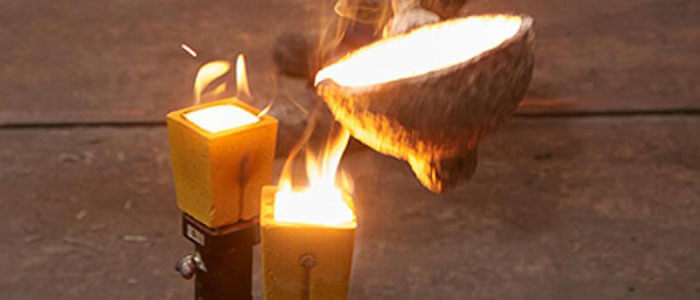
Thermal analysis depends on obtaining a representative molten-metal sample and measuring its cooling behavior consistently.
This is where the thermal analysis cup becomes an important consumable.
A suitable cup works together with the thermal-analysis system to provide a controlled sampling and cooling environment. The cup design, thermocouple configuration, material, geometry, and analyzer compatibility can all influence the consistency of measurements.
For this reason, selecting a thermal analysis cup should not be treated as simply buying a disposable container.
The cup should be matched with:
- The thermal analyzer
- The measurement method
- The cast iron grade
- Required parameters
- Sampling procedure
- Thermocouple configuration
- Production environment
For a detailed selection guide, see:
[How to Choose a Thermal Analysis Cup for Cast Iron]
SF-Foundry also supplies carbon cups for molten iron analysis, designed for applications involving carbon and silicon measurement and rapid molten-iron testing.
Thermal Analysis vs. Spectrometer: Which One Should You Choose?
A simple decision guide is:
Choose thermal analysis when your priority is:
- Fast melt control
- Carbon equivalent control
- Cooling-curve analysis
- Solidification behavior
- Inoculation evaluation
- Undercooling monitoring
- Frequent production checks
Choose a spectrometer when your priority is:
- Detailed chemical composition
- Alloy verification
- Multiple-element analysis
- Grade verification
- Monitoring alloying and residual elements
- Laboratory or quality documentation
Use both when you need:
- Detailed chemistry
- Real-time melt-condition information
- Stronger process control
- More reliable interpretation of melt behavior
Conclusion
Thermal analysis and spectrometry should not be viewed simply as competing technologies.
They provide different types of information.
A spectrometer primarily answers:
What is in the molten iron?
Thermal analysis helps answer:
How is the molten iron behaving as it cools and solidifies?
For routine chemical verification, spectrometry remains highly valuable. For rapid production control and solidification-related information, thermal analysis offers important additional insight.
For many cast iron foundries, the most effective approach is therefore to use spectrometry for detailed composition control and thermal analysis for rapid melt and solidification control.
The result is a more complete picture of molten iron quality—and a stronger basis for making process decisions before the metal reaches the mold.
Frequently Asked Questions
Is thermal analysis the same as spectrometer analysis?
No. Thermal analysis evaluates the temperature-time behavior of a cooling and solidifying metal sample, while spectrometry primarily measures elemental composition.
Can thermal analysis measure carbon and silicon?
Depending on the analyzer, thermal analysis can be used to estimate or determine carbon-, silicon-, and CE-related parameters through calibrated cooling-curve analysis. The exact capabilities depend on the system.
Is a spectrometer more accurate than thermal analysis?
For direct elemental composition measurement, spectrometry is generally the more appropriate method. Thermal analysis provides different information related to solidification and melt behavior, so “more accurate” depends on what you are trying to measure.
Do ductile iron foundries need both methods?
Many ductile iron foundries can benefit from both. Spectrometry provides detailed chemical composition, while thermal analysis can provide additional information about solidification and melt condition.
Can thermal analysis replace chemical analysis?
No. Thermal analysis can complement chemical analysis, but it should not automatically be treated as a complete replacement for detailed elemental analysis.
Why is the thermal analysis cup important?
The cup provides the sampling and cooling environment used to generate the thermal-analysis measurement. Consistent cup design, thermocouple configuration, and sampling practice are important for obtaining comparable results.
Related Resources
- How to Choose a Thermal Analysis Cup for Cast Iron
- Understanding Cooling Curves in Thermal Analysis of Cast Iron
- How to Measure Carbon Equivalent in Cast Iron
- What Is Carbon Equivalent (CE) in Cast Iron and Why Does It Matter?
- Thermal Analysis Cups (Sampling Cups): What Foundries Need to Know
- SEFU Carbon Cup for Molten Iron
If your foundry is looking for thermal analysis cups or carbon cups compatible with a specific analyzer, providing the analyzer model, cup type, measurement parameters, cast iron grade, and current cup specification can help determine the most suitable option.
