


In cast iron production, carbon and silicon have a major influence on how molten iron solidifies.
However, evaluating carbon and silicon separately does not always provide a complete picture of the solidification behavior of the melt. This is why foundries commonly use carbon equivalent (CE) as an important process control parameter.
Carbon equivalent combines the effects of carbon and other elements into a simplified value that helps predict how cast iron will behave during solidification.
CE is widely used in gray iron and ductile iron production to support decisions related to:
- Melt composition
- Solidification behavior
- Fluidity
- Graphite formation
- Shrinkage tendency
- Chill tendency
- Casting consistency
Understanding carbon equivalent helps foundries connect chemical composition with actual casting behavior.
But what exactly is CE, how is it calculated, and why does it matter in everyday foundry production?
What Is Carbon Equivalent in Cast Iron?
Carbon equivalent (CE) is a calculated value used to estimate the combined influence of carbon and certain alloying elements on the solidification behavior of cast iron.
In simple terms, CE provides a way to express the overall graphitizing effect of the melt using a single value.
For many cast iron applications, carbon equivalent is commonly expressed using a relationship between carbon, silicon, and phosphorus.
A commonly used formula is:
CE = C + (Si + P) / 3
Where:
- C = Carbon content
- Si = Silicon content
- P = Phosphorus content
Depending on the alloy system, foundry practice, or analysis method, different formulas and calculation models may also be used.
For this reason, CE should always be interpreted according to the specific material grade and process being controlled.
The important concept is that CE helps foundries understand how close the molten iron is to eutectic solidification behavior.
Why Is Carbon Equivalent Important?
Carbon equivalent influences how cast iron solidifies.
Changes in CE can affect:
- Graphite formation
- Carbide formation
- Chill tendency
- Fluidity
- Shrinkage behavior
- Casting hardness
- Microstructure
This makes CE an important bridge between chemical composition and casting performance.
Two melts may have different carbon and silicon contents but a similar carbon equivalent.
Although they are not metallurgically identical, their overall solidification behavior may be more comparable than if carbon content alone were considered.
This is why CE is widely used as a practical foundry process control parameter.
Understanding the Eutectic Point
To understand why CE matters, it is useful to understand the eutectic condition.
Cast iron does not always solidify in the same way.
Depending on composition and cooling conditions, the metal may behave as:
- Hypoeutectic
- Near-eutectic
- Hypereutectic
Carbon equivalent helps describe the relationship between the melt composition and eutectic solidification.
In general terms:
Lower CE
The melt tends to be further below the eutectic composition.
This can increase the tendency toward:
- Carbide formation
- Higher hardness
- Chill
- Reduced graphite formation
Higher CE
The melt moves closer to or beyond eutectic conditions.
This can promote:
- Graphite formation
- Improved fluidity
- Reduced chill tendency
However, excessively high CE may also create process challenges depending on the alloy and casting design.
The correct CE range should therefore be determined according to the specific cast iron grade and production requirements.
How Carbon Equivalent Affects Solidification
During cooling, molten cast iron undergoes phase transformations.
The composition of the melt influences:
- When solidification begins
- How eutectic solidification occurs
- Whether graphite or carbides form
- The final microstructure
Carbon equivalent provides a simplified way to evaluate these tendencies.
A change in CE can shift the solidification behavior of the melt.
This is why CE is closely related to thermal analysis.
When molten iron is poured into a thermal analysis cup, the cooling curve records characteristic temperature changes during solidification.
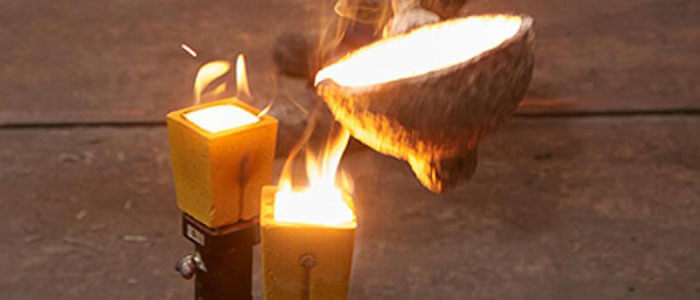
These thermal events can be analyzed to estimate information related to the metallurgical condition of the melt, including carbon equivalent depending on the analysis system.
How Does CE Affect Graphite Formation?
Graphite formation is a major factor in cast iron properties.
The amount, shape, and distribution of graphite influence mechanical and physical characteristics.
Carbon and silicon are both important graphitizing elements.
As the effective graphitizing tendency increases, the melt may become more favorable for graphite formation under suitable processing conditions.
However, CE is only one part of the picture.
Graphite formation is also affected by:
- Cooling rate
- Inoculation
- Chemical composition
- Nucleation conditions
- Section thickness
- Magnesium treatment in ductile iron
Therefore, CE should not be used alone to predict final microstructure.
It is best viewed as one important process indicator.
Carbon Equivalent and Chill Tendency
Chill refers to the formation of hard carbide structures, particularly in areas with rapid cooling.
Low CE can increase the tendency toward carbide formation under certain conditions.
This may contribute to:
- Increased hardness
- Difficult machining
- Unwanted white iron structures
Higher CE can generally reduce the tendency toward chill by supporting graphitic solidification.
However, the actual result also depends on cooling rate and other metallurgical factors.
For example, a thin casting section cools much faster than a thick section.
Even if both castings use the same molten iron, their final microstructures may differ because of different cooling conditions.
This is why CE should be evaluated together with casting geometry and process conditions.
Carbon Equivalent and Fluidity
Carbon equivalent can also influence molten iron fluidity.
Melt composition affects the solidification range and how long the metal remains sufficiently fluid during mold filling.
For many cast iron applications, composition closer to eutectic conditions may provide favorable fluidity characteristics.
This can be important for:
- Thin-wall castings
- Complex shapes
- Long metal flow paths
- Intricate gating systems
However, increasing CE simply to improve fluidity is not always the correct solution.
The target composition must also meet the mechanical property and microstructure requirements of the casting.
Carbon Equivalent and Shrinkage
Solidification shrinkage is another important consideration in casting production.
The relationship between CE and shrinkage is complex.
Changes in composition can influence:
- Graphite expansion
- Solidification behavior
- Feeding requirements
- Shrinkage tendency
In cast iron, graphite precipitation can partially compensate for solidification contraction.
For this reason, melt composition and CE can influence the overall feeding and shrinkage behavior.
However, CE alone cannot predict whether a casting will develop shrinkage defects.
Other factors include:
- Casting geometry
- Hot spot location
- Feeding system design
- Pouring temperature
- Mold characteristics
- Solidification rate
For shrinkage control, CE should therefore be considered together with proper casting design and feeding practice.
Carbon Equivalent in Gray Iron
Carbon equivalent is commonly used in gray iron process control.
Gray iron production requires a suitable balance between:
- Carbon
- Silicon
- Inoculation
- Cooling conditions
If CE is too low for the intended application, the risk of chill or carbide formation may increase.
If CE is too high, other issues related to structure and mechanical properties may need to be considered.
The appropriate target range depends on:
- Casting section thickness
- Required strength
- Hardness requirements
- Casting design
- Production process
Thin-wall castings and thick-section castings may require different composition strategies.
For this reason, foundries typically establish CE targets according to specific casting grades and production conditions rather than using one universal value.
Carbon Equivalent in Ductile Iron
CE is also important in ductile iron production.
However, ductile iron requires additional consideration because the process involves:
- Magnesium treatment
- Nodular graphite formation
- Inoculation
- Fading effects
- Matrix control
Carbon equivalent can help evaluate the general solidification condition of the melt.
But successful ductile iron production depends on more than CE.
Other important parameters may include:
- Carbon
- Silicon
- Magnesium
- Sulfur
- Residual elements
- Inoculation practice
For this reason, CE should be used as one part of a broader ductile iron process control system.
How Is Carbon Equivalent Measured?
Carbon equivalent can be determined using different methods.
1. Calculation From Chemical Analysis
If the chemical composition is known, CE can be calculated using an appropriate formula.
For example:
CE = C + (Si + P) / 3
Chemical composition may be obtained through laboratory analysis or a spectrometer.
2. Thermal Analysis
Thermal analysis provides another method for evaluating the solidification behavior of molten iron.
A molten metal sample is poured into a thermal analysis cup.
A thermocouple records the temperature as the sample cools.
The resulting cooling curve contains characteristic thermal events related to solidification.
Depending on the thermal analysis system, these temperatures can be used to estimate parameters such as:
- Carbon equivalent
- Carbon content
- Silicon content
- Eutectic behavior
This allows foundries to obtain rapid process information directly during production.
Thermal Analysis vs. Spectrometer for CE Control
Thermal analysis and spectrometer analysis provide different information.
| Thermal Analysis | Spectrometer |
|---|---|
| Evaluates solidification behavior | Measures elemental composition |
| Uses cooling curve data | Uses chemical analysis |
| Fast production feedback | Detailed composition control |
| Useful for monitoring melt condition | Useful for verifying element content |
In many foundries, these methods are complementary.
A spectrometer provides chemical composition data.
Thermal analysis provides information about how the molten iron behaves during cooling and solidification.
Using both can provide a broader understanding of the melt condition.
Why CE Can Change During Production
The chemical composition of molten iron can change throughout the production process.
Possible causes include:
- Different charge materials
- Return scrap variation
- Alloy additions
- Silicon additions
- Carbon adjustment
- Melt treatment
- Inoculation practice
- Temperature changes
- Holding time
For this reason, CE should not always be treated as a fixed value.
Regular process monitoring can help identify changes before they create significant casting quality problems.
Common Problems Associated With Poor CE Control
Poor control of melt composition can contribute to unstable production conditions.
Depending on the application, problems may include:
Excessive Chill Tendency
Potentially associated with lower graphitizing tendency and rapid cooling conditions.
Inconsistent Microstructure
Variations in composition and solidification conditions can lead to differences between production batches.
Changes in Fluidity
Melt composition changes may affect mold filling behavior.
Increased Process Variation
Without consistent CE monitoring, changes in charge materials or melt treatment may not be identified quickly.
It is important to remember that casting defects rarely have a single cause.
CE should be investigated as part of the complete metallurgical and process control system.
How Foundries Can Control Carbon Equivalent
Effective CE control usually begins with consistent process monitoring.
A practical workflow may include:
Charge Material Selection
          ↓
Melting
          ↓
Chemical Analysis
          ↓
Thermal Analysis
          ↓
Evaluate CE and Melt Condition
          ↓
Adjust Composition if Necessary
          ↓
Treatment / Inoculation
          ↓
Final Process Check
          ↓
Pouring
The exact process varies between foundries.
The objective is to identify composition or solidification changes early enough to make controlled adjustments.
Why Thermal Analysis Is Useful for CE Control
Traditional chemical analysis provides important information about elemental composition.
However, foundry production also needs fast feedback about how the melt behaves.
Thermal analysis provides this additional perspective.
By analyzing the cooling curve, foundries can monitor changes in the solidification behavior of molten iron.
This can be particularly useful for:
- Furnace process control
- Batch-to-batch comparison
- Inoculation monitoring
- Melt consistency
- Production troubleshooting
A thermal analysis cup provides a practical and repeatable method for obtaining the sample required for this process.
Frequently Asked Questions
What is carbon equivalent in cast iron?
Carbon equivalent is a calculated value that represents the combined influence of carbon and certain alloying elements, particularly silicon, on the solidification behavior of cast iron.
What is the carbon equivalent formula for cast iron?
A commonly used formula is:
CE = C + (Si + P) / 3
However, different formulas may be used depending on the alloy system and foundry practice.
Why is carbon equivalent important?
CE helps foundries evaluate how melt composition may influence graphite formation, chill tendency, fluidity, and solidification behavior.
Is higher carbon equivalent always better?
No. The correct CE depends on the cast iron grade, casting geometry, cooling rate, mechanical property requirements, and production process.
How can carbon equivalent be measured?
CE can be calculated from chemical composition or estimated using thermal analysis systems that analyze the cooling curve of a molten iron sample.
Can CE predict casting defects?
CE can help identify metallurgical tendencies, but it cannot independently predict all casting defects. Casting quality also depends on gating, feeding, cooling conditions, melt treatment, mold design, and other process factors.
Conclusion
Carbon equivalent is one of the most useful process control concepts in cast iron production.
By combining the effects of carbon and other graphitizing elements into a simplified value, CE helps foundries evaluate the relationship between melt composition and solidification behavior.
Proper CE control can support more consistent production by helping monitor:
- Graphitizing tendency
- Chill tendency
- Fluidity
- Solidification behavior
- Process stability
However, CE should not be treated as an isolated number.
The final casting result also depends on:
- Cooling rate
- Inoculation
- Melt treatment
- Casting geometry
- Chemical composition
- Gating and feeding design
For this reason, effective foundry process control combines chemical analysis with practical monitoring of molten metal solidification behavior.
Thermal analysis provides a fast way to evaluate this behavior during production. By using a thermal analysis cup and temperature measurement system, foundries can obtain rapid feedback from the cooling curve of molten iron.

SF-Foundry supplies thermal analysis cups and related molten metal sampling solutions for cast iron process control.
For more information about thermal analysis cups or foundry sampling applications, contact SF-Foundry with your equipment and process requirements.
Email: info@sf-foundry.com
WhatsApp: +8618636913699