


You’ve just finished a pour. You knock out the casting, and instead of a clean part, you find fragments of fiberglass mesh embedded in the metal. Or worse—the filter tore mid-pour, and now you have slag inclusions scattered through an entire batch.
If this sounds familiar, you’re not alone. Filter breakage is one of the most frustrating—and costly—problems in aluminum casting. Here’s what’s actually happening and how to stop it.
The Short Answer
Fiberglass mesh filters break during aluminum casting for four main reasons:
-
Wrong temperature rating – the filter softens and collapses under heat
-
Thermal shock – cold filter meets 700°C+ metal and cracks
-
Mechanical overload – metal velocity or pressure exceeds the filter‘s strength
-
Poor installation – gaps, wrinkles, or undersized filters create weak points
Let’s walk through each one—and more importantly, how to fix them.
Reason #1: You’re Using the Wrong Grade of Fiberglass for Your Pour Temperature
This is the most common killer of fiberglass mesh filters.
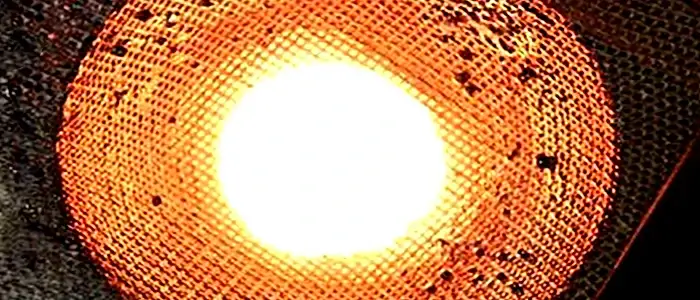
Standard E-glass fiberglass mesh has a working temperature of 700–800°C and a softening point around 900°C. That sounds like plenty of headroom for aluminum (which pours at 680–800°C–), but here’s the catch: that 100–200°C gap between working temperature and softening point is not a time buffer—it’s a temperature safety margin for short-duration exposure.
If your process runs above 800°C, or if molten metal stays in contact with the filter longer than 10–20 minutes, standard fiberglass will soften and collapse mid-run.
The Fix
-
Know your actual pour temperature—not just the alloy’s melting point. Pure aluminum melts at 660°C, but real-world pouring temperatures with superheat run 720–790°C.
-
Match the filter grade to your process:
-
Standard E-glass: 700–800°C, for most aluminum casting
-
High-silica (96%+ SiO₂): up to 1700°C softening point, for higher-temperature or longer-duration applications
-
-
Check your dwell time. If metal sits on the filter longer than the product‘s rated sustained working time (typically 10 minutes), upgrade to a higher-temperature grade.
Reason #2: Thermal Shock – The Cold Filter Problem
Imagine plunging a cold glass into boiling water. That’s exactly what happens when a room-temperature fiberglass filter meets 700°C molten aluminum.
The temperature difference can exceed 1000°C. In that instant, the filter expands rapidly. If the material can’t handle the thermal stress, it cracks. Once cracked, the filter has no structural integrity left—it tears apart under the flow of metal.
A poor-quality filter made with substandard slurry preparation and sintering processes is especially vulnerable to thermal shock cracking.
The Fix
-
Preheat the filter—but not too much. For aluminum, preheating to 100–150°C is sufficient to reduce thermal shock–. (For iron and steel, you‘d go higher—200–400°C—but aluminum doesn’t need that.)
-
Don‘t overdo it. Some sources note that for aluminum, cold filters can be used directly without preheating–—but if you’re experiencing cracking, a gentle preheat is the easiest fix.
-
Buy from a quality manufacturer. Inferior filters crack because of poor slurry preparation and sintering processes. The coating and heat-setting process matters.
Reason #3: Mechanical Overload – Too Much Metal, Too Fast
Fiberglass mesh has mechanical limits. Exceed them, and it tears.
Three specific scenarios cause mechanical failure:
A. Excessive Flow Velocity
When aluminum flows through the filter too fast, the mechanical冲击 can break the fibers.
One real-world example: an auto parts foundry tilted their ladle too quickly, causing the flow rate to spike. Inclusions larger than 100μm—which should have been intercepted by the 16-mesh filter—were forced straight through, resulting in batch scrap.
The fix: Keep aluminum flow velocity below 1.2 m/s. If you‘re pouring faster than that, slow down or increase your filter area.
B. Filter Area Too Small
Insufficient filter area is a common mistake. When the filter is too small for the volume of metal passing through it, the metal accelerates through the available openings. That increased velocity puts stress on the filter—and eventually, it breaks.
The fix: Calculate your filter area based on your pour rate. A general rule: the cut filter block should be about 20–30mm larger than the cross-sectional area of the gating system.
C. Filter Capacity Exceeded
This one is less obvious but equally destructive. Every filter has a filtration capacity—the total amount of slag and inclusions it can hold before it becomes blocked.
When a filter exceeds its capacity, the metal flow slows, pressure builds, and the filter fractures–. One case study of large engine crankshaft castings found that the original fiber filter screen exceeded its filtration capacity because the pour volume and time were greater than standard castings—and the filter fractured as a result.
The fix:
-
Match the filter‘s rated capacity to your pour volume
-
For larger castings, use a larger filter or multiple filters
-
If you see premature clogging, bump the mesh size up one step or add more filter area
Reason #4: Installation Problems – Gaps, Wrinkles, and Poor Seating
Even the best filter will fail if it’s installed wrong.
A. Gaps Around the Edges
If the filter doesn‘t fit snugly against the mold wall, metal bypasses the filter entirely–. But more than that—the unsupported edges of the filter become stress points where tearing starts.
The fix: Cut the filter slightly oversized so it fits securely in the seat–. For sand molds, design a recessed filter seat—a dedicated step or slot where the filter can rest securely.
B. Wrinkles and Folds
A wrinkled filter is a pre-weakened filter. When you place the filter, the bending surface should be kept upward and flattened from the center to the four sides. The filter mesh cannot have wrinkles.
The fix: Take the extra 10 seconds to smooth the filter flat before closing the mold.
C. Crooked or Misaligned Placement
A crooked filter spreads flow unevenly across its face. One section clogs first, pressure builds unevenly, and tearing starts at the clogged section.
The fix: Align the filter properly. Ensure it contacts the mold wall around its entire perimeter.
D. Filter Placed in a Turbulent Area
Placing the filter directly under the sprue—where metal falls with maximum velocity and turbulence—is asking for trouble.
The fix: Position the filter in the runner after the sprue, where flow has stabilized–. Engineering practice shows the best results come from placing the filter at the bottom of the sprue, more than 150mm from the cavity.
Quick Reference: Breakage Causes & Solutions
| Symptom | Most Likely Cause | What to Do |
|---|---|---|
| Filter melted or sagged | Temperature too high / wrong grade | Check pour temp; use high-silica grade if >800°C |
| Filter cracked into pieces | Thermal shock | Preheat to 100–150°C before pouring |
| Filter torn in the middle | Flow velocity too high | Slow pour rate; increase filter area |
| Filter torn at the edges | Poor seating / gaps | Cut oversized; use recessed seat; flatten wrinkles |
| Filter clogged then broke | Exceeded filtration capacity | Use larger filter or coarser mesh; add multiple filters |
| Filter broke during handling | Low mechanical strength | Source from a quality manufacturer |
The Bottom Line
Most fiberglass mesh filter breakage in aluminum casting comes down to one of four things: wrong temperature rating, thermal shock, mechanical overload, or poor installation.
The good news? Every single one is preventable.
-
Know your pour temperature and match your filter grade
-
Preheat gently (or at least don‘t pour cold)
-
Keep flow velocity under 1.2 m/s
-
Size your filter correctly for both area and capacity
-
Install it flat, snug, and wrinkle-free
Get these right, and your filters will survive the pour—every time.
Have a specific breakage pattern you’re seeing? Drop us a line—we‘ve probably seen it before and can help you troubleshoot.