


How ceramic foam filtration ensures clean aluminum for extrusion, rolling, and high-end applications
Direct Chill (DC) casting is the predominant method for producing aluminum billets and slabs—the semi-finished products that feed extrusion presses, rolling mills, and downstream manufacturing operations. Whether you are producing extrusion billets for automotive structural components, rolling slabs for can stock and aluminum foil, or high-end aluminum profiles for aerospace applications, one factor is universal: melt cleanliness is non-negotiable.
Alumina ceramic foam filter plates have become the industry standard for molten aluminum filtration in DC casting operations. Installed in the filter box between the furnace and the casting station, these filters remove non-metallic inclusions that would otherwise compromise billet and slab quality, leading to surface defects, reduced mechanical properties, and costly downstream failures.
What Is DC Casting?
Direct Chill (DC) casting is a semi-continuous vertical casting process used to produce aluminum billets (round cross-section) and slabs (rectangular cross-section). In this process, molten aluminum is poured into a water-cooled mold; as the metal solidifies, the cast product is continuously withdrawn downward while water is sprayed directly onto the emerging surface—hence the name “direct chill.”
DC casting is the primary production route for:
-
Billets – round logs that are later extruded into profiles, tubes, and automotive structural components
-
Slabs – rectangular plates that are rolled into sheet, foil, can stock, and plate products
The quality of the final downstream product—whether an extruded automotive component or a rolled aluminum can—is determined largely by the cleanliness of the DC-cast billet or slab from which it was made.

The Challenge: Non-Metallic Inclusions in DC Casting
Molten aluminum inevitably contains non-metallic inclusions. These include:
-
Oxide films (Al₂O₃) – formed when molten aluminum reacts with oxygen
-
Slag and dross – from furnace operations and melt handling
-
Refractory particles – eroded from furnace linings and launders
-
Borides and carbides – from alloying additions
These inclusions are problematic for several reasons. If left unfiltered, they become trapped in the solidifying billet or slab. In billets, inclusions tend to concentrate near the cross-section center and at the beginning and end of the billet length. In slabs, they are located mostly within 13 mm of the surface and in bands between the centerline and the surface.
The consequences of these inclusions manifest downstream:
-
Extrusion – inclusions cause surface streaks, die wear, and can lead to catastrophic billet failure during extrusion
-
Rolling – inclusions create surface defects and pinholes in rolled sheet and foil
-
Machining – hard inclusions accelerate tool wear and increase machining costs
-
Mechanical properties – inclusions act as stress concentrators, reducing fatigue strength and ductility
Ceramic foam filtration is the most effective and cost-efficient method for removing these inclusions before they become embedded in the solidifying metal.
How Ceramic Foam Filter Plates Work
Unlike simple mesh screens that act as surface sieves, ceramic foam filter plates operate through deep-bed (depth) filtration. The filter is a three-dimensional, open-cell porous structure with interconnected voids—essentially a ceramic maze that molten aluminum must navigate.
The filtration process involves multiple mechanisms:
-
Mechanical interception – larger inclusions are physically trapped at the filter surface and within the pore channels
-
Cake filtration – as inclusions accumulate, they form a “filter cake” that enhances filtration efficiency over time
-
Deep-bed adsorption – smaller inclusions attach to the internal surfaces of the ceramic structure through physical and chemical interactions
-
Flow rectification – the tortuous path through the filter converts turbulent flow into laminar flow, reducing gas entrapment and oxide formation
The result is significantly cleaner metal. The filter captures inclusions while maintaining smooth, stable metal flow—a critical requirement for consistent DC casting.
Key Specifications for DC Casting Applications
When selecting an alumina ceramic foam filter plate for DC casting, several technical parameters determine performance.
PPI (Pores Per Inch)
PPI measures the number of pores per linear inch. Lower PPI = coarser pores, higher flow rate. Higher PPI = finer pores, higher filtration precision.
For DC casting applications, the following PPI ranges are generally recommended:
| Application | Recommended PPI | Rationale |
|---|---|---|
| Large billets and ingots | 10–20 PPI | High flow rate required for large cross-sections |
| Standard billet production | 20–30 PPI | Balanced filtration precision and flow rate |
| High-quality slabs and critical alloys | 30–40 PPI | Higher filtration precision for demanding applications |
Research confirms the impact of pore size: A study comparing slab quality after DC casting using 30 PPI, 50 PPI, and 50 PPI + HF filters found significant differences in inclusion size, number, and distribution. Casting slabs with a finer pore-size filter (50 PPI) greatly reduced the number of non-metallic inclusions.
For civil extruded profiles, cast rods, and slabs, 10–40 PPI filter plates are typically selected based on product category and melt cleanliness requirements. For primary aluminum with good melt cleanliness, 20–30 PPI is often sufficient; for recycled aluminum with higher inclusion levels, 30–40 PPI provides more aggressive filtration.
Porosity
Open porosity typically ranges from 82% to 90%. Higher porosity improves flow but can reduce mechanical strength.
Bulk Density
Typical bulk density ranges from 0.38 to 0.55 g/cm³.
Compressive Strength
Compressive strength at room temperature typically ranges from 0.8 to 1.5 MPa. This is important for handling, installation, and withstanding the pressure of the molten metal head.
Maximum Working Temperature
Alumina (Al₂O₃) ceramic foam filters have a maximum working temperature of ≤1250°C—well above the typical aluminum casting temperature of 660–760°C. Alumina’s chemical inertness ensures it does not react with or contaminate the molten aluminum.
Filter Sizes
Ceramic foam filter plates for DC casting are available in a wide range of sizes to accommodate different filter boxes and flow rates. Common sizes range from 225 mm to 660 mm (9 inches to 26 inches) square. Standard sizes include 7″, 9″, 12″, 15″, 17″, 20″, and 23″.
Benefits of Alumina Ceramic Foam Filter Plates in DC Casting
1. Reduced Inclusion-Related Defects
By removing non-metallic inclusions down to the micron level, ceramic foam filters dramatically reduce defects in the final billet or slab. This translates to fewer surface imperfections, fewer internal defects, and higher overall quality.
2. Improved Mechanical Properties
Cleaner metal means better mechanical properties. Inclusions act as stress concentrators that reduce fatigue strength, ductility, and fracture toughness. Filtration removes these weak points, resulting in stronger, more reliable downstream products.
3. Better Surface Quality
For slabs destined for rolling, surface quality is paramount. Any inclusions near the slab surface will manifest as surface defects in rolled sheet or foil. Ceramic foam filtration removes these near-surface inclusions, ensuring smoother rolling and higher yields.
4. Extended Die and Tool Life
For extrusion operations, clean billets mean longer die life. Hard inclusions in the billet cause premature die wear, increasing tooling costs and production downtime. Filtration protects downstream equipment.
5. Increased Productivity
Scrap reduction of 10–30% is achievable with proper ceramic foam filtration. By reducing defects and improving first-pass yield, filtration directly impacts the bottom line.
6. Flow Stabilization
One of the most overlooked benefits of ceramic foam filters is flow rectification. By converting turbulent flow into laminar flow, the filter reduces gas entrapment and oxidation during casting. This is particularly important in DC casting, where stable metal flow is essential for consistent solidification.
Installation and Operation Considerations
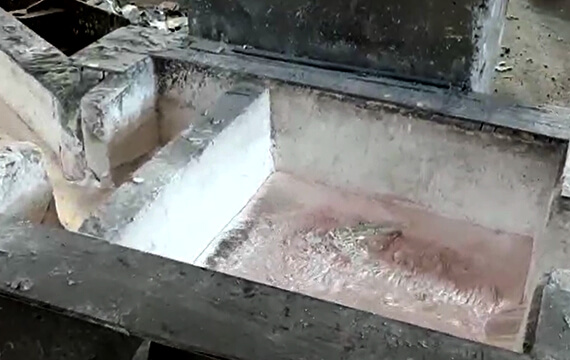
Ceramic foam filter plates are installed in a filter box located between the furnace/degassing unit and the casting station. The filter sits in a rigid, dimensionally stable chamber that maintains consistent metal head and flow distribution across the filter surface.
Key operational considerations:
-
Preheating is essential – the filter must be preheated to ≥600°C for 30–45 minutes before contact with molten aluminum to prevent thermal shock cracking
-
Sealing is critical – proper sealing around the filter edges prevents bypass flow
-
Filter box design matters – the box must maintain consistent metal head and even flow distribution
Conclusion
Alumina ceramic foam filter plates are not optional in modern DC casting of aluminum billets and slabs—they are essential. By removing non-metallic inclusions through deep-bed filtration, these filters ensure the melt cleanliness required for high-quality downstream processing.
Whether you are casting billets for automotive extrusion, slabs for can stock and foil, or high-end aluminum profiles for demanding applications, the right ceramic foam filter plate—with the appropriate PPI, size, and material specification—is your first and most important line of defense against inclusion-related defects.
The data is clear: finer pore-size filters significantly reduce non-metallic inclusions. The choice of PPI, filter size, and installation practice directly impacts billet and slab quality, downstream yields, and ultimately, your profitability.
Choose wisely. Filter properly. Cast clean.
Need assistance selecting the right ceramic foam filter plate for your DC casting operation? Our technical team can help you determine the optimal PPI, size, and specifications for your specific billet or slab production requirements. Contact us for a consultation.
Email: info@sf-foundry.com
WhatsApp: 8618636913699