


If you’ve ever admired the brilliant sparkle of a piece of “ceramic” jewelry, been grateful for a strong and natural-looking dental crown, or considered the engineering marvel of a jet engine, you’ve likely encountered zirconia without even knowing it. As someone who has worked with advanced materials for years, I’ve come to see zirconia, or zirconium dioxide (ZrO₂), not just as another ceramic, but as a cornerstone of modern technology and medicine. Its unique ability to combine seemingly contradictory properties makes it, in my opinion, one of the most essential and versatile materials of our time.
So, what makes this material so indispensable? Let’s delve into the world of zirconia.
More Than Just a Ceramic: The Unique Properties of Zirconia
Zirconia stands out in the crowded field of advanced materials due to a phenomenal combination of characteristics, but one in particular is its claim to fame.
The “Transformation Toughening” Superpower
At its core, pure zirconia can exist in different crystal structures (or phases) – monoclinic, tetragonal, and cubic. Scientists discovered that by adding stabilizers like Yttria (Y₂O₃), they could lock the zirconia into a “metastable” tetragonal phase at room temperature.
Here’s where the magic happens: when a force is applied and a crack begins to form, the stress at the tip of that crack triggers the surrounding zirconia grains to transform to a more stable, monoclinic phase. This transformation is accompanied by a slight volume expansion. This expansion effectively “squeezes” the crack shut, preventing it from propagating further. This mechanism, known as Transformation Toughening, grants zirconia a fracture toughness that is far superior to other ceramics, earning it the nickname “ceramic steel”.
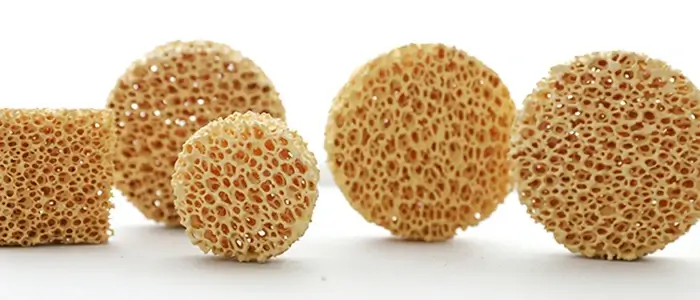
This one property shatters the primary weakness of most ceramics – brittleness – and opens the door to a world of applications.
Beyond this, zirconia boasts a formidable portfolio of properties:
-
Exceptional Strength & Hardness: It is highly resistant to wear and deformation, making it incredibly durable.
-
Excellent Biocompatibility: The human body tolerates zirconia exceptionally well, with minimal inflammatory response, making it ideal for medical implants.
-
Chemical Inertness: It is highly resistant to corrosion, even in harsh environments.
-
Ionic Conductivity: When stabilized, zirconia becomes a conductor of oxygen ions, a property critical for sensors and fuel cells.
Where It Shines: The Essential Applications of Zirconia
Zirconia’s blend of properties makes it a critical, and often irreplaceable, material across diverse industries.
Dentistry & Medicine: A Biocompatible Revolution
This is perhaps the most personal and widespread impact of zirconia for many people.
-
Dental Crowns and Bridges: Zirconia has revolutionized restorative dentistry. Its high strength allows it to withstand the immense forces of chewing, even for back teeth (molars). Furthermore, modern formulations can be engineered to have varying levels of translucency, perfectly mimicking the appearance of natural teeth. For patients, this means restorations that are not only incredibly durable but also highly aesthetic. Its biocompatibility also means it’s hypoallergenic, a safe choice for nearly everyone.
-
Orthopedic Implants: Zirconia’s wear resistance and biocompatibility make it an excellent material for hip and knee joint replacements. Its use leads to less wear debris and longer-lasting implants, significantly improving patient outcomes.
Industrial Engineering: The Tough Workhorse
In harsh industrial environments, zirconia’s reliability is paramount.
-
Wear-Resistant Components: It is used for wire drawing guides, pump seals, and valve components where abrasion would quickly destroy lesser materials.
-
Cutting Tools: Zirconia-based blades are employed to cut fibrous and abrasive materials like carbon fiber composites, outlasting traditional tools.
-
Thermal Barrier Coatings (TBCs): A thin layer of yttria-stabilized zirconia is applied to critical components like jet engine turbine blades. It acts as a superb insulator, allowing the metal underneath to operate at much higher temperatures, which dramatically improves engine efficiency and performance.
Advanced Technology & Electronics
-
Oxygen Sensors: The ionic conductivity of stabilized zirconia is harnessed in the lambda sensors of your car’s exhaust system. These sensors measure oxygen levels to optimize fuel combustion and reduce harmful emissions.
-
Fuel Cells: Solid Oxide Fuel Cells (SOFCs) use a zirconia-based electrolyte to generate electricity efficiently through electrochemical reactions.
Consumer Goods: Everyday Luxury & Durability
-
Watch Cases & Bezels: High-end watchmakers use zirconia for its scratch-resistance, light weight, and unique matte finish. It’s harder than sapphire crystal and most metals, making it virtually scratch-proof for daily wear.
-
Jewelry: Often marketed as “ceramic” jewelry, zirconia’s hypoallergenic nature, ability to hold a polish, and availability in various colors make it a popular choice for rings, pendants, and bracelets.
Table: Key Properties and Their Practical Benefits
| Property | Why It Matters | Primary Applications |
|---|---|---|
| Transformation Toughening | Resists chipping and cracking; unparalleled toughness for a ceramic. | Dental restorations, cutting tools, industrial wear parts. |
| High Strength & Hardness | Withstands heavy loads and abrasive forces. | Orthopedic implants, industrial components. |
| Excellent Biocompatibility | Non-toxic and integrates well with human tissue. | Dental implants, crowns, orthopedic implants. |
| Wear & Corrosion Resistance | Long-lasting in harsh chemical and physical environments. | Pump seals, valve components, chemical processing. |
| Ionic Conductivity | Conducts oxygen ions at high temperatures. | Oxygen sensors, solid oxide fuel cells. |
| Aesthetic Versatility | Can be made to look like natural teeth or polished to a high luster. | Dental crowns, fashion jewelry, watch cases. |
The Future and Considerations
While zirconia is a remarkable material, it’s not without its challenges. It can be more expensive to produce than some traditional materials, and its processing requires specialized expertise. However, continuous research and technological advancements are steadily making it more accessible.
Looking ahead, the future of zirconia is bright. Researchers are developing new composites and nano-structured forms of zirconia to push the boundaries of its strength, transparency, and functionality even further. From its role in the biomaterials of tomorrow to its potential in next-generation energy systems, zirconia is poised to remain an essential material for years to come.
Conclusion: A Material That Quietly Shapes Our World
In summary, zirconia’s status as an essential material is firmly rooted in its unique combination of metal-like toughness, ceramic-like hardness, and exceptional biocompatibility. It solves complex problems that other materials cannot, whether it’s enabling a more efficient jet engine, allowing for a stronger and more beautiful dental crown, or creating a durable, scratch-proof watch.
It’s a material that works behind the scenes and in our daily lives, consistently delivering performance, reliability, and beauty. That, in my experience, is the very definition of an essential material.