


If you are involved in metal casting, you have likely encountered the term PPI when selecting ceramic foam filters. It appears on product datasheets, in technical discussions, and as a key specification when ordering filters from suppliers like SF-FOUNDRY.
But what does PPI actually mean? How does it affect your casting quality? And how do you choose the right PPI for your specific application?
This guide answers these questions in practical terms, helping you make informed decisions when selecting ceramic foam filters for your foundry.
What Is PPI?
PPI stands for Pores Per Inch. It is a measurement that indicates the number of pores in one linear inch of a ceramic foam filter.
Think of it this way:
-
If you place a ruler next to a filter and count the pores along one inch, the number you count is the PPI rating.
-
A 10 PPI filter has approximately 10 pores per inch.
-
A 20 PPI filter has approximately 20 pores per inch.
-
A 30 PPI filter has approximately 30 pores per inch.
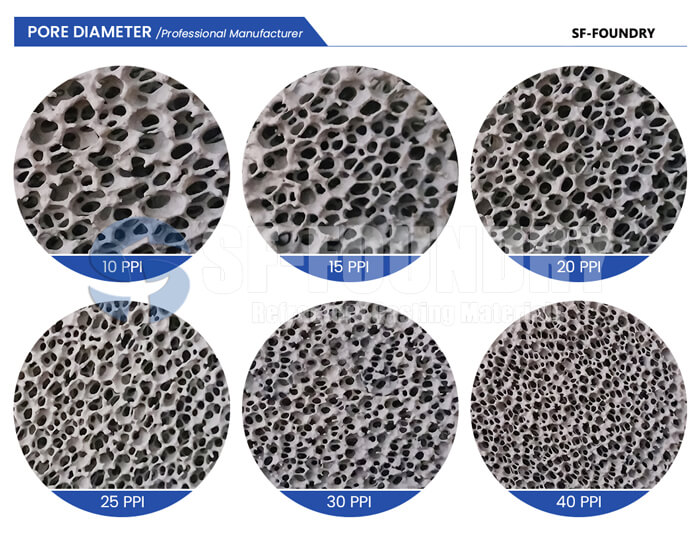
Visual Understanding
| PPI Rating | Visual Description |
|---|---|
| 10 PPI | Open structure, pores are clearly visible to the naked eye |
| 20 PPI | Medium structure, pores visible but finer |
| 30 PPI | Dense structure, pores are fine and tightly packed |
Important Note
PPI is not the same as pore size measured in micrometers (µm), although they are related. Higher PPI generally means smaller individual pore openings. However, the exact pore diameter can vary between manufacturers depending on their specific production processes.
At SF-FOUNDRY, we control our manufacturing process to ensure consistent PPI ratings across all production batches, so you get predictable performance every time.
Common PPI Ratings and Their Characteristics
Ceramic foam filters are typically available in three standard PPI ratings, each with distinct characteristics:
| PPI | Pore Size | Flow Rate | Filtration Efficiency | Typical Applications |
|---|---|---|---|---|
| 10 PPI | Coarse | High | Lower | Large castings, heavy sections, high pouring rates |
| 20 PPI | Medium | Moderate | Balanced | General purpose, most iron and steel castings |
| 30 PPI | Fine | Lower | Higher | Critical components, aluminum alloys, thin-wall castings |
The Trade-Off
Understanding PPI selection comes down to a fundamental trade-off:
-
Lower PPI (10): Faster flow, but may allow smaller inclusions to pass through.
-
Higher PPI (30): Better inclusion capture, but slower flow and higher risk of premature clogging.
Your job as a foundry engineer is to find the right balance for your specific casting.
How PPI Affects Filtration Performance
Inclusion Capture
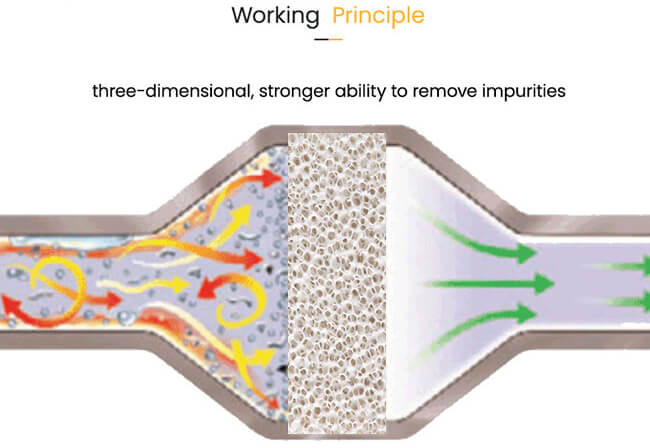
The primary function of any filter is to trap non-metallic inclusions—oxides, slag, dross, and refractory particles—before they enter the mold cavity.
-
A 10 PPI filter will capture larger inclusions (typically >1-2 mm) effectively.
-
A 20 PPI filter captures medium-sized inclusions.
-
A 30 PPI filter can capture finer inclusions, sometimes down to 0.1-0.3 mm depending on the filter quality.
Flow Rate
Flow rate is directly affected by PPI. A 10 PPI filter allows molten metal to pass through quickly, which is important for:
-
Large castings requiring high volume filling
-
Metals with lower pouring temperatures that may freeze quickly
-
Situations where mold filling time is critical
A 30 PPI filter restricts flow more significantly. If your gating system is not designed to accommodate this, you may experience:
-
Slow mold filling
-
Cold shuts or misruns
-
Premature filter clogging
Pressure Drop
As PPI increases, so does the pressure drop across the filter. This means the metal must push harder to get through. Your gating system design must account for this by providing adequate metallostatic head pressure.、
Clogging Risk
Higher PPI filters clog faster if the metal being poured contains a high volume of inclusions. This is why metal cleanliness before the filter matters—cleaner metal allows you to use finer filtration.
How to Choose the Right PPI
There is no single “correct” PPI for all applications. The right choice depends on several factors:
Factor 1: Alloy Type
| Alloy | Typical PPI Recommendation |
|---|---|
| Gray Iron | 10-20 PPI (lower inclusion sensitivity) |
| Ductile Iron | 20 PPI (moderate inclusion control needed) |
| Steel Castings | 10-20 PPI (high temperature, flow rate priority) |
| Aluminum Alloys | 20-30 PPI (finer oxide removal needed) |
| Copper Alloys | 10-20 PPI (depends on application) |
Factor 2: Casting Size and Section Thickness
| Casting Type | Recommended PPI |
|---|---|
| Large castings (>500 kg) | 10 PPI (priority on flow rate) |
| Medium castings (50-500 kg) | 20 PPI (balanced approach) |
| Small castings, thin sections | 20-30 PPI (flow control + filtration) |
Factor 3: Quality Requirements
| Requirement Level | Recommended PPI |
|---|---|
| Standard commercial castings | 10-20 PPI |
| Critical components (valves, pumps) | 20 PPI |
| High-integrity applications (aerospace, hydraulics) | 30 PPI (with proper system design) |
Factor 4: Metal Cleanliness
If your melt is exceptionally clean (good melting practice, clean charge materials, effective slag removal), you can use finer PPI with lower clogging risk.
If your melt contains significant inclusions, a coarser PPI may be necessary to avoid premature blockage.
Practical Examples
Example 1: Large Ductile Iron Casting (500 kg valve body)
Considerations:
-
High pouring temperature (~1400°C)
-
Significant volume to fill
-
Quality requirements are important but not extreme
Recommended PPI: 20 PPI — Provides good inclusion removal while maintaining adequate flow.
Example 2: Thin-Wall Aluminum Casting (automotive component)
Considerations:
-
Lower pouring temperature (~700°C)
-
Risk of freezing if flow is too slow
-
Oxide inclusions are a major concern
Recommended PPI: 20-30 PPI — Finer filtration helps remove oxides, but system design must ensure sufficient fill rate.
Example 3: Heavy Steel Casting (mining equipment)
Considerations:
-
Very high temperature (>1550°C)
-
Large volume, fast filling required
-
Inclusions present but flow is priority
Recommended PPI: 10 PPI — Maximizes flow rate; coarse inclusions are still captured.
How to Confirm PPI Quality
When evaluating filters from any supplier, including SF-FOUNDRY, here is what you should look for:
Visual Inspection
-
Consistency: Pores should appear uniform across the filter surface.
-
No blocked pores: The structure should be open, not filled with excess ceramic.
-
Clean edges: The filter should be free of loose particles or “filter bits.”
Dimensional Check
A quality filter will have consistent thickness and dimensions. At SF-FOUNDRY, we control our production to ensure:
-
Thickness tolerance: ±0.5 mm
-
Length/width tolerance: ±1.0 mm
-
Consistent PPI across every batch
Sample Testing
The best way to verify PPI suitability is to test samples in your actual production environment. Most reputable suppliers, including SF-FOUNDRY, offer samples for customer evaluation.
Frequently Asked Questions About PPI
Q1: Can I use a 30 PPI filter for all my castings?
A: Not recommended. While 30 PPI provides excellent filtration, it significantly reduces flow rate. For large or heavy-section castings, this can lead to filling problems. Match the PPI to your specific application.
Q2: What happens if I choose the wrong PPI?
A: Two possible outcomes:
-
Too coarse (e.g., 10 PPI for critical aluminum casting): Inclusions may pass through, defeating the purpose of filtration.
-
Too fine (e.g., 30 PPI for large steel casting): Filter may clog prematurely, or mold filling may be too slow, causing defects.
Q3: Does PPI affect filter strength?
A: Generally, higher PPI filters have more ceramic struts per inch, which can make them slightly stronger structurally. However, the primary consideration for strength is the filter material (alumina, silicon carbide, zirconia) and sintering quality, not PPI alone.
Q4: How do I calculate filter area based on PPI?
A: A common rule of thumb:
-
For 10 PPI: Minimum filter area = 3× the choke area
-
For 20 PPI: Minimum filter area = 4× the choke area
-
For 30 PPI: Minimum filter area = 5× the choke area
These ratios help compensate for the reduced flow rate of finer PPI filters.
Q5: Is higher PPI always better for quality?
A: No. “Better” means appropriate for your application. Using too fine a filter in the wrong application can create defects (slow fill) rather than prevent them. The goal is the right PPI for your specific casting conditions.
Conclusion
PPI—Pores Per Inch—is a fundamental specification for ceramic foam filters that directly impacts your casting quality and production efficiency.
| PPI | Best Used For |
|---|---|
| 10 PPI | Large castings, high flow rate priority, coarse inclusions |
| 20 PPI | Most general applications, balanced performance |
| 30 PPI | Critical components, aluminum alloys, fine inclusion removal |
Understanding this simple measurement helps you make better filter selections, reduce defects, and improve your foundry’s performance.
Need Help Selecting the Right Filter?
At SF-FOUNDRY, we manufacture ceramic foam filters in 10, 20, and 30 PPI, available in:
-
Multiple materials: Alumina, Silicon Carbide, Zirconia
-
Various shapes: Round, square, custom dimensions
-
Different sizes: From 40×40 mm to 300×300 mm and larger
Our team can help you determine the appropriate PPI and filter specifications for your specific application. Contact us for:
-
Technical advice
-
Sample requests
-
Quotations for regular or custom filters
SF-FOUNDRY
Website: https://sf-foundry.com/
Email: info@sf-foundry.com