


You’ve just poured a batch of castings. After shakeout, you see defects on the surface. Or maybe you don’t see anything until machining, when internal voids or dark spots appear.
The first question every foundry engineer asks: What caused this?
Two of the most common casting defects—shrinkage porosity and inclusions—often look similar to the untrained eye. But they have completely different causes. And more importantly, they require completely different solutions.
Mixing them up means wasting time and money on the wrong fix.
This guide helps you tell them apart, understand what caused them, and know what to do next.
| Defect | What It Is | Root Cause | Solution |
|---|---|---|---|
| Shrinkage | Internal voids or cavities | Metal contracted during solidification; insufficient feed metal | Improve risering; use exothermic/insulating sleeves; adjust gating |
| Inclusions | Non-metallic particles trapped in the casting | Dross, slag, sand, or oxides entered the mold | Improve filtration; reduce turbulence; cleaner melting practice |
The simplest rule of thumb:
-
Shrinkage is about feeding —did the riser provide enough metal?
-
Inclusions are about cleanliness —did contaminants reach the casting?
What Is Shrinkage Porosity?
How It Forms
When molten metal solidifies, it contracts. All metals do this. If there isn’t enough liquid metal available to feed the solidifying casting, the last areas to freeze will pull metal from wherever they can—creating voids.
Think of it like ice cubes: water expands when it freezes, but most metals do the opposite. They shrink.

What Shrinkage Looks Like
| Location | Appearance |
|---|---|
| On machined surface | Small, dark holes or cavities with irregular shapes |
| On fracture surface | Crystalline, rough texture—not smooth |
| Under X-ray | Dark areas (less dense) with irregular, often branched shapes |
| In section | Sometimes called “sponge” or “pipe” depending on location |
Common Locations
-
Thick sections where metal solidifies last
-
Under the riser (if the riser didn’t feed properly)
-
At hot spots where sections join
-
Opposite gates (far from the feed path)
Causes of Shrinkage
| Cause | What Happens |
|---|---|
| Riser too small | Not enough feed metal available |
| Riser solidified too early | Metal froze before feeding was complete |
| Poor directional solidification | Casting froze in the wrong order, cutting off feed paths |
| Section too thick | Hot spot created that risers couldn’t feed |
| Pouring temperature too low | Metal started freezing before mold was full |
Solutions for Shrinkage
| Solution | When to Use |
|---|---|
| Larger riser | Simple fix for small castings |
| Exothermic or insulating sleeve | Increase riser feeding efficiency without increasing size |
| Chills | Accelerate solidification in thick sections |
| Gating redesign | Improve directional solidification |
| Higher pouring temperature | Give metal more time to feed |
What Are Inclusions?
How They Form
Inclusions are non-metallic particles that become trapped in the casting. They can come from:
-
Slag or dross from the furnace or ladle
-
Sand from mold or core erosion
-
Oxides formed during pouring (reoxidation)
-
Reaction products from nodularization (ductile iron)
Think of it like dirt in a stream—it flows with the metal and gets deposited wherever the metal goes.
What Inclusions Look Like
| Type | Appearance |
|---|---|
| Slag/dross | Dark, often irregular patches on machined surface |
| Sand | Hard, light-colored spots; can damage cutting tools |
| Oxides | Thin, film-like defects; sometimes only visible after machining or etching |
| On fracture surface | Smooth or flaky appearance—different from shrinkage’s crystalline look |
| Under X-ray | Dense spots (heavier than base metal) or irregular dark patches |
Common Locations
-
Near gates (where metal enters)
-
Under the sprue (where turbulence is highest)
-
On top surfaces (where light inclusions float)
-
In areas of turbulent flow (changes in section, around cores)
Causes of Inclusions
| Cause | What Happens |
|---|---|
| No filter | Inclusions travel freely into the mold |
| Filter bypass | Metal flows around the filter, unfiltered |
| Turbulent gating | Air entrains; oxides form |
| Poor melting practice | Too much slag carried from furnace to ladle to mold |
| Erosion | Sand washed into the metal stream |
| Reoxidation | Metal exposed to air after filtration |
Solutions for Inclusions
| Solution | When to Use |
|---|---|
| Ceramic foam filter | Capture inclusions before they reach casting |
| Proper filter sealing | Prevent bypass flow |
| Gating redesign | Reduce turbulence; promote laminar flow |
| Cleaner melting | Skim slag; use cleaner charge materials |
| Improved pouring practice | Fill sprue quickly; maintain steady flow |
How to Tell Them Apart
This is the most important part. Use these clues to diagnose which defect you’re dealing with.
Visual Clues
| Feature | Shrinkage | Inclusions |
|---|---|---|
| On machined surface | Dark holes, often rounded | Dark spots, sometimes with rough edges |
| Internal | Voids, cavities | Particles, films |
| Surface feel | Smooth-walled cavity | Sometimes hard spots |
| Location | Thick sections, hot spots | Near gates, top surfaces, turbulent areas |
Location Clues
| Defect Location | Likely Cause |
|---|---|
| Always in thick sections | Shrinkage |
| Always near gates | Inclusions (from turbulence or unfiltered metal) |
| Under riser | Could be either (riser not feeding = shrinkage; riser carrying inclusions = inclusions) |
| Throughout casting randomly | Inclusions (from dirty melt) |
Process Clues
| What You Observe | Likely Cause |
|---|---|
| Defects worse on large castings | Shrinkage (larger sections harder to feed) |
| Defects worse on first pours | Inclusions (slag carried from furnace) |
| Defects appear after gating change | Inclusions (turbulence increased) |
| Defects appear after riser change | Shrinkage (feeding changed) |
Simple Test
If you’re still unsure:
-
Cut through the defect
-
Look at the surface
-
Shrinkage: Rough, crystalline surface—like broken metal
-
Inclusions: Smooth, often dark or discolored—something trapped in the metal
Decision Tree
Use this simple flow chart to guide your diagnosis:
Defect appears
     │
     ▼
Where is it located?
     │
     ├── In thick sections only ──→ Likely SHRINKAGE
     │
     ├── Near gates/top surfaces ──→ Likely INCLUSIONS
     │
     └── Throughout ──→ Check other clues
                          │
                          ▼
What does it look like?
     │
     ├── Rough, crystalline surface ──→ SHRINKAGE
     │
     └── Smooth, dark, or flaky ──→ INCLUSIONS
Once you know what you’re dealing with, the solution becomes clearer.
What to Do Next
If You Identify Shrinkage
| Step | Action |
|---|---|
| 1 | Check if riser is large enough |
| 2 | Verify riser neck is open (not frozen too early) |
| 3 | Consider exothermic or insulating sleeves |
| 4 | Add chills to heavy sections if needed |
| 5 | Review pouring temperature |
Don’t: Add filters. Filters don’t fix feeding problems.
If You Identify Inclusions
| Step | Action |
|---|---|
| 1 | Check if you’re using filters |
| 2 | Verify filters are properly sealed (no bypass) |
| 3 | Review gating for turbulence |
| 4 | Check melting and ladle practice |
| 5 | Consider finer PPI if needed |
Don’t: Add bigger risers. Risers don’t remove inclusions.
Real-World Example
Scenario
A foundry casting ductile iron valve bodies reported internal defects after machining. The defects appeared in the thickest section of the casting, near the center.
What they tried first: Added a larger riser. Defects continued.
What they tried second: Added a ceramic foam filter. Defects continued.
What the defect looked like: On the machined surface, small dark holes with rough internal surfaces. Located consistently in the thick section.
Diagnosis: Shrinkage. The riser was still too small or feeding too early, even after upsizing.
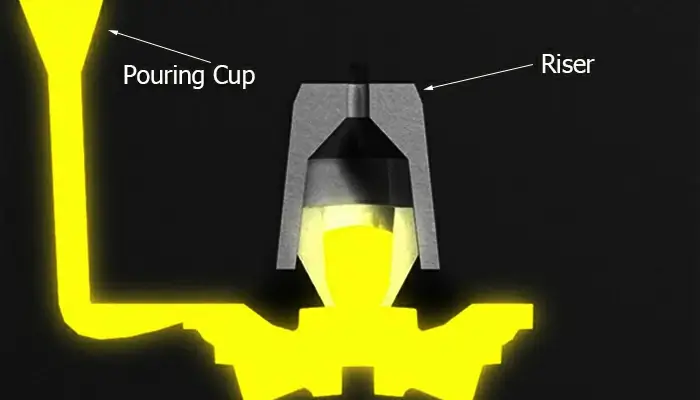
What worked: Changed to an exothermic riser sleeve on the same size riser. Defects disappeared.
Why: The exothermic sleeve kept the riser molten longer, allowing it to feed the thick section properly. The filter had never been the issue.
Frequently Asked Questions
Q1: Can shrinkage and inclusions happen in the same casting?
A: Yes. It’s possible to have both. If you have multiple defect types, address the one that’s causing the most scrap first, then re-evaluate.
Q2: I’m using filters but still see defects. Does that mean filters don’t work?
A: Not necessarily. Check:
-
Is the filter the right material for your alloy?
-
Is the filter properly sealed (no metal bypass)?
-
Is the defect type actually inclusions (not shrinkage)?
Q3: How can I tell if my filter is working?
A: Inspect the filter after pouring. If it’s heavy with trapped slag or dross, it was working. If it’s clean and light, either the metal was very clean—or the metal bypassed the filter.
Q4: What if I can’t tell which defect I have?
A: Run a simple test: cut one casting through the defect and look at the fracture surface. If you’re still unsure, send a sample to a lab for analysis. Knowing what you’re dealing with saves time and money in the long run.
Q5: Can using the wrong filter cause shrinkage?
A: Indirectly, yes. If a filter is too fine for your application and restricts flow too much, it can cause slow filling and cold shuts. But true shrinkage (insufficient feed metal) is not caused by the filter.
Conclusion
Shrinkage and inclusions are often confused, but they are fundamentally different:
| Defect | Root Cause | Fix |
|---|---|---|
| Shrinkage | Not enough feed metal | Improve risering; use sleeves |
| Inclusions | Contaminants in the melt | Improve filtration; reduce turbulence |
The next time you see defects in your castings, ask yourself:
-
Where is it located? (Thick sections? Near gates?)
-
What does it look like? (Rough crystalline? Smooth dark spots?)
-
What changed? (Riser design? Gating? Melting practice?)
Answering these questions will point you toward the right solution—and save you from spending time and money on the wrong fix.
Need Help Diagnosing Your Defects?
At SF-Foundry, we’ve helped foundries around the world identify and solve both shrinkage and inclusion problems. If you’re dealing with casting defects and aren’t sure what’s causing them, we can help.
Contact our technical team:
-
Email: info@sf-foundry.com
-
Website: https://sf-foundry.com/
- WhatsApp: 8618636913699