


When it comes to measuring molten metal temperatures in foundries and steel mills, two families of thermocouples dominate the high-temperature arena: Platinum-Rhodium (Types S, R, and B) and Tungsten-Rhenium (Types W, C, and D). Both are capable of withstanding extreme heat, but they represent fundamentally different approaches to high-temperature measurement—one built on precious metal stability, the other on refractory metal performance at a fraction of the cost.
So which one is right for your melt? The answer depends on your temperature range, atmosphere, accuracy requirements, and budget.
What They’re Made Of
The material composition is the foundation of everything that follows.
Platinum-Rhodium thermocouples are noble metal thermocouples, constructed from platinum and rhodium alloys. The three common types differ by rhodium content:
| Type | Positive Leg | Negative Leg |
|---|---|---|
| Type S | Platinum 90% + Rhodium 10% | Pure Platinum |
| Type R | Platinum 87% + Rhodium 13% | Pure Platinum |
| Type B | Platinum 70% + Rhodium 30% | Platinum 94% + Rhodium 6% |
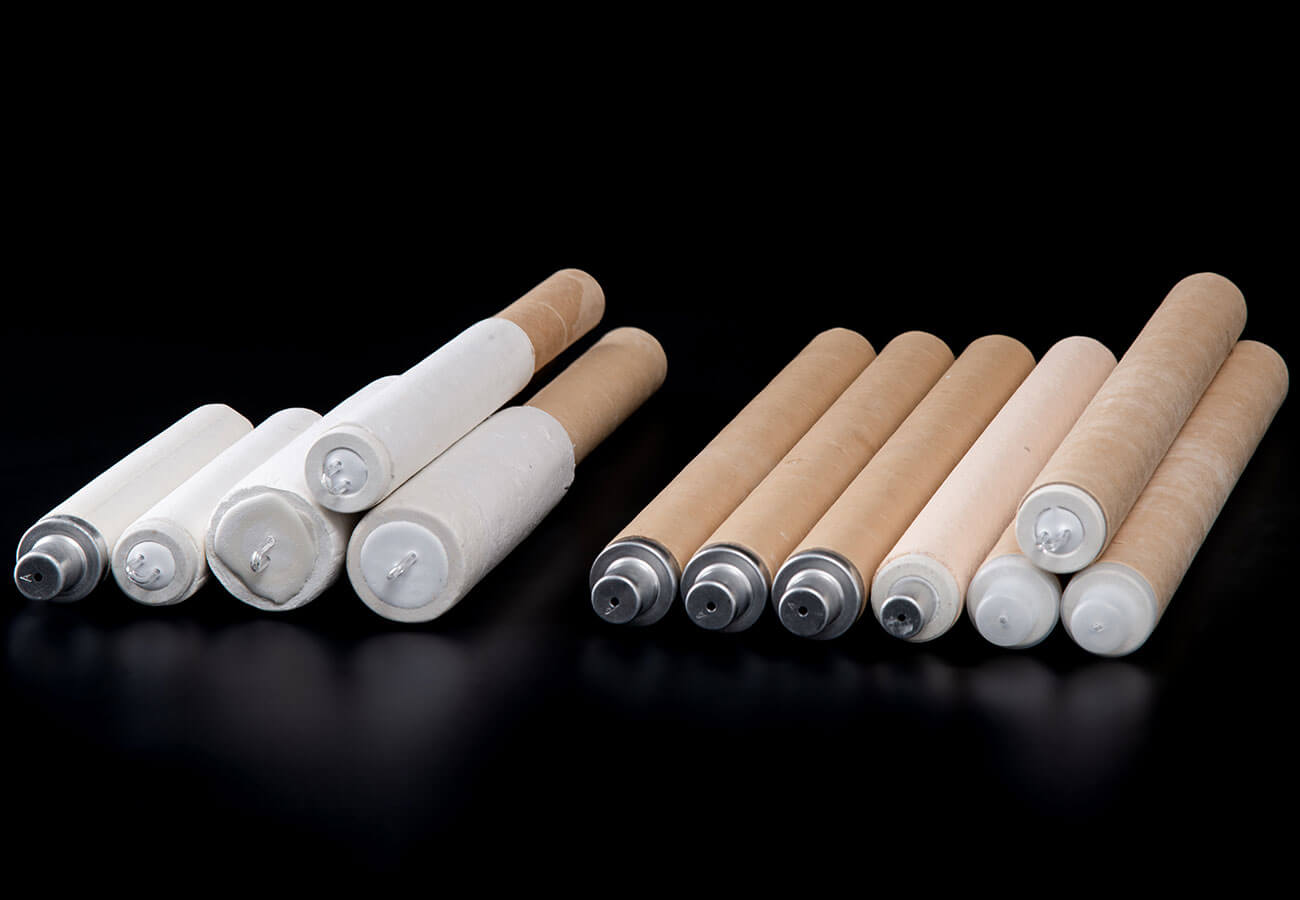
Tungsten-Rhenium thermocouples are refractory metal thermocouples, made from tungsten-rhenium alloys. Common configurations include:
| Type | Positive Leg | Negative Leg |
|---|---|---|
| Type C | Tungsten 95% + Rhenium 5% | Tungsten 74% + Rhenium 26% |
| Type D | Tungsten 97% + Rhenium 3% | Tungsten 75% + Rhenium 25% |
The tungsten-rhenium alloy has an extremely high melting point—the wire itself can withstand 3120–3360°C—making it the most heat-resistant metal thermocouple available.
Temperature Range: The Defining Difference
This is the single most important factor in your selection.
Platinum-Rhodium thermocouples are designed for the 1300–1700°C sweet spot:
| Type | Continuous Use | Short-Term Max |
|---|---|---|
| Type S | Up to 1398°C (2550°F) | 1482°C (2700°F) |
| Type R | Up to 1398°C (2550°F) | 1482°C (2700°F) |
| Type B | Up to 1704°C (3100°F) | 1820°C (3308°F) |
Important: Type S and R thermocouples are not recommended for continuous use above 1398°C. Type B is the only platinum-rhodium option that can handle sustained temperatures above 1600°C.
Tungsten-Rhenium thermocouples are built for extreme temperatures:
| Type | Temperature Range |
|---|---|
| Type W/C/D | 0 – 2300°C (up to 2315°C / 4200°F) |
The takeaway: If your process consistently exceeds 1800°C, platinum-rhodium thermocouples simply cannot handle it—you must use tungsten-rhenium.
Atmosphere Compatibility: The Critical Constraint
This is where many foundry operators make costly mistakes.
Platinum-Rhodium: The Oxidizing Champion
Platinum-rhodium thermocouples have excellent oxidation resistance and are specifically designed for use in oxidizing and inert atmospheres. They are the natural choice for:
-
Air environments
-
Oxygen-rich furnace atmospheres
-
Inert gas (argon, nitrogen) environments
However, they are easily contaminated in reducing atmospheres (hydrogen, CO), which can rapidly damage calibration.
Tungsten-Rhenium: The Vacuum/Inert Specialist
Tungsten-rhenium thermocouples will oxidize and fail in minutes if exposed to air or oxidizing atmospheres at high temperatures. They are designed for:
-
Vacuum environments
-
Inert gas (argon, nitrogen)
-
Reducing atmospheres (hydrogen, CO)
Critical rule of thumb: If there’s oxygen or air involved → Platinum-Rhodium is your only choice. If you’re working in vacuum, inert gas, or hydrogen → Tungsten-Rhenium is the winner—especially because it handles much higher temperatures.
Note: Tungsten-rhenium thermocouples with special protective tubes can also be used for extended periods in oxidizing atmospheres at up to 1600°C, but this requires careful engineering.
Performance Comparison
| Aspect | Platinum-Rhodium | Tungsten-Rhenium |
|---|---|---|
| Accuracy at High Temps | Excellent (±0.25% to 0.5%) | Decent (±0.5% to 1%) |
| Long-Term Stability | Excellent (minimal drift) | Good (some drift after 1000+ hours) |
| Sensitivity | Standard | ~2× higher than platinum-rhodium |
| Response Time | Average | Faster |
| Mechanical Strength | Relatively soft | Becomes brittle at high temps |
| Compensation Cable | Usually not needed | Required |
| Cost | Very expensive | Relatively affordable |
Cost: The Economic Reality
Platinum-rhodium thermocouples are expensive—they use precious metals, and prices have been rising sharply–. This is particularly impactful for disposable/consumable thermocouples used in foundry quick-immersion measurements, where each measurement consumes a new tip.
Tungsten-rhenium thermocouples are significantly more affordable. For high-volume foundry operations where thermocouples are consumed frequently, this cost advantage can translate into substantial savings.
As one study noted: “Tungsten-rhenium thermocouple wire is inexpensive, can measure up to 2300°C high temperature, and its measurement success rate is similar to platinum-rhodium, with a temperature deviation of less than 10°C. Promoting tungsten-rhenium thermocouples for temperature measurement can yield significant technical and economic benefits.”

Quick Decision Guide
| Your Application | Recommended Type | Why |
|---|---|---|
| Carbon steel, iron, non-ferrous metals (Cu, Al) below 1600°C in air | Type S | Industry standard, reliable, most economical choice for most foundries |
| Stainless steel, specialty alloys at or above 1600°C in air | Type B | Superior stability at extreme temps, outperforms S/R above 1600°C |
| Ultra-high temp processes above 1800°C in vacuum/inert gas | Tungsten-Rhenium | The only option that can handle these temperatures |
| High-volume, cost-sensitive disposable measurements in vacuum/inert gas | Tungsten-Rhenium | Much lower cost than platinum-rhodium, comparable accuracy |
| High-precision laboratory or calibration applications | Type S | Defines international temperature scale |
Summary
Platinum-Rhodium is the precision, stability king for 1600°C work in oxidizing atmospheres–. It’s the proven, reliable choice for most conventional foundry and steelmaking operations—but you pay a premium for that reliability.
Tungsten-Rhenium is the ultra-high-temp champion for 2300°C in vacuum, inert, or reducing environments–. It offers exceptional value for money, especially in high-volume disposable applications, but requires careful attention to atmosphere control.
The bottom line: Choose based on your temperature first, then your atmosphere, then your budget. If you’re below 1600°C in air, Type S or B platinum-rhodium is your answer. If you’re above 1800°C—or if cost is a critical factor and you’re working in a protected atmosphere—tungsten-rhenium is the way to go.
Need help selecting the right thermocouple for your specific melt conditions? Contact our technical team for personalized recommendations.