


Choosing the right ceramic pouring cup material is one of the most critical decisions in investment casting. The pouring cup is where molten metal first makes contact with your gating system—and if the material isn’t matched to your process, defects follow.
Three materials dominate the investment casting pouring cup market: mullite, fused silica, and alumina (high-alumina silicate) . Each offers distinct advantages and trade-offs. Here’s what you need to know to make the right choice.
Quick Overview: The Three Contenders
| Material | Composition | Max Service Temperature | Primary Strength |
|---|---|---|---|
| Mullite | 3Al₂O₃·2SiO₂ (approx. 65% Al₂O₃, 30% SiO₂) | 1,650°C | Excellent all-around performer |
| Fused Silica | Amorphous SiO₂ | ~1,650°C | Lowest thermal expansion |
| Alumina (High-Alumina Silicate) | Al₂O₃–SiO₂ matrix | 1,650°C | Highest refractoriness |
All three can operate at the 1,650°C mark that covers most investment casting applications, with refractoriness ranging from 1,580–1,770°C. But that’s where the similarities end.
Mullite: The Workhorse
Mullite (3Al₂O₃·2SiO₂) is the most thermally stable mineral in the alumina-silica system–. It’s the industry’s go-to material for a reason—it strikes an ideal balance between performance and cost.
Key Properties
-
Maximum service temperature: 1,650°C
-
Bulk density: 2.2 g/cm³
-
Open porosity: 30%
-
Modulus of Rupture (room temp.): 20 MPa
-
Modulus of Rupture (1,250°C): 15 MPa
-
Thermal expansion (20–1,000°C): 6.5 × 10⁻⁶/K
-
Thermal conductivity: 2 W/m·K
-
Specific heat capacity: 0.8 kJ/kg·K
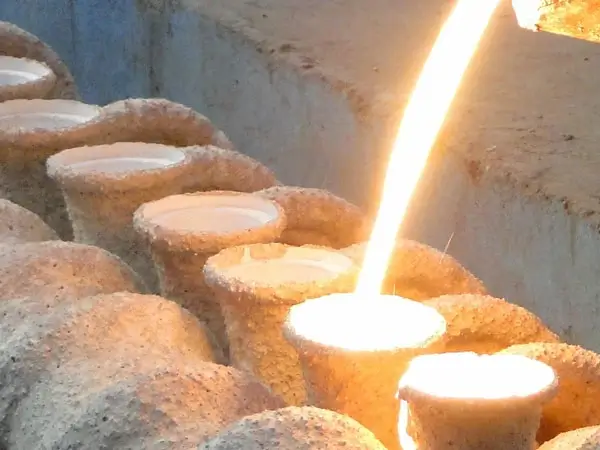
Advantages
High thermal shock resistance – Mullite’s needle-like grain structure gives it excellent resistance to cracking during rapid temperature changes. This is critical when preheated cups encounter molten metal.
Chemical stability – Mullite pouring cups show no reaction with molten metal at high temperatures–. They’re compatible with ferrous, nickel, aluminum, bronze-based metals, and even some aerospace-grade superalloys.
Proven track record – MRI®-engineered mullite compositions have been proven in investment casting applications for over 40 years–.
Smooth surface finish – Reduces erosion and minimizes the risk of inclusions in the final casting.
Good high-temperature strength – Mullite shells maintain flexural strength even at elevated temperatures, though aluminosilicate shells (including mullite) show inadequate high-temperature flexural strength at 1,400°C compared to fused silica.
Best Applications
Mullite is recommended for most casting requirements. It’s the default choice for:
-
General investment casting
-
Ferrous and non-ferrous alloys
-
High-volume production foundries
-
Applications where a single material needs to handle multiple alloy types
Fused Silica: The Thermal Shock Specialist
Fused silica is amorphous silicon dioxide (SiO₂) produced by melting high-purity silica at extremely high temperatures. Its defining characteristic is the lowest coefficient of thermal expansion of any known material.
Key Properties
-
Coefficient of thermal expansion (20–1,000°C): 0.5–0.75 × 10⁻⁶/K
-
Thermal conductivity: 1.2–1.4 W/m·K
-
Density: ~2.2 g/cm³
-
Melting point: ~1,900°C
-
Thermal shock resistance: Exceptionally high
-
Chemical stability: Excellent resistance to corrosion from molten metals and glass
Advantages
Unmatched thermal shock resistance – Fused silica’s extremely low thermal expansion means it can withstand rapid temperature changes without cracking. This is its single biggest advantage.
Dimensional stability – Fused silica provides stable behavior against thermal expansion, with values ranging from 0.054 to −1.139 depending on temperature.
Chemical inertness – Shows good chemical stability in molten metal and is easily leached in strong alkaline solutions.
Low thermal conductivity – Helps maintain temperature control during the pour.
Limitations
Devitrification risk – Fused silica will devitrify (crystallize) at temperatures over 1,100°C, which can alter its properties over extended high-temperature exposure.
Creep at high temperatures – Unmodified fused silica fibers can melt with the matrix and aggravate viscous flow at high temperatures, increasing creep deformation. (This is more relevant to cores than pouring cups, but worth noting.)
Lower high-temperature flexural strength – Compared to aluminosilicate materials, fused silica has lower high-temperature flexural strength.
Best Applications
Fused silica is suggested for large pouring cups where differential thermal expansion between the cup and the mold may cause cracking or separation. Specific use cases include:
-
Large pouring cups
-
Situations with significant temperature differentials
-
Applications where minimizing thermal stress is critical
-
Single-crystal and directionally solidified (SC/DS) casting applications–
Alumina (High-Alumina Silicate): The High-Temperature Champion
Alumina-based materials offer the highest refractoriness and mechanical strength of the three. High-alumina silicate compositions are widely used in investment casting for demanding high-temperature applications.
Key Properties
-
Maximum service temperature: 1,650°C+ (some grades up to 1,700°C)
-
Bulk density: 3.7 g/cm³ (for 95% Al₂O₃)
-
Open porosity: 0% (for 95% Al₂O₃)
-
Modulus of Rupture (room temp.): 250 MPa (for 95% Al₂O₃)
-
Thermal expansion (20–1,000°C): 8 × 10⁻⁶/K (for 95% Al₂O₃)
-
Thermal conductivity: 25 W/m·K (for 95% Al₂O₃); 18–30 W/m·K for 94–99.8% alumina grades
-
Thermal expansion coefficient (25–1,000°C): 7.5–9.5 × 10⁻⁶/K
Advantages
Highest refractoriness – Alumina can withstand exceptionally high temperatures and reduces cracking during thermal cycling. High-alumina silicate compositions combine refractoriness up to 1,650°C with good thermal shock resistance.
Superior mechanical strength – With a room-temperature modulus of rupture of 250 MPa, alumina offers by far the highest strength of the three materials. This makes it ideal for withstanding the mechanical impact of molten metal pouring.
Excellent thermal and chemical stability – Alumina shows outstanding thermal shock resistance, chemical stability, and dimensional reliability even above 1,700°C.
Dense structure – Zero open porosity in high-purity grades means minimal risk of metal penetration into the cup material.
Limitations
Highest thermal expansion – At 8 × 10⁻⁶/K, alumina expands significantly more than mullite or fused silica. This creates greater thermal stress during heating and cooling cycles.
Highest thermal conductivity – At 25 W/m·K, alumina conducts heat away from the molten metal more rapidly, which can affect thermal management during the pour.
Higher cost – High-purity alumina is typically more expensive than mullite or fused silica.
Best Applications
Alumina is the material of choice for:
-
Highest-temperature alloys and superalloys
-
Aerospace and gas turbine components
-
Applications where mechanical strength is paramount
-
Castings requiring the highest refractoriness
-
High-purity applications where zero porosity is beneficial
Head-to-Head Comparison
| Property | Mullite | Fused Silica | Alumina (95%) |
|---|---|---|---|
| Max Service Temp. | 1,650°C | ~1,650°C | 1,650–1,700°C |
| Bulk Density | 2.2 g/cm³ | ~2.2 g/cm³ | 3.7 g/cm³ |
| Open Porosity | 30% | — | 0% |
| MOR (RT) | 20 MPa | — | 250 MPa |
| Thermal Expansion (×10⁻⁶/K) | 6.5 | 0.5–0.75 | 8.0 |
| Thermal Conductivity (W/m·K) | 2 | 1.2–1.4 | 25 |
| Thermal Shock Resistance | Good | Excellent | Good |
| High-Temp Strength | Moderate | Lower | Highest |
| Cost | Moderate | Moderate | Higher |
How to Choose: A Decision Framework
Choose Mullite If:
-
You need a reliable all-purpose material for most casting requirements
-
Your foundry casts multiple alloy types (ferrous, nickel, aluminum, bronze)
-
You want proven performance with decades of industry validation
-
Cost-effectiveness is important
-
You don’t have extreme thermal shock or ultra-high-temperature requirements
Choose Fused Silica If:
-
You’re using large pouring cups where differential thermal expansion between cup and mold is a concern
-
You need maximum thermal shock resistance
-
The cup will experience rapid temperature cycling
-
You’re working with SC/DS casting applications
Choose Alumina If:
-
You’re casting highest-temperature alloys and superalloys
-
Mechanical strength is the top priority
-
You need zero porosity for the cleanest possible pour
-
Your application demands the highest refractoriness
-
You’re in aerospace, defense, or power generation markets
The Bottom Line
There’s no single “best” material—only the right material for your specific casting process.
-
Mullite is the versatile workhorse that handles the vast majority of investment casting applications with proven reliability.
-
Fused silica is the specialist for applications where thermal shock and expansion mismatch are primary concerns.
-
Alumina is the high-performance choice for the most demanding high-temperature, high-strength applications.
At SF-Foundry, we supply ceramic pouring cups, with rigorous quality control for dimensional accuracy, surface finish, and material composition. Contact us to discuss which material is right for your specific casting requirements.