


As a foundry engineer with years of hands-on experience, I’ve seen firsthand how shrinkage defects can plague production lines, leading to scrapped parts and lost revenue. Shrinkage porosity—those dreaded voids or cavities in a casting—is one of the most common and frustrating issues we face. The good news is that it’s also one of the most preventable.
This guide will walk you through the core principles and practical steps to eliminate shrinkage defects, drawing from proven foundry practices and the latest industry knowledge.
Understanding the Root Cause: Why Shrinkage Happens
Before we fix it, we must understand it. All metals and alloys contract (shrink) as they transition from a liquid to a solid. If this volumetric shrinkage isn’t continuously fed with molten metal, a void forms. This is the fundamental cause of shrinkage porosity in castings.
The ultimate goal in preventing casting defects is to control this solidification process. We need to ensure that the thickest sections of the casting are fed until the very end, a principle known as directional solidification.
Proven Strategies to Prevent Shrinkage Defects
Here are the most effective methods, from design to pouring.
1. Master Riser and Feeder Design
Risers (or feeders) are your number one weapon against shrinkage. They act as a reservoir of hot metal, feeding the casting as it solidifies.
-
Key Principle: The riser must solidify after the casting section it is feeding.
-
From My Experience: Proper riser placement is more critical than its size. I always use solidification simulation software to identify the last points to freeze—the “hot spots”—and place risers directly there. For critical jobs, we use insulating or exothermic riser sleeves to dramatically increase their feeding efficiency.
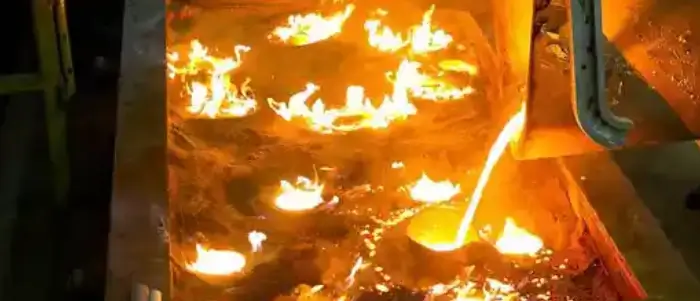
2. Utilize Chills for Directional Solidification
Sometimes, you need to cool specific areas faster. That’s where chills come in. Chills are metal or graphite inserts placed in the mold to rapidly draw heat away.
-
Key Principle: Use chills to force a thick section to solidify before an adjacent thinner section, thereby preventing isolated hot spots.
-
Practical Application: If you have a thick hub connected to a thin wheel rim, placing chills around the hub will make it solidify first, allowing the riser to feed the rim effectively. This is a cornerstone of achieving directional solidification.
3. Optimize Your Gating System
The gating system isn’t just for filling the mold; it’s crucial for controlling temperature and flow.
-
Key Principle: A well-designed gating system should deliver metal quietly and quickly to minimize heat loss and turbulence.
-
Expert Tip: In precision processes like investment casting, the choice of components matters immensely. Using a high-quality ceramic pouring cup for investment casting can significantly reduce turbulence and heat loss at the very start of the pour, setting the stage for a sound casting.
4. Control Process Parameters Rigorously
Even the perfect design can fail with poor process control.
-
Pouring Temperature: This is a delicate balance. Too low, and the metal won’t flow to feed shrinkage. Too high, and it increases the total shrinkage volume and can slow down solidification. Find the optimal pouring temperature for your specific alloy.
-
Mold Rigidity: This is a often-overlooked factor. A soft green sand mold can “wall move” or expand under the pressure of the metal, effectively making the casting cavity larger and worsening shrinkage. Using a rigid mold, like a hard-rammed green sand or chemically-bonded sand, is essential for preventing microporosity.
Quick-Reference Troubleshooting Table
| Shrinkage Defect Type | What It Looks Like | How to Fix It |
|---|---|---|
| Macro-Shrinkage | Large, open cavities in heavy sections. | 1. Increase riser size or number. 2. Add a chill to the affected area. 3. Ensure directional solidification. |
| Micro-Porosity | Scattered, fine pores throughout the casting. | 1. Increase mold rigidity/hardness. 2. Optimize pouring temperature. 3. Improve alloy composition (shorter freezing range). |
| Centerline Shrinkage | A porous line along the center of a wall. | 1. Improve feeding path with chills or padding. 2. Redesign to achieve directional solidification. |
Conclusion
In my career, I’ve learned that preventing shrinkage casting defects is never about a single magic bullet. It’s about a systematic approach that combines smart casting design, precise methoding with risers and chills, and strict control over the pouring process.
Start by analyzing where your defects are occurring—they will always point you to the last solidifying area. Then, apply the principles of directional solidification. By mastering these techniques, you can dramatically reduce scrap rates and produce higher integrity, more profitable castings.