


Shrinkage defects—including shrinkage cavities and porosity—are among the most common and challenging problems in metal casting. These defects occur when molten metal solidifies and contracts, but insufficient liquid metal is available to compensate for the volume reduction. While risers are the primary tools for feeding shrinkage, the location of the ingate (the point where metal enters the mold cavity) plays a surprisingly critical role in determining whether shrinkage defects will form.
This article provides a comprehensive guide to selecting ingate locations specifically to prevent shrinkage defects. Drawing on research, case studies, and established foundry principles, we explore how gate placement influences solidification patterns and feeding efficiency.
Understanding the Relationship Between Ingate Location and Shrinkage
The Thermal Influence of Ingates
Every ingate creates a local thermal condition in the casting. During filling, the hottest metal flows through the ingate and into the cavity. This means the region near the ingate remains hotter longer than other areas. If this heat concentration is not managed properly, it can create a “hot spot” that solidifies last—but without a connection to a riser, this isolated hot liquid will shrink and form porosity.
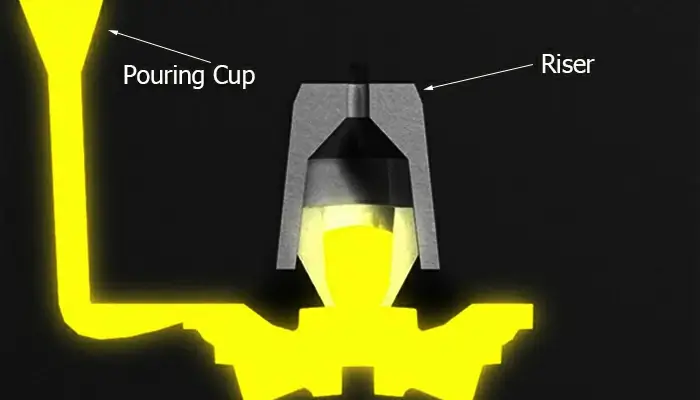
The fundamental principle: Ingates should be positioned to direct the hottest metal toward risers or thicker sections that require feeding, never into isolated regions that cannot be fed.

Ingate Root Overheating
Research on investment casting of large plain parts identifies a specific phenomenon: ingate root overheating. When metal flows through a constricted gate into a larger cavity, the turbulence and friction generate additional heat at the gate-casting junction. This localized overheating creates a persistent hot spot that remains molten after surrounding areas have solidified, leading to shrinkage porosity at the ingate root.
A practical case study illustrates this problem: large plane castings consistently developed shrinkage porosity at the ingate root due to this overheating effect.
General Principles for Ingate Placement to Prevent Shrinkage
Position Gates to Feed Thick Sections Directly
The most direct strategy for preventing shrinkage is to position ingates to feed thick sections directly. A high-pressure die casting patent for ultra-large aluminum castings emphasizes this principle explicitly:
“The interior surface further defines a feeding channel extending from the at least one ingate directly to the second casting feature for conveying a portion of the molten metal flow from the ingate to the second casting feature.”
The “second casting feature” refers to thicker sections (bosses, ribs, etc.) that require continued molten metal flow to compensate for shrinkage. By providing a clear feeding path from the ingate directly to these thick sections, the system ensures that liquid metal remains available during solidification.
Consider the Casting Orientation
For bottom-gated castings, ingate position relative to the overall casting height matters. A European patent notes that ingates should be placed “below the top of the mould cavity” and preferably “through said bottom, upwardly facing, wall of the cavity so that the flow of metal through the ingate is substantially vertically upwardly”.
This orientation ensures that:
-
The hottest metal rises to the top, promoting directional solidification
-
The feeding path from gate to riser is maintained throughout filling
Maintain Adequate Distance from the Sprue
Research on slag skimming capability provides guidance relevant to shrinkage prevention:
“When designing gating system construction, it should be avoided that the ingate was set at top of the runner, and/or too near to the end of the runner; the distance from the center of the sprue to first ingate also could not be too near.”
While this study focused on slag inclusion, the principle applies to shrinkage as well. Gates placed too close to the sprue may receive excessively turbulent, overheated metal that creates uncontrolled hot spots.
Managing Ingate Root Hot Spots
The Distance Strategy
The ingate root overheating problem requires specific countermeasures. The investment casting case study on large plain parts explored two approaches:
Approach A: Pad on the Mold
-
Researchers initially placed wax pads on the mold (runner) side
-
Result: Shrinkage porosity continued to occur
-
Why: The overheating at the gate-casting junction was not addressed
Approach B: Pad on the Casting
-
Researchers moved the wax pad to the casting side
-
Result: Shrinkage porosity was eliminated
-
Why: Increasing the distance between the ingate and the casting allowed the overheated zone to shift away from critical casting areas
Key takeaway: When overheating at the ingate root causes shrinkage, increasing the physical distance between the ingate and the casting can move the hot spot into a less critical area—or into an area that can be fed by a riser.
Gate Thickness Modification
A study on AlSi7Mg turbocharger shell castings addressed shrinkage defects near the gate location through a different approach:
“Increasing the gate thickness in gate position was presented to eliminate the shrinkage defects near the gate location.”
By comparing two process schemes—(1) tracheal plus riser, and (2) tracheal plus riser with added copper plate—researchers found that adding a copper plate at the ingate completely eliminated macro-porosity. The copper acted as a chill, accelerating solidification at the ingate and preventing the formation of an isolated hot spot.
The Magnesium Alloy Aircraft Pod Case
A 2024 study on an ultra-large magnesium alloy aircraft pod casting provides a comprehensive example of ingate optimization for shrinkage prevention. The casting suffered from shrinkage defects at rounded corners. The solution involved two ingate-related modifications:
-
Adding ingates in the existing pouring system
-
Optimizing ingate geometry to enhance riser feeding capacity
The researchers used ProCAST simulation to analyze flow fields, temperature fields, and solid phase rates. The optimized design successfully eliminated shrinkage defects.
Practical insight: Multiple ingates, properly positioned, can distribute hot metal to multiple risers, ensuring that every region requiring feeding has a liquid metal source.
Advanced Strategy: The “Last to Solidify” Ingate
Feeding Modulus Concept
For complex castings with multiple ingates, a sophisticated strategy emerges from recent patent literature. The approach designates one ingate as the “last to solidify ingate” —the gate that remains molten longest to continue feeding the casting after other gates have frozen.
This ingate must have a feeding modulus greater than all other ingates. The feeding modulus is calculated as:
Mf=(ts/C1)C2
Where:
-
Mf = feeding modulus
-
ts = local solidification time
-
C1 and C2 = material and mold constants
This mathematical approach ensures that one gate remains open longer, providing a continuous liquid path to thick sections that require extended feeding.
Thermal Management Integration
The “last to solidify” strategy can be enhanced with thermal management elements—heaters or insulation placed along the feeding channel to keep metal molten longer. These elements ensure that the path from the ingate to the thick section remains open throughout solidification.
For ultra-large castings (mega-castings or giga-castings), where thick sections may be meters away from ingates, this thermal management becomes essential.
What to Avoid: Ingate Placement Taboos
Research and practical experience have identified specific ingate placement scenarios that increase shrinkage risk:
Avoid Gates at the Top of Runners
Placing ingates at the top of runners creates conditions where metal may not fully fill the runner, leading to inconsistent flow and unpredictable thermal patterns that can cause isolated hot spots.
Avoid Gates Too Close to Runner Ends
Gates positioned very close to the end of the runner receive metal that has traveled the shortest distance and may be excessively hot relative to the rest of the cavity. This creates a concentrated heat source that can form a shrinkage cavity if not properly fed.
Avoid Gates into Thin Sections Near Thick Sections
When thick sections must be fed, avoid placing gates only into adjacent thin sections. The thin sections will solidify first, cutting off the liquid supply to the thick section before it has fully solidified. This creates shrinkage porosity in the thick section despite adequate gating elsewhere.
Avoid Insufficient Distance Between Gate and Casting
As the investment casting case study demonstrated, insufficient distance between the ingate and the casting places the overheated zone directly in the casting wall, creating a persistent hot spot that shrinks.
Systematic Optimization Approaches
Design of Experiments (DOE)
A study on Rene 77 alloy investment casting used Design of Experiments to investigate seven gating designs and their effects on shrinkage porosity. The research examined multiple variables including gate position, trailing edge direction, and chill placement.
Key findings:
-
Gate position alone was not the only factor—interactions with chill placement and insulation methods were critical
-
Using room temperature chills eliminated both macroporosity and microporosity
-
The optimal design combined specific gate location with chills and insulation wrap
Multi-Objective Optimization with Simulation
For magnesium alloy castings, researchers used Taguchi methods and MAGMASOFT simulation to optimize four gating parameters: ingate height, ingate width, runner height, and runner width. They considered multiple objectives:
-
Filling velocity
-
Shrinkage porosity
-
Product yield
This systematic approach allows engineers to balance competing objectives while identifying ingate dimensions and positions that minimize shrinkage defects.
Numerical Simulation Validation
The large cast-steel cylinder study used ViewCast simulation to analyze why shrinkage occurred near the ingate:
“The simulated results show that shrinkage is found in the thick and large position around ingate, because the position between the riser and the region cools so fast that the feeding passage of the region is blocked during solidification.”
Simulation revealed that the region between the riser and the area needing feed was solidifying too quickly, blocking the feeding path. This insight led to applying heating material to maintain the feeding connection.
Practical Decision Framework
Based on the research reviewed, here is a practical framework for selecting ingate locations to prevent shrinkage:
Step 1: Identify Thick Sections
Map all regions of the casting that will require feeding during solidification.
Step 2: Position Gates for Direct Feeding
Place ingates to provide a clear feeding path directly to these thick sections. The path should be unobstructed by thinner sections that would solidify early.
Step 3: Manage Ingate Root Heat
For gates entering large flat areas, increase the distance between the gate and the casting to move the overheated zone away from critical regions.
Step 4: Consider Multiple Gates
For complex castings with multiple thick sections, use multiple ingates positioned to feed each section. Design one gate with a larger feeding modulus to remain liquid longest.
Step 5: Add Thermal Control
For ultra-large castings or challenging geometries, incorporate heaters or insulation along the feeding path to ensure liquid remains available.
Step 6: Validate with Simulation
Use CFD and solidification simulation to verify that ingate locations create favorable temperature gradients and feeding paths.
Step 7: Consider Chills
If ingate root overheating persists, consider adding chills (copper plates) at the ingate to accelerate local solidification.
Conclusion
Selecting the right ingate location to prevent shrinkage defects requires understanding the thermal influence of every gate, positioning gates to feed thick sections directly, and managing the inevitable overheating at the gate-casting junction.
The research summarized in this article provides clear guidance:
-
Feed thick sections directly through clear paths from ingate to the region requiring liquid metal
-
Increase gate-casting distance when overheating causes root porosity
-
Design one gate as “last to solidify” with a larger feeding modulus
-
Use multiple gates to distribute hot metal to multiple risers
-
Consider gate thickness modification or chills to manage local thermal conditions
-
Validate designs with simulation before committing to tooling
By applying these principles—and learning from documented case studies—foundry engineers can select ingate locations that not only fill the mold efficiently but also ensure that every region of the casting receives the liquid metal it needs during solidification, eliminating shrinkage defects and producing sound, high-quality castings.