


Choosing an automatic pouring ladle for aluminum casting is not simply a matter of selecting the right capacity. The ladle must match the automatic pouring equipment, molten aluminum temperature, casting process, pouring weight, mounting system and production requirements.
For aluminum foundries, the material of the ladle is also important. Traditional metal ladles can be heavy and may interact with molten aluminum, while ceramic-fiber composite pouring ladles are designed specifically for high-temperature aluminum transfer.
So, how should you choose an automatic pouring ladle for your aluminum casting line?
This guide explains the key factors to consider before ordering.
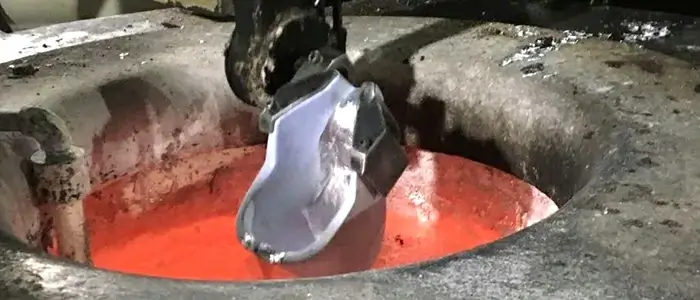
What Is an Automatic Pouring Ladle for Aluminum?
An automatic pouring ladle is a container installed on an automatic pouring machine or robotic pouring system to transfer molten aluminum from a holding furnace to the mold, pouring cup or casting station.
Unlike a traditional manually operated ladle, an automatic pouring ladle works together with the movement and control system of the casting equipment.
It needs to provide:
- Stable molten aluminum transfer
- Consistent pouring volume
- Reliable thermal insulation
- Good resistance to thermal cycling
- Low interaction with molten aluminum
- Suitable mechanical strength
- Compatibility with the automatic pouring equipment
Automatic pouring ladles can be used in different aluminum casting processes, including high-pressure die casting, gravity casting and sand casting, depending on the equipment and ladle design.
Start With Your Automatic Pouring Equipment
The first factor to check is not the ladle material. It is the equipment interface.
An automatic pouring ladle must be properly connected to the automatic pouring machine, robot arm or other handling mechanism.
Before ordering, check:
- Mounting position
- Connection method
- Bracket dimensions
- Bolt-hole positions
- Ladle orientation
- Robot arm clearance
- Pouring angle
- Distance between the furnace and mold
- Space available around the pouring station
A ladle with the correct capacity may still be unsuitable if its mounting structure does not match your existing equipment.
What should you send to the supplier?
If possible, provide:
- Photos of the existing ladle
- Photos of the robot or pouring equipment
- Existing ladle dimensions
- Mounting drawing
- Bracket drawing
- Connection dimensions
A photo with several basic dimensions can also be useful if a technical drawing is not available.
Determine the Required Ladle Capacity
The second important factor is capacity.
The ladle should provide enough volume for the required aluminum transfer or pouring cycle without being unnecessarily large.
Capacity selection depends on:
- Casting weight
- Number of cavities
- Pouring weight per cycle
- Required metal reserve
- Casting cycle time
- Pouring system design
- Automatic equipment configuration
For example, a small aluminum casting line may require a relatively small ladle, while an automotive casting line may require a larger capacity.
The important point is that larger does not automatically mean better.
An oversized ladle can increase weight, affect robot movement and increase the amount of molten aluminum exposed during transfer.
The correct capacity should therefore be determined from the actual pouring process.
Consider the Ladle Material
Material is one of the most important differences between traditional metal ladles and modern ceramic-fiber composite ladles.
Traditional ladles may use cast iron or other refractory materials. For aluminum casting, however, the ladle material needs to withstand repeated contact with molten aluminum while maintaining sufficient strength and thermal stability.
A ceramic-fiber composite automatic pouring ladle can provide several useful characteristics.
Lightweight Construction
Ceramic-fiber composite materials can be lighter than conventional refractory constructions.
Lower ladle weight can be beneficial for automatic equipment because the robot or pouring mechanism has less mass to move.
Thermal Insulation
A suitable composite structure can reduce heat transfer from the molten aluminum to the ladle body and surrounding equipment.
This can help maintain more stable metal temperature during transfer.
Resistance to Aluminum Wetting
A properly designed surface and coating can help reduce aluminum sticking to the ladle.
This is important because accumulated aluminum or dross can change the effective ladle shape and interfere with consistent pouring.
Mechanical Strength
The ladle must also withstand repeated movement, thermal cycling and mechanical handling.
Therefore, material selection should consider not only temperature resistance but also strength, toughness and service conditions.
Check the Maximum Operating Temperature
Molten aluminum is handled at high temperatures, so the automatic pouring ladle must be suitable for the actual operating environment.
However, you should not select a ladle based only on the maximum temperature number shown in a catalog.
Also consider:
- Actual aluminum temperature
- Heating and cooling cycles
- Immersion time
- Pouring frequency
- Preheating conditions
- Ladle wall thickness
- Coating condition
- Continuous or intermittent operation
For example, SEFU’s current automatic pouring ladle specification lists a maximum operating temperature of 780°C, with a ceramic composite density of approximately 1600 kg/m³ and thickness options of 8–25 mm. Actual suitability should be confirmed according to the customer’s process conditions.
Check the Pouring Weight and Pouring Geometry
Capacity is only part of the equation.
The shape of the ladle and the design of its pouring lip can directly affect how molten aluminum leaves the ladle.
The supplier should understand:
- Required pouring weight
- Pouring speed
- Pouring angle
- Pouring height
- Pouring lip position
- Mold or die location
- Distance between ladle and mold
- Robot movement path
A ladle designed for one casting machine may not work correctly on another machine even when the nominal capacity is similar.
This is why customized automatic pouring ladles are often necessary for automated aluminum casting lines.
Consider the Casting Process
Different aluminum casting processes can place different requirements on the pouring ladle.
High-Pressure Die Casting
For high-volume production, the ladle needs to work reliably with the automatic pouring system and maintain consistent transfer from cycle to cycle.
Important factors include:
- Cycle time
- Pouring weight
- Robot compatibility
- Ladle durability
- Thermal stability
- Pouring accuracy
Gravity Casting
Gravity casting may use different ladle capacities and pouring geometries depending on the mold design.
The pouring lip and pouring angle can be particularly important when the molten metal needs to enter a specific location.
Sand Casting
For automated sand casting lines, the ladle must be compatible with the molding system and automatic pouring equipment.
The required capacity and pouring geometry should be determined from the mold and casting layout.
Look at Aluminum Non-Wetting Performance
One of the practical problems in aluminum transfer is aluminum sticking to the ladle surface.
When aluminum repeatedly adheres to the ladle, several problems may occur:
- Dross accumulation
- Reduced effective ladle volume
- Changes in pouring geometry
- More frequent cleaning
- Increased maintenance
- Potential contamination of the molten metal
A suitable non-wetting surface can reduce aluminum adhesion.
SEFU’s automatic pouring ladle uses a surface coating designed to reduce aluminum penetration and sticking. The current product specification describes a boron nitride (BN) coating as part of its surface design.
The coating itself should be selected according to the actual aluminum alloy, operating temperature and service conditions.
Consider Service Life and Maintenance
For an automated production line, ladle replacement can affect production efficiency.
When evaluating a supplier, do not only ask:
How much does one ladle cost?
Also ask:
How long can the ladle operate under my actual production conditions?
Important factors include:
- Number of casting cycles
- Operating temperature
- Thermal cycling frequency
- Mechanical impact
- Aluminum alloy
- Coating condition
- Cleaning method
- Storage and handling
The actual service life varies according to operating conditions, so suppliers should avoid using a single service-life number as a guarantee for every application.
Instead, provide your production conditions and ask the manufacturer to evaluate the expected service requirements.
Make Sure the Ladle Can Be Customized
Automatic pouring equipment is not standardized across every aluminum foundry.
For this reason, customization can be more important than simply selecting a standard ladle.
Common customization requirements include:
Capacity
The ladle capacity can be designed according to the required pouring weight and production process.
Mounting Bracket
The connection structure can be adapted to the customer’s robot arm or automatic pouring machine.
Shape
Different casting lines may require different ladle shapes to provide sufficient clearance.
Pouring Lip
The pouring lip can be designed according to the required pouring position and trajectory.
Wall Thickness
Wall thickness affects weight, thermal behavior and mechanical performance and should be considered together with the operating conditions.
Connection Dimensions
The connection between the ladle and the automatic equipment should be checked before production.
Automatic Pouring Ladle Selection Checklist
Before requesting a quotation, prepare the following information:
| Requirement | Information to Provide |
|---|---|
| Casting process | Die casting, gravity casting, sand casting, etc. |
| Aluminum alloy | Alloy type if known |
| Pouring weight | kg per cycle |
| Required capacity | Approximate ladle capacity |
| Operating temperature | Actual molten aluminum temperature |
| Pouring frequency | Cycles per hour or day |
| Equipment | Robot, automatic pouring machine, etc. |
| Mounting | Bracket and connection dimensions |
| Ladle shape | Existing shape or required design |
| Pouring lip | Position and dimensions if available |
| Drawing | Technical drawing if available |
| Photos | Existing ladle and equipment photos |
| Quantity | Trial quantity and expected production quantity |
You do not need to have every parameter ready.
A photo of your existing ladle together with its main dimensions can be a useful starting point for a supplier to evaluate a replacement or customized design.
Ceramic-Fiber Composite vs. Traditional Metal Ladles
When comparing different automatic pouring ladles, buyers should look beyond the initial purchase price.
| Factor | Traditional Metal Ladle | Ceramic-Fiber Composite Ladle |
|---|---|---|
| Weight | Generally heavier | Generally lighter |
| Thermal insulation | Depends on construction | Designed for low heat transfer |
| Aluminum sticking | May require more attention | Non-wetting surface can reduce sticking |
| Equipment load | Higher | Lower |
| Customization | Possible | Possible |
| Automatic pouring | Suitable with proper design | Suitable with proper design |
| Maintenance | Depends on material and process | Depends on material, coating and process |
The actual performance depends on the specific design, material, coating, temperature and operating conditions.
For this reason, buyers should evaluate the complete ladle design rather than comparing material names alone.
Common Mistakes When Buying an Automatic Pouring Ladle
Mistake 1: Choosing Only by Capacity
A 50 kg ladle is not automatically suitable for every 50 kg aluminum pouring application.
Mounting dimensions, pouring geometry and robot clearance also matter.
Mistake 2: Ignoring the Existing Equipment
Even a high-quality ladle may not work correctly if the mounting system does not match the automatic pouring machine.
Mistake 3: Looking Only at Purchase Price
A cheaper ladle may have a shorter service life or require more frequent replacement.
Consider the total operating cost instead of only the initial purchase price.
Mistake 4: Ignoring the Coating
The surface condition directly affects aluminum sticking and ladle maintenance.
Mistake 5: Not Providing Drawings or Photos
Without basic dimensional information, it is difficult for a manufacturer to accurately evaluate compatibility.
Why Choose SF-Foundry Automatic Pouring Ladles?
SF-Foundry supplies automatic pouring ladles designed for aluminum and aluminum alloy casting applications.
Our current automatic pouring ladle uses a ceramic-fiber composite material and is designed for integration with automatic pouring equipment.
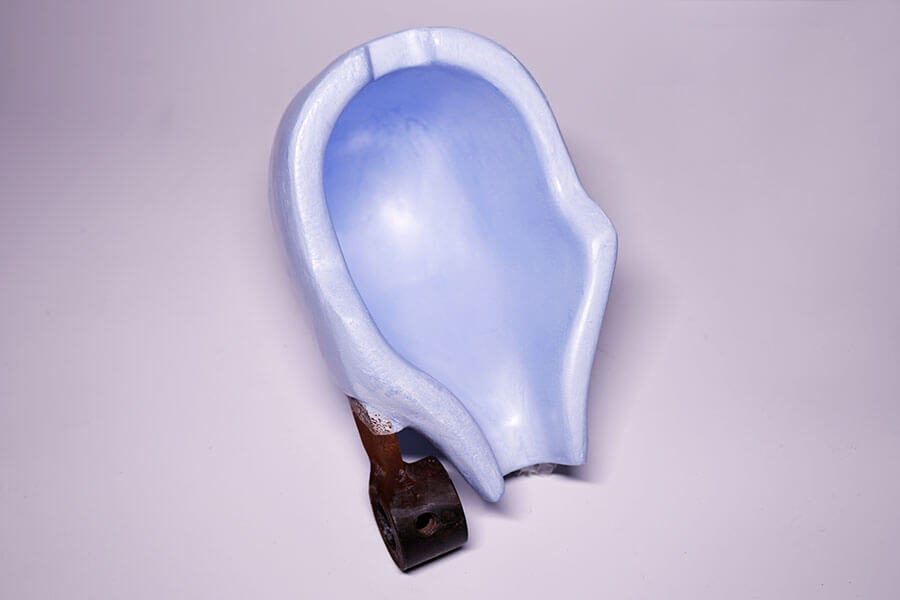
Available specifications include:
- Capacity options from approximately 0.5–120 kg
- Density of approximately 1600 kg/m³
- Thickness options of 8–25 mm
- Maximum operating temperature up to 780°C
- Customized capacity
- Customized bracket design
- Customized configuration according to equipment requirements
The ladle can be used in high-pressure casting, gravity casting and sand casting applications when the design is matched to the specific production process.
If you are replacing an existing automatic pouring ladle, you can send us:
Existing Ladle Photo + Dimensions + Equipment Information + Pouring Weight
Our team can evaluate the requirements and discuss a suitable customized design.
Request an Automatic Pouring Ladle Quote →
Frequently Asked Questions
What is the best material for an automatic pouring ladle for aluminum?
The appropriate material depends on the operating temperature, casting process, pouring frequency, equipment and required service life. Ceramic-fiber composite materials are one option specifically used for automatic aluminum transfer.
Can an automatic pouring ladle be customized?
Yes. Capacity, mounting bracket, shape, pouring geometry and other dimensions can be customized according to the automatic pouring equipment and casting process.
Can I use the same ladle for different aluminum casting machines?
Not necessarily. Different machines may have different mounting positions, robot arms, clearances, pouring angles and required capacities. Compatibility should be checked before ordering.
How do I select the right ladle capacity?
Start with the required pouring weight per cycle and the actual production process. Then consider the required reserve volume, cycle time and equipment limitations.
Does a ceramic-fiber composite ladle stick to aluminum?
The surface can be designed with a non-wetting coating to reduce aluminum sticking. Actual performance depends on the coating, alloy, temperature and operating conditions.
What information should I send when requesting a quotation?
Send the casting process, aluminum alloy, pouring weight, required capacity, operating temperature, existing ladle dimensions, mounting information and photos or drawings if available.
Request a Customized Automatic Pouring Ladle
Looking for an automatic pouring ladle for aluminum casting?
Send us your current ladle photo, dimensions or equipment information.
We can evaluate:
- Ladle capacity
- Material
- Wall thickness
- Mounting bracket
- Pouring geometry
- Coating
- Equipment compatibility
- Customized requirements
Related Aluminum Foundry Products
You may also be interested in: