


A casting filter is designed to improve molten metal cleanliness, but it also becomes part of the gating system. If the filter restricts metal flow more than expected, is partially blocked, is damaged, or is incorrectly installed, it can contribute to filling problems.
However, a slow or incomplete filling problem does not automatically mean that the filter is the cause.
The gating system, pouring temperature, metal cleanliness, filter area, filter type, filter placement, and pouring conditions can all affect how molten metal reaches the mold cavity.
So when a casting shows incomplete filling, cold shuts, misruns, or unexpectedly slow filling, the right approach is not simply to replace the filter. A foundry should diagnose the entire filling system and determine whether the filter is actually contributing to the problem.

This guide explains a practical way to diagnose filter-related filling problems in metal casting.
What Are the Common Signs of a Filter-Related Filling Problem?
The first step is to identify what changed in the casting process.
Typical symptoms may include:
- Slower-than-normal mold filling
- Incomplete filling or misruns
- Cold shuts
- Reduced metal flow after the filter
- Metal backing up above the filter
- Excessive turbulence near the filter
- A filter that appears heavily blocked after pouring
- Filter cracking or breaking during pouring
- Different filling behavior after changing filter size or type
These symptoms can have several possible causes.
For example, a misrun may be caused by low pouring temperature, insufficient metal volume, excessive heat loss, poor gating design, or restricted flow through the filter.
Therefore, the symptom itself is not enough to identify the cause.
The key question is:
Did the filter create or significantly increase the flow restriction under the actual casting conditions?
Start With the Casting Process, Not the Filter
Before changing the filter, compare the current casting process with a known successful production condition.
Check:
- Pouring temperature
- Pouring time
- Metal quantity
- Alloy or iron grade
- Filter material
- Filter size
- Filter PPI or mesh specification
- Filter placement
- Gating dimensions
- Runner and ingate configuration
- Mold temperature or preheating conditions, where applicable
- Metal cleanliness and inclusion load
If only the filter was changed and the filling problem appeared immediately afterward, the filter deserves closer investigation.
If several process parameters changed simultaneously, however, it is much more difficult to identify the filter as the primary cause.
A useful troubleshooting principle is:
Change one major variable at a time whenever possible.
This makes production trials much easier to interpret.
Check Whether the Filter Is Actually Restricting Flow
One of the most important checks is to compare the flow conditions before and after the filter.
A filter introduces resistance into the molten-metal flow path. The actual effect depends on factors such as:
- Filter material
- Filter thickness
- Filter area
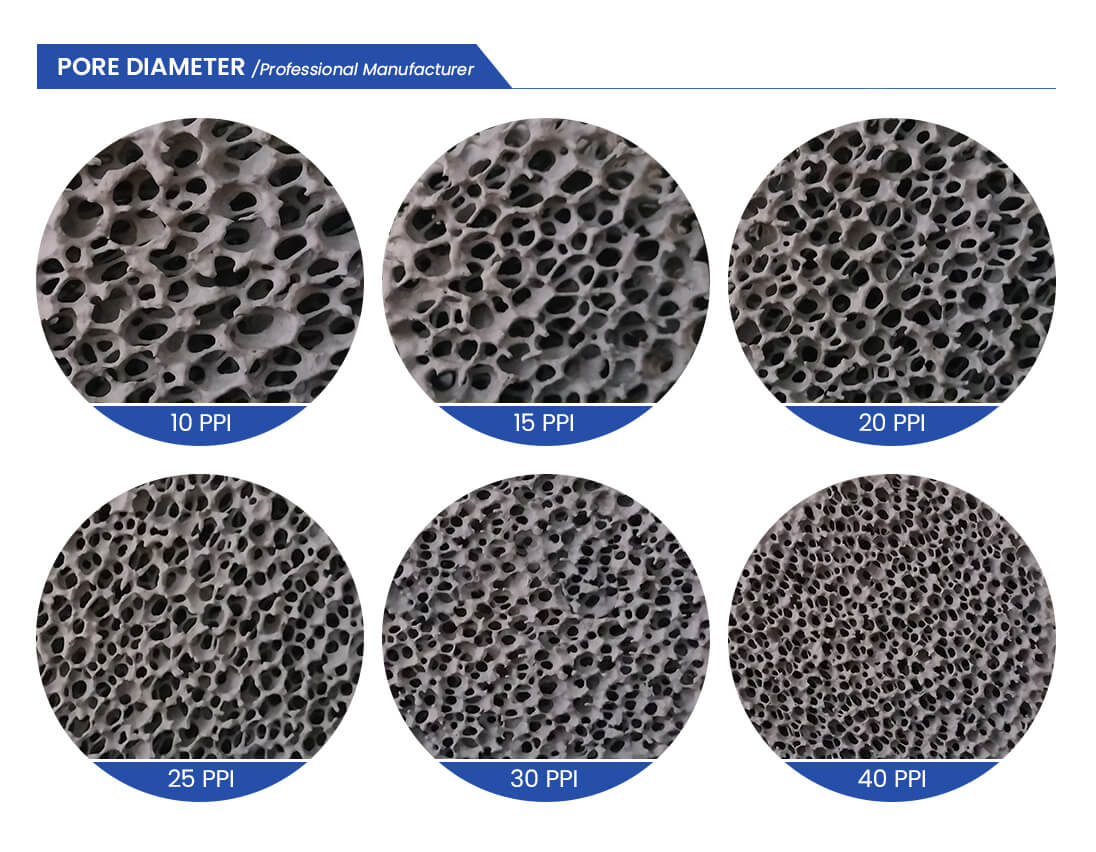
- PPI or aperture size
- Metal temperature
- Alloy characteristics
- Inclusion concentration
- Filter placement
- Pouring rate
A filter with a smaller effective flow area may produce greater resistance than a larger filter of the same material.
This is why simply specifying a filter by PPI or mesh size is not enough.
A practical diagnostic approach
Compare the following between a successful casting and a problem casting:
| Parameter | Successful condition | Problem condition |
|---|---|---|
| Filter material | Record | Record |
| Filter size | Record | Record |
| PPI / mesh | Record | Record |
| Metal temperature | Record | Record |
| Pouring time | Record | Record |
| Casting weight | Record | Record |
| Filter placement | Record | Record |
| Filter condition after pouring | Record | Record |
| Filling behavior | Record | Record |
If the filter specification remained unchanged but filling suddenly became slower, look for other causes such as temperature, gating changes, or increased inclusion loading.
If the filling problem appeared after changing filter specifications, compare the old and new filter conditions carefully.
Check Filter Area Relative to the Casting and Gating System
Filter area is one of the most important variables when diagnosing flow problems.
A filter needs sufficient effective area to allow the required amount of molten metal to pass without creating excessive restriction.
A useful engineering concept is:
Required filter capacity should be considered together with casting weight, metal flow rate, filter characteristics, and pouring conditions.
The filter should not be treated as an isolated component.
For example, increasing the casting weight without reviewing the filtration and gating design may change the required flow conditions.
Similarly, using a smaller filter in an existing gating system may reduce the effective flow area even though the filter material and PPI remain unchanged.
Important distinction
A larger filter does not automatically solve every filling problem.
If the gating system itself is undersized, poorly designed, or excessively restrictive, increasing filter area alone may not correct the problem.
The filter and gating system should therefore be evaluated together.
Inspect the Filter After Pouring
The used filter can provide valuable evidence.
After a filling problem occurs, inspect the filter rather than immediately discarding it.
Look for:
Heavy blockage
If the filter contains a large amount of trapped dross, oxides, slag, or inclusions, filtration may have significantly reduced the available flow area during pouring.
This can be especially important when molten metal cleanliness varies between heats.
Partial blockage
If only part of the filter is heavily loaded, the effective filtration area may have been substantially reduced.
This can produce inconsistent flow behavior between castings.
Cracks or breakage
A damaged filter may indicate:
- Excessive thermal shock
- Mechanical impact
- Improper installation
- Incompatible filter selection
- Excessive local metal velocity
A broken filter can also create a different problem: instead of excessive restriction, molten metal may bypass the intended filtration path.
Filter displacement
Check whether the filter remained correctly seated during pouring.
A filter that moves, tilts, or is not properly supported may change the flow path and create unpredictable filling behavior.
Check Whether the Filter Is Clogging
Clogging is one of the most common filter-related mechanisms that can reduce flow.
A filter does not necessarily have to be completely blocked to affect filling.
As inclusions accumulate, the effective open flow area can decrease.
This can create a sequence such as:
High inclusion load → progressive filter blockage → increased flow resistance → reduced downstream flow → longer filling time
If the first castings in a batch fill normally but later castings become progressively worse, changing metal cleanliness or filter loading should be investigated.
This pattern can be particularly useful diagnostically.
The foundry should compare:
- Filter appearance
- Inclusion level
- Metal treatment
- Pouring temperature
- Time between treatment and pouring
- Filling behavior from different heats
If the problem correlates with unusually dirty metal, the solution may involve upstream melt treatment rather than simply changing the filter.
Check Pouring Temperature Before Changing the Filter
Low molten-metal temperature can produce filling problems that look like filtration problems.
As molten metal loses heat, its viscosity and solidification behavior can change, reducing its ability to fill thin or complex sections.
For this reason, always verify pouring temperature when investigating:
- Misruns
- Cold shuts
- Incomplete filling
- Thin-wall filling problems
- Increased filling time
For aluminum, iron, steel, and other alloys, the acceptable temperature range depends on the alloy and casting process.
The important point is that a filter should not be blamed for a filling problem that is actually caused by insufficient thermal conditions.
A useful diagnostic sequence is:
Temperature check → Pouring-rate check → Gating check → Filter check
rather than immediately replacing the filter.
Check Filter Placement in the Gating System
Filter position can influence both filtration performance and metal flow.
A filter should be properly supported and positioned according to the gating design and filter type.
Potential problems include:
- Filter installed at an unsuitable location
- Poor seating
- Gaps around the filter
- Insufficient support
- Excessive metal impact
- Filter positioned where inclusion accumulation is unusually high
- Flow entering the filter unevenly
Uneven flow can cause one portion of a filter to load faster than another.
If the filter is designed for a particular gating configuration, changing its location without reviewing the complete system may change its performance.
Therefore, when a filter-related filling problem appears after a gating modification, evaluate the filter placement and gating change together.
Distinguish Filter Restriction From Gating Restriction
This is one of the most important parts of troubleshooting.
A filter may appear to be the bottleneck because it is located in the visible flow path. But the actual restriction may be somewhere else.
Possible restrictions include:
- Pouring basin
- Sprue
- Runner
- Runner extension
- Filter
- Ingate
- Narrow passages
- Poorly designed transitions
For example, if the runner cross-section is already too small, installing a larger filter may have little effect.
Likewise, if the filter area is adequate but the downstream ingates are restrictive, the casting may still fill slowly.
The correct question is therefore not:
“Is the filter too small?”
but:
“Where is the dominant flow restriction in the complete gating system?”
This change in thinking can prevent unnecessary filter changes.
Use a Symptom-to-Cause Diagnostic Table
The following table can be used as a starting point for production troubleshooting.
| Casting symptom | Possible filter-related cause | Other possible causes | What to check |
|---|---|---|---|
| Slow filling | Insufficient filter area | Small runner, low temperature | Filter area and gating dimensions |
| Incomplete filling | Filter restriction or clogging | Low temperature, poor gating | Used filter + pouring conditions |
| Cold shut | Reduced flow after filter | Low temperature, turbulence | Temperature and filling pattern |
| Filter heavily blocked | High inclusion load | Excessive melt contamination | Metal cleanliness and filter condition |
| Filter cracks | Thermal/mechanical stress | Improper installation | Filter material, support, pouring conditions |
| Metal bypasses filter | Poor seating or breakage | Gating design | Filter position and mold design |
| Filling becomes worse during production | Progressive clogging | Temperature variation | Filter loading and heat-to-heat variation |
| Problem starts after filter change | New filter has different flow characteristics | Other process changes | Old vs. new specifications |
This table should be treated as a diagnostic framework rather than a universal troubleshooting formula.
Actual results depend on the alloy, casting geometry, filter design, and gating system.
A Practical Troubleshooting Workflow
When a casting begins to show filling problems, a foundry can use the following sequence.
Step 1: Confirm the symptom
Determine exactly what has changed.
Is the problem:
- Longer filling time?
- Misrun?
- Cold shut?
- Incomplete filling?
- Filter breakage?
- Inconsistent filling?
A precise description is more useful than simply saying “the filter is not working.”
Step 2: Check process conditions
Record:
- Metal temperature
- Pouring time
- Metal quantity
- Alloy
- Mold condition
- Gating configuration
Compare these values with a successful production run.
Step 3: Inspect the filter
Check:
- Blockage
- Cracks
- Breakage
- Displacement
- Uneven loading
Step 4: Review filter specifications
Compare:
- Material
- Size
- Thickness
- PPI or mesh
- Available filtration area
Step 5: Review the gating system
Check whether the runner, ingates, sprue, and filter area are appropriately matched.
Step 6: Run a controlled trial
Where practical, change one major variable and compare the results.
For example, the foundry may test a different filter area while keeping the alloy, temperature, gating configuration, and pouring procedure as consistent as possible.
Step 7: Record the result
Create a simple production record containing:
Casting → Alloy → Weight → Filter → Size → PPI/Mesh → Temperature → Pouring Time → Result
Over time, this information can become extremely valuable for filter selection and process optimization.
When Should You Change the Filter?
A filter change may be appropriate when the investigation shows that the filter is genuinely contributing to the filling problem.
Examples include:
- The effective filter area is insufficient
- The filter becomes excessively blocked
- The filter specification is unsuitable for the metal and application
- The filter repeatedly cracks under actual pouring conditions
- The filter does not fit or remain stable in the gating system
- A different filter design is required for the casting process
But changing the filter should normally be based on evidence.
For example, if a filter is heavily blocked because the molten metal contains excessive inclusions, simply installing a more open filter may reduce filtration effectiveness without addressing the upstream problem.
The better solution may require both:
Melt cleanliness control + appropriate filtration
Choosing the Right Filtration Solution After Diagnosis
Different casting processes require different filtration approaches.
For example, SF-FOUNDRY supplies ceramic foam filters and fiberglass mesh filters for different foundry applications.
Ceramic foam filters such as alumina, silicon carbide, and zirconia can be selected according to the metal, temperature, and filtration requirements.
Fiberglass mesh filters can provide a different filtration approach where a flexible and economical filter format is appropriate.
The important point is that filter selection should follow the process requirements rather than simply choosing the filter with the smallest opening or highest nominal filtration specification.
For a new application, the foundry should provide the supplier with useful process information, including:
- Metal or alloy
- Casting weight
- Metal temperature
- Pouring method
- Gating configuration
- Required filter size
- Existing filter specification
- Current filling problem
- Photos of the used filter, when available
This information allows the supplier to recommend a more application-specific solution.
Final Checklist for Diagnosing Filter-Related Filling Problems
Before changing a casting filter, ask:
Process
- Is the pouring temperature stable?
- Has the pouring time changed?
- Has the alloy changed?
- Has the mold or gating system changed?
Filter
- Is the filter area sufficient?
- Is the PPI or mesh appropriate?
- Is the filter damaged?
- Is it clogged?
- Is it correctly positioned?
- Did the filter specification recently change?
Gating
- Is the runner large enough?
- Are the ingates restrictive?
- Is metal entering the filter evenly?
- Is there a possible restriction elsewhere in the system?
Metal quality
- Has the inclusion or dross load increased?
- Has melt treatment changed?
- Is the filter receiving an unusually high inclusion load?
Validation
- Can the problem be reproduced?
- Can one variable be changed at a time?
- Has the result been recorded?
This approach helps distinguish a filter problem from a gating problem, temperature problem, or molten-metal-quality problem.
Conclusion
A casting filter is only one part of the filling system. When a casting fills slowly or incompletely, replacing the filter immediately may not solve the underlying problem.
A better approach is to diagnose the complete process:
Casting symptom → Process conditions → Filter condition → Filter area → Gating system → Metal cleanliness → Controlled trial
By following this sequence, foundries can determine whether the filter is actually restricting flow, whether it is becoming overloaded, or whether another part of the casting process is responsible.
For foundries selecting or troubleshooting ceramic foam filters, fiberglass mesh filters, or other molten-metal filtration products, providing detailed process information is one of the most effective ways to identify an appropriate filtration solution.