


Investment casting—also known as lost-wax casting—is one of the most precise metal forming processes available today. It produces complex, near-net-shape components for aerospace engines, medical implants, industrial gas turbines, and countless other critical applications.
But precision comes with demanding quality requirements. Even a single non-metallic inclusion can turn a flawless-looking casting into a rejected part.
Unlike sand casting, where you can filter metal just before it enters the mold, investment casting has a unique challenge: the ceramic mold is created around the gating system before the metal is ever poured. This means every consumable you use must survive the shell-building and dewax processes, not just the pour itself.
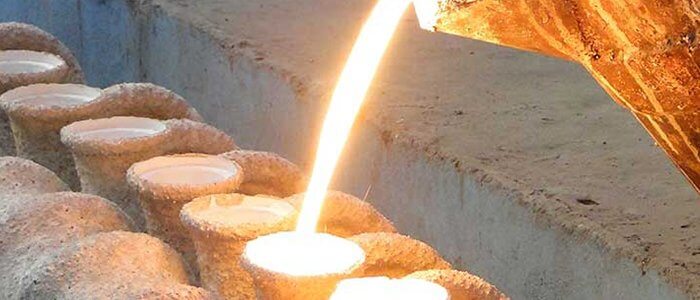
This guide explains the three essential consumable categories for investment casting:
| Product | Role | Key Feature |
|---|---|---|
| Filters | Remove inclusions from molten metal | Must withstand shell-building and dewax |
| Pouring Cups | Direct metal flow into the mold | High-strength ceramic, survives firing |
| Shell Materials | Form the mold cavity | Multi-layer refractory system |
Filters for Investment Casting
Why Filtration Is Critical
Investment castings are often used in high-integrity applications where any internal defect is unacceptable—turbine blades, orthopedic implants, valve bodies. Inclusions not only weaken the casting but can cause failure in service–.
Ceramic foam filters trap and remove non-metallic inclusions from the molten metal stream, reducing casting defects and improving mechanical properties.
How Filtration Works in Investment Casting
In sand casting, you can place a filter directly in the runner and pour. But in investment casting, the filter becomes part of the ceramic shell assembly. It must:
-
Withstand shell building — survive multiple dips in ceramic slurry and stucco
-
Survive dewax — withstand steam autoclave or flash fire without cracking
-
Withstand firing — survive 900-1000°C preheating before pouring
-
Perform during pour — filter effectively at casting temperature
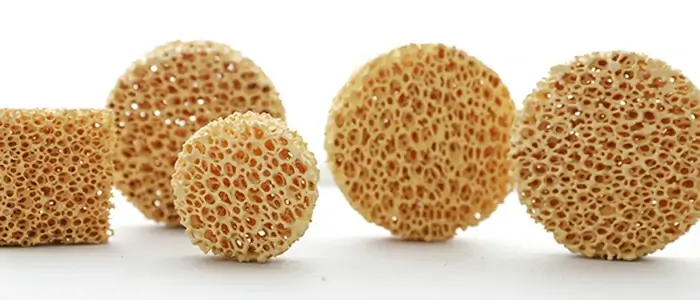
Types of Filters for Investment Casting
| Filter Type | Best For | Advantages | Limitations |
|---|---|---|---|
| Ceramic Foam (Zirconia) | Steel, superalloys, titanium | Highest temperature resistance; depth filtration– | More expensive |
| Ceramic Foam (Alumina) | Aluminum, copper alloys | Good temperature resistance; cost-effective | Not for high-temp alloys |
| Cellular/Honeycomb | High-volume production, steel, iron | High filtration efficiency; laminar flow control; no foam fragility– | Higher pressure drop |
| Silica Mesh | Iron, steel (small castings) | Low cost | Lower filtration efficiency |
Ceramic Foam Filters for Investment Casting
Ceramic foam filters have a three-dimensional open-cell structure that acts as a depth filter, mechanically trapping and adsorbing inclusions down to the micron level–.
For high-temperature alloys (steel, superalloys):
-
Material: Zirconia (ZrO₂) ceramic foam
-
Why: Excellent resistance to attack and corrosion from molten steel; withstands extreme temperatures–
-
PPI: 10-20 PPI for most applications
For aluminum and non-ferrous alloys:
-
Material: Alumina ceramic foam
-
Why: Chemically stable, cost-effective
-
PPI: 20-30 PPI
Wax-Impregnated Filters
Some filters for investment casting are pre-impregnated with wax. This allows them to be:
-
Inserted directly into the wax pattern assembly
-
Invested (coated with ceramic) along with the rest of the pattern
-
Burned out during dewax, leaving the filter in place in the ceramic shell–
Filter Cup: Integrated Filtration and Pouring
The most common investment casting filtration solution is the filter cup—a ceramic pouring cup with a built-in filter element.
| Feature | Benefit |
|---|---|
| Integrated design | Filter and pouring cup in one unit |
| Pre-assembled | No separate filter placement |
| Shell integration | Becomes part of the ceramic mold |
Filter cups are available in:
-
Mullite — for most casting requirements
-
Fused silica — for applications requiring very low thermal expansion–
Ceramic Pouring Cups
What Is a Ceramic Pouring Cup?
A ceramic pouring cup is a refractory component installed at the top of the wax runner assembly. After shell building and dewax, it becomes the entry point for molten metal. It is typically installed at the bottom of the wax runner and is composed of the mold shell, which can improve resistance to molten metal impact and avoid slag inclusion caused by shell cracks.

Why Use Ceramic Pouring Cups?
| Reason | Benefit |
|---|---|
| Impact resistance | Withstands molten metal flow without cracking |
| Clean entry | Reduces turbulence at the pour point |
| Slag trapping | Helps prevent inclusions from entering the mold |
| Consistent pour | Provides repeatable filling conditions |
Key Properties
| Property | Typical Value | Why It Matters |
|---|---|---|
| Material | Mullite, fused silica, alumina, zirconia | Matches alloy temperature requirements |
| Manufacturing | Isostatically pressed at high temperature and pressure | Ensures consistent density and strength |
| Thermal shock resistance | Excellent | Survives preheating and metal contact– |
| Strength | High | Withstands shell-building stresses |
Alloy Compatibility
Ceramic pouring cups are suitable for a wide range of alloys:
| Alloy Type | Compatibility |
|---|---|
| Ferrous (steel, stainless) | Yes |
| Nickel-based alloys | Yes |
| Aluminum | Yes |
| Copper/bronze | Yes |
| Superalloys (aerospace) | Yes, with appropriate material grade– |
Filter Cups vs. Standard Pouring Cups
| Feature | Standard Pouring Cup | Filter Cup |
|---|---|---|
| Filtration | No | Yes (integrated filter) |
| Cost | Lower | Higher |
| Best for | Clean melts, lower quality requirements | Critical castings, inclusion-sensitive alloys |
Shell Materials (Refractories)
What Is the Ceramic Shell?
The ceramic shell is the mold in investment casting. It’s built up layer by layer around a wax pattern, then the wax is removed, leaving a hollow ceramic cavity ready for metal.
The Shell-Building Process
| Step | Description |
|---|---|
| 1. Pattern assembly | Wax patterns are attached to a wax runner system |
| 2. Prime coat | Fine refractory slurry + fine stucco (creates smooth surface finish) |
| 3. Backup coats | Coarser slurry + coarser stucco (builds shell thickness) |
| 4. Drying | Each coat is dried before the next is applied |
| 5. Dewax | Wax is removed (steam autoclave or flash fire) |
| 6. Firing | Shell is fired to cure the ceramic |
Key Refractory Materials
| Material | Layer | Properties |
|---|---|---|
| Zircon (ZrSiO₄) | Prime coat (face coat) | High refractoriness; excellent surface finish; slower cooling– |
| Fused Silica | Backup coats | Very low thermal expansion; excellent thermal shock resistance– |
| Alumina (Al₂O₃) | Special applications | High refractoriness; dimensional stability |
| Zirconia (ZrO₂) | Specialty alloys | Highest temperature resistance; for nickel, titanium, cobalt alloys– |
| Aluminosilicate | General purpose | Cost-effective; good performance |
Prime Coat (Face Coat)
The prime coat is the layer that contacts the molten metal. It determines surface finish and must resist metal penetration.
| Material | Best For | Key Characteristic |
|---|---|---|
| Zircon | Steel, superalloys | Excellent surface finish, high refractoriness |
| Fused silica | Aluminum, lower-temperature alloys | Thermal shock resistance |
| Alumina | High-temperature alloys | High refractoriness |
Backup Coats
Backup coats provide shell strength. They typically use fused silica or aluminosilicate refractories.
A mixture of fused silica and zircon can act as a thermal insulator, providing slower cooling than pure fused silica–. This is useful for controlling solidification rates.
Binders
| Binder | Shell Type | Applications |
|---|---|---|
| Colloidal silica | Standard investment casting | Most applications |
| Ethyl silicate | High-strength shells | Large castings, demanding applications |
| Water glass | Lower-cost shells | General purpose, less demanding– |
Shell Quality Considerations
| Factor | Why It Matters |
|---|---|
| Layer thickness consistency | Affects dimensional accuracy |
| Drying control | Prevents cracking and weak spots |
| Firing temperature | Determines shell strength |
| Permeability | Allows gases to escape during pouring |
Selection Guide by Alloy
| Alloy Type | Recommended Filter | Pouring Cup Material | Shell Prime Coat |
|---|---|---|---|
| Steel / Stainless Steel | Zirconia foam or honeycomb | Mullite or fused silica | Zircon |
| Superalloys (Ni, Co) | Zirconia foam | High-purity alumina | Zircon or alumina |
| Aluminum | Alumina foam | Mullite | Fused silica |
| Copper / Bronze | Alumina foam or SiC | Mullite | Zircon |
| Titanium | Zirconia foam (special grade) | Zirconia-based | Zirconia |
Installation Best Practices
Filter Integration
Step-by-step for ceramic foam filters in investment casting:
| Step | Action |
|---|---|
| 1. Select | Choose the right filter size, material, and PPI for your alloy– |
| 2. Position | Place filter close to the casting cavity for best results– |
| 3. Assemble | Integrate into wax pattern assembly or use pre-assembled filter cup |
| 4. Invest | Apply ceramic shell over the entire assembly |
| 5. Dewax | Remove wax—filter remains in place in the shell |
| 6. Fire | Pre-heat shell before pouring |
| 7. Pour | Pour molten metal through filter |
Pouring Cup Placement
-
Install at the bottom of the wax runner assembly
-
Ensure cup is properly sealed to prevent shell cracks
-
For filter cups, no additional filter placement is needed
Common Mistakes to Avoid
| Mistake | Consequence | Prevention |
|---|---|---|
| Wrong filter material for alloy | Filter fails or contaminates melt | Match material to alloy temperature |
| Filter too small | Restricts flow, incomplete fill | Calculate required filter area |
| Poor cup sealing | Shell cracks during dewax | Ensure proper integration |
| Inadequate prime coat | Metal penetration, rough surface | Use correct refractory for alloy |
| Incomplete drying | Shell cracking during firing | Follow drying protocols |
Frequently Asked Questions
Q1: What’s the difference between a filter cup and a separate filter?
A: A filter cup has a filter integrated into the pouring cup—one piece, no assembly required. A separate filter is placed elsewhere in the gating system. For most investment casting applications, filter cups are simpler and more reliable.
Q2: Can I use the same filter for different alloys?
A: Not recommended. Filters are alloy-specific. Zirconia for steel/superalloys, alumina for aluminum. Using the wrong material can cause filter failure.
Q3: What is the ideal filter placement in investment casting?
A: As close to the casting cavity as possible. This minimizes reoxidation after filtration and ensures the cleanest metal reaches the part–.
Q4: Do I need to preheat filters before pouring?
A: In investment casting, the filter is part of the ceramic shell and is preheated along with the shell during the firing step. No separate preheating is required.
Q5: How do I choose the right shell material?
A: Consider your alloy temperature and surface finish requirements. Zircon prime coat for steel/superalloys; fused silica for aluminum. Your refractory supplier can provide specific recommendations.
Q6: What PPI filter should I use for investment casting?
A: 10-20 PPI for most steel and superalloy applications; 20-30 PPI for aluminum. Finer PPI gives better filtration but may restrict flow.

Q7: Can I use paper casting runners in investment casting?
A: No. Paper runners are designed for sand casting and cannot survive the shell-building and dewax processes of investment casting.
Conclusion
Investment casting requires a specialized set of consumables designed to survive the shell-building and dewax processes while delivering clean, high-quality castings.
| Product | Key Takeaway |
|---|---|
| Filters | Zirconia for high-temp alloys; alumina for aluminum; filter cups simplify the process |
| Pouring Cups | High-strength ceramic; filter cups integrate filtration and pouring |
| Shell Materials | Multi-layer refractory system; prime coat determines surface finish |
When all three work together, you get castings that meet the demanding requirements of aerospace, medical, and industrial gas turbine applications.
At SF-Foundry, we supply a complete range of investment casting consumables:
| Product Category | Offerings |
|---|---|
| Filters | Zirconia foam, alumina foam, filter cups |
| Pouring Cups | Mullite, fused silica, filter cups |
| Ceramic Fiber Products | For aluminum investment casting |
Contact us:
-
Email: info@sf-foundry.com
-
Technical Support: 8618636913699
-
Website: www.sf-foundry.com