


If you run an aluminum foundry, you know the scene well: molten metal being transferred from furnace to mold, with operators managing ladles, trying to pour consistently shift after shift. It’s hot, physically demanding, and quality depends heavily on the person holding the ladle.
Automatic pouring ladles have changed this picture dramatically. But here’s what many foundries don’t realize: the real breakthrough in automatic pouring isn’t just the automation—it’s the material the ladle is made from.
Modern automatic ladles use advanced ceramic composite materials that outlast traditional cast iron ladles by 3 to 6 times, reduce inclusions in your castings, and lower your energy costs.

What Is an Automatic Pouring Ladle?
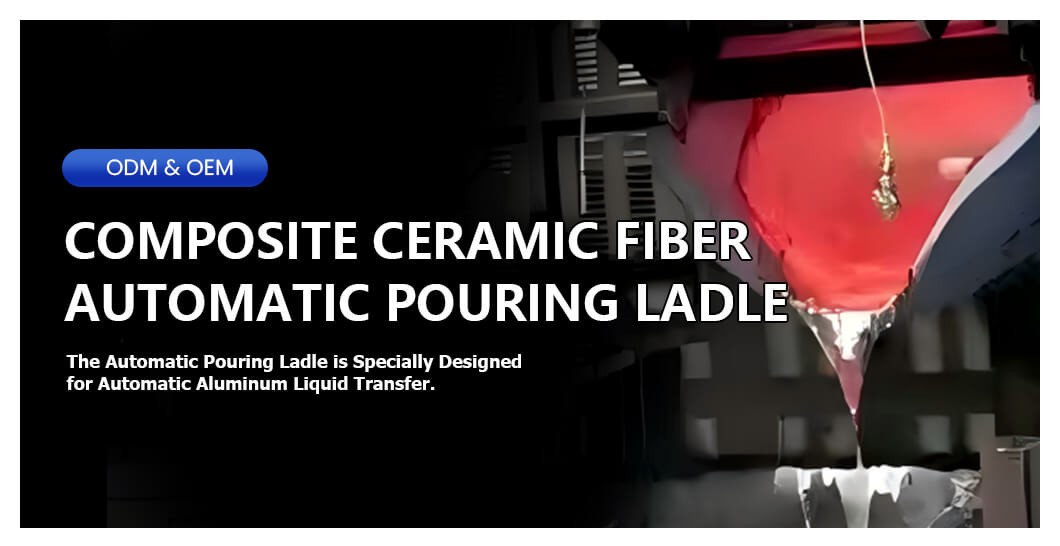
An automatic pouring ladle is a mechanized system that transfers molten aluminum from a holding furnace to a casting station (die casting machine, sand mold, or gravity casting line) without manual operation.
But a modern automatic ladle is more than just a bucket on a robot. It’s an engineered system designed for:
| Function | Purpose |
|---|---|
| Clean metal transfer | Minimize turbulence and oxide formation |
| Consistent pour | Repeatable flow rate and volume every cycle |
| Long service life | Withstand thermal cycling and mechanical handling |
| Low maintenance | Reduce downtime for ladle changes |
The Material Breakthrough — Why Ladle Material Matters
Traditional ladles are made from cast iron. They work, but they have significant drawbacks:
| Problem | Consequence |
|---|---|
| Iron dissolves in aluminum | Contamination, hard spots, inclusions |
| Aluminum sticks to surface | Dross buildup, flow disruption |
| Thermal fatigue | Cracking, short service life |
| Heavy weight | More strain on handling equipment |
The Solution: Advanced Ceramic Composites
Modern automatic ladles use materials like Reinforced Fiberglass Material or similar ceramic composites. These materials were developed specifically for molten aluminum handling.
| Property | Benefit |
|---|---|
| Non-wetting | Aluminum doesn’t stick; dross doesn’t build up |
| Thermal shock resistance | Withstands repeated immersion in molten metal |
| Low thermal conductivity | Metal stays hot; less heat loss during transfer |
| Chemical stability | No reaction with aluminum; no contamination |
| Lightweight | Easier to handle, less strain on equipment |
Real-World Performance
Compared to traditional cast iron ladles, advanced ceramic composite ladles deliver:
| Metric | Cast Iron | Ceramic Composite |
|---|---|---|
| Service life | Weeks to months | 3-6× longer |
| Dross buildup | Frequent cleaning needed | Minimal |
| Inclusions in castings | Common | Significantly reduced |
| Furnace temperature | Higher to compensate for heat loss | Lower → energy savings |
Why Automate? The Benefits
Consistent Pouring Quality
Manual pouring varies from operator to operator. An automated system pours the same way every time:
| Variable | Manual | Automated |
|---|---|---|
| Pouring speed | Varies by operator | Consistent |
| Pouring weight | Approximate | Precise |
| Start/stop timing | Reaction time varies | Exact |
| Inclusion generation | Depends on skill | Minimized by design |
Reduced Inclusions and Scrap
The combination of non-wetting material and controlled pouring dramatically reduces inclusions:
-
No iron contamination from ladle material
-
Less dross from metal sticking
-
Smooth, laminar flow reduces oxide formation
Many foundries report significant scrap reduction after switching to ceramic composite automatic ladles.
Improved Safety
Pouring molten metal is one of the highest-risk tasks in a foundry. Automation removes operators from the danger zone.
Labor Optimization
With automatic ladles, one operator can oversee multiple pouring stations instead of manually pouring each shot.
Energy Savings
Ceramic composites have low thermal conductivity. Metal stays hot during transfer, allowing you to:
-
Lower holding furnace temperatures
-
Reduce energy costs
-
Maintain consistent casting quality
When to Automate — A Decision Framework
When Automation Makes Sense
| Scenario | Why |
|---|---|
| High-volume die casting | ROI improves with volume |
| Labor shortages | Reduces dependency on skilled pourers |
| Quality issues from inclusions | Cleaner transfer reduces defects |
| Frequent ladle changes | Longer-lasting material reduces downtime |
| Energy cost concerns | Lower furnace temperatures save money |
When Manual Pouring May Still Be Fine
| Scenario | Why |
|---|---|
| Very low volume | Automation cost may not be justified |
| Simple, non-critical castings | Quality requirements are moderate |
| Limited capital budget | Upfront investment may be prohibitive |
Types of Automatic Pouring Systems
Robotic Pouring (Most Common)
A robot arm equipped with a ceramic composite ladle performs the pouring motion. Used in high-pressure die casting, gravity casting, and sand casting.
Best for: Flexible operations, multiple casting stations, high-volume production
Tilting Ladle Systems
A fixed or rail-mounted ladle that tilts to pour. Often used in gravity casting and sand casting lines.
Best for: Simpler setups, dedicated casting stations
Slide Gate / Pumped Systems
Uses a valve or pump mechanism at the bottom of the ladle for precise flow control.
Best for: Very high precision requirements, continuous pouring
Customization
Automatic ladles are not one-size-fits-all. Key customization options include:
| Option | Considerations |
|---|---|
| Ladle capacity | Match to your largest casting weight |
| Mounting position | Top-mount, side-mount, or custom bracket |
| Clearance requirements | Fit within your existing machine layout |
| Shape | Round, rectangular, or custom profile |
| Pouring lip design | Optimized for your mold or die entry |
Implementation Steps
Step 1: Assess Your Current Process
| What to Measure | Why |
|---|---|
| Current scrap rate | Baseline for ROI calculation |
| Ladle change frequency | Current downtime cost |
| Energy consumption | Potential savings from lower furnace temps |
| Labor allocation | Potential for redeployment |
Step 2: Define Your Requirements
| Question | What to Consider |
|---|---|
| What casting processes? | Die casting, gravity, sand—or multiple? |
| What volume? | High-volume needs robust, fast systems |
| What’s your layout? | Space, robot access, furnace location |
| What’s your budget? | Capital available for upfront investment |
Step 3: Choose Your Material
| Material | Best For |
|---|---|
| Ceramic composite (RFM or equivalent) | Most applications; longest life; cleanest metal |
| Cast iron | Low-volume, cost-sensitive, non-critical |
Step 4: Work with an Experienced Supplier
Look for suppliers who offer:
-
Engineering support for customization
-
Proven track record in your process type
-
Material expertise (not just automation)
Step 5: Install, Train, and Optimize
-
Installation — work with experienced integrators
-
Training — operators need to understand the material, not just the controls
-
Monitor — track scrap, downtime, and energy use before and after
Common Questions
Q1: What’s the most important feature of an automatic pouring ladle?
A: The material. A non-wetting ceramic composite ladle will outperform cast iron by 3-6× in service life, while also reducing inclusions and energy costs.
Q2: Can I retrofit an automatic ladle to my existing equipment?
A: Yes. Most automatic ladles can be customized to fit existing robots, furnaces, and casting stations.
Q3: How much longer do ceramic composite ladles last compared to cast iron?
A: Typically 3 to 6 times longer, depending on operating conditions.
Q4: Does a non-wetting ladle really reduce inclusions?
A: Yes. When aluminum doesn’t stick to the ladle, dross doesn’t build up and flake off into the casting. This significantly reduces inclusion-related defects.
Q5: Can I use automatic ladles for both high-pressure die casting and gravity casting?
A: Yes. Many systems are designed to work across multiple casting processes. Customization ensures the right design for each application.
Q6: What maintenance is required?
A: Ceramic composite ladles require minimal maintenance. Regular inspection for wear, cleaning if any dross accumulates, and replacement only when service life is reached (typically months, not weeks).
Conclusion
Automatic pouring ladles offer a clear path to better quality, safer operations, and lower costs for aluminum foundries. The key is choosing the right material for your application:
| Material | Service Life | Inclusion Control | Energy Savings |
|---|---|---|---|
| Cast iron | Baseline | Poor | None |
| Ceramic composite (RFM or equivalent) | 3-6× longer | Excellent | Significant |
Consider automation if:
-
You’re facing labor shortages
-
Inclusion-related scrap is significant
-
You want to reduce energy costs
-
You need consistent quality for demanding customers
At SF-Foundry, we supply automatic pouring ladles for aluminum foundries—including advanced ceramic composite options that deliver longer service life, cleaner metal, and lower operating costs.
Contact us:
-
Email: info@sf-foundry.com
-
Technical Support: 8618636913699
-
Website: www.sf-foundry.com