


When selecting a ceramic foam filter for your foundry, one of the most important decisions you will make is choosing the filter material. While PPI (Pores Per Inch) determines filtration fineness, the material composition determines whether the filter can survive your pouring temperature, resist thermal shock, and maintain structural integrity throughout the casting process.
Three materials dominate the foundry filtration market: Alumina (Al₂O₃) , Silicon Carbide (SiC) , and Zirconia (ZrO₂). Each has distinct properties that make it suitable for specific alloys and applications.
This guide explains the differences between these materials and helps you select the right one for your castings.
Why Filter Material Matters
The Role of Filter Material
The material of a ceramic foam filter affects:
| Property | Why It Matters |
|---|---|
| Temperature resistance | The filter must withstand your pouring temperature without softening or failing |
| Thermal shock resistance | Sudden contact with molten metal creates thermal stress; the filter must not crack |
| Chemical compatibility | The filter should not react with your alloy or introduce contaminants |
| Mechanical strength | The filter must resist erosion and withstand metal flow pressure |
| Cost | Material choice significantly affects filter price |
The Consequence of Wrong Material Choice
| Problem | Likely Cause |
|---|---|
| Filter cracks during pouring | Thermal shock resistance too low |
| Filter softens or deforms | Temperature limit exceeded |
| Filter erodes rapidly | Chemical reaction with alloy |
| Filter performs well but costs too much | Over-specifying expensive material |
Material Properties at a Glance
| Property | Alumina (Al₂O₃) | Silicon Carbide (SiC) | Zirconia (ZrO₂) |
|---|---|---|---|
| Maximum Service Temperature | ~1100°C | ~1500°C | ~1700°C |
| Thermal Shock Resistance | Moderate | Good | Excellent |
| Chemical Stability | Good vs. aluminum | Good vs. iron/cast iron | Excellent vs. steel |
| Thermal Conductivity | Low | High | Low |
| Density | ~3.9 g/cm³ | ~3.2 g/cm³ | ~5.7 g/cm³ |
| Relative Cost | Low | Medium | High |
| Primary Applications | Aluminum, Magnesium | Gray iron, Ductile iron, Copper alloys | Steel, Stainless steel, Superalloys |
Alumina (Al₂O₃) Filters
What Is Alumina?
Alumina (aluminum oxide) is the most common and economical ceramic filter material. It offers good refractoriness up to approximately 1100°C and excellent chemical stability, particularly with aluminum alloys.

Key Characteristics
| Property | Value |
|---|---|
| Temperature Limit | ~1100°C (2012°F) |
| Thermal Shock Resistance | Moderate—requires proper preheating |
| Chemical Compatibility | Excellent with aluminum and its alloys |
| Color | Typically white or off-white |
Best Applications
| Alloy Type | Why It Works |
|---|---|
| Aluminum alloys | Temperature range matches perfectly; chemically inert with aluminum |
| Magnesium alloys | Similar temperature requirements |
| Zinc alloys | Low-temperature applications |
| Copper alloys (low-temperature) | Some bronzes and brasses below 1100°C |
Limitations
-
Not suitable for iron, steel, or high-temperature copper alloys
-
Requires careful preheating to avoid thermal shock
-
Limited use above 1100°C
Practical Tip
If you cast aluminum, alumina is your most cost-effective choice. At SF-FOUNDRY, our alumina filters are manufactured with consistent pore structure and clean edges, ensuring reliable performance in aluminum foundries.
Silicon Carbide (SiC) Filters
What Is Silicon Carbide?
Silicon carbide is a synthetic ceramic material known for its high thermal conductivity, excellent strength at elevated temperatures, and good resistance to thermal shock. It is the most widely used filter material for iron castings.

Key Characteristics
| Property | Value |
|---|---|
| Temperature Limit | ~1500°C (2732°F) |
| Thermal Shock Resistance | Good—better than alumina |
| Thermal Conductivity | High—helps distribute heat evenly |
| Chemical Compatibility | Excellent with iron, good with copper alloys |
| Color | Typically gray or dark gray |
Best Applications
| Alloy Type | Why It Works |
|---|---|
| Gray iron | Temperature range ideal; cost-effective |
| Ductile iron | Handles nodular iron temperatures well |
| Copper alloys | Suitable for most bronze and brass applications |
| Some steel castings (small/light) | Where temperatures are at the lower end |
Why Silicon Carbide Excels for Iron
-
Thermal conductivity helps prevent localized overheating
-
Good strength at iron pouring temperatures (1350-1450°C)
-
Chemical stability in contact with iron melts
-
Cost balance —more expensive than alumina but justified for iron
Limitations
-
May react with basic slags in some applications
-
Not suitable for superalloys or very high-temperature steels
-
Upper temperature limit (~1500°C) is adequate for most iron but marginal for some steel
Practical Tip
For most iron foundries, silicon carbide is the standard choice. At SF-FOUNDRY, our silicon carbide filters are engineered to provide consistent performance across a wide range of iron casting applications.
Zirconia (ZrO₂) Filters
What Is Zirconia?
Zirconia (zirconium dioxide) is a high-performance ceramic material, typically used in partially stabilized form (PSZ) for foundry filters. It offers the highest temperature resistance and exceptional thermal shock resistance among common filter materials.
Key Characteristics
| Property | Value |
|---|---|
| Temperature Limit | ~1700°C (3092°F) |
| Thermal Shock Resistance | Excellent—can withstand rapid temperature changes |
| Chemical Stability | Excellent, even with aggressive steel melts |
| Density | High (~5.7 g/cm³)—feels heavier than other filters |
| Color | White or tan/orange depending on stabilization |
Why Zirconia Excels for Steel
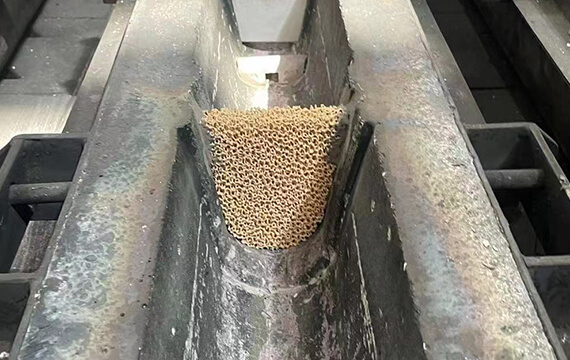
The unique property of partially stabilized zirconia is its ability to absorb thermal stress through phase transformation. When sudden temperature change occurs, the material’s microstructure adapts, preventing crack propagation. This makes zirconia filters ideal for:
-
Steel castings at 1550-1650°C
-
Stainless steel requiring clean surfaces
-
Superalloys for aerospace and power generation
-
Large iron castings where extended solidification time demands maximum filter reliability
Best Applications
| Alloy Type | Why It Works |
|---|---|
| Carbon steel | Withstands 1550°C+ pouring temperatures |
| Stainless steel | Chemically stable, no contamination |
| High-alloy steels | Reliable at extreme temperatures |
| Superalloys | Highest performance requirement |
| Large ductile iron castings | Extra safety margin for critical components |
Limitations
-
Higher cost —typically 2-3× more expensive than silicon carbide
-
Heavier —may require different handling considerations
-
Over-specification risk —unnecessary for standard iron or aluminum
Practical Tip
Use zirconia filters when you need the highest reliability at high temperatures. For critical steel castings, the extra cost is justified by reduced defect rates. SF-FOUNDRY offers partially stabilized zirconia filters with excellent thermal shock resistance, available in both white and tan/orange variants.
Material Selection Guide by Alloy
Quick Reference Table
| Your Alloy | Pouring Temperature | Recommended Material | Why |
|---|---|---|---|
| Aluminum | 680-800°C | Alumina | Temperature matched, cost-effective |
| Magnesium | 650-750°C | Alumina | Similar to aluminum |
| Gray Iron | 1350-1450°C | Silicon Carbide | Industry standard, good value |
| Ductile Iron | 1350-1450°C | Silicon Carbide | Handles nodular iron well |
| Ductile Iron (large/heavy) | 1350-1450°C | Zirconia | Extra safety margin |
| Copper/Bronze | 1050-1200°C | Silicon Carbide | Good temperature match |
| Brass | 900-1050°C | Silicon Carbide or Alumina | Either may work |
| Carbon Steel | 1550-1650°C | Zirconia | Required for temperature |
| Stainless Steel | 1550-1650°C | Zirconia | Required for temperature |
| Superalloys | 1400-1600°C+ | Zirconia | Highest reliability needed |
Special Cases
| Situation | Recommendation |
|---|---|
| Mixed foundry (iron + aluminum) | Stock both SiC and alumina; use each for its intended alloy |
| Occasional steel castings in iron foundry | Keep zirconia filters for steel jobs |
| Very large castings of any alloy | Consider zirconia for the extra safety margin |
| Cost-sensitive high-volume production | Match material precisely; don’t over-specify |
How to Verify Filter Material Quality
Visual Inspection
| Material | Typical Appearance | What to Check |
|---|---|---|
| Alumina | White, off-white | Uniform color, no discoloration |
| Silicon Carbide | Gray, dark gray | Consistent gray throughout |
| Zirconia | White or tan/orange | Color indicates stabilization type |
Documentation
Reputable suppliers provide material certification. For SF-FOUNDRY filters, you can request:
-
Material composition data
-
Maximum service temperature specifications
-
Physical property test results
Simple Tests
-
Weight comparison: Zirconia filters feel noticeably heavier than alumina or SiC of the same size
-
Thermal shock test (if samples available): Subject to rapid temperature change and inspect for cracking
Frequently Asked Questions
Q1: Can I use alumina filters for gray iron?
A: Not recommended. Gray iron pouring temperatures (1350-1450°C) exceed alumina’s safe limit of ~1100°C. The filter may soften or fail, leading to inclusions and defects.
Q2: Can silicon carbide filters handle steel?
A: For small, light steel castings at the lower end of steel pouring temperatures, silicon carbide may survive. However, for reliable performance in most steel applications, zirconia is the safer choice.
Q3: Why are zirconia filters more expensive?
A: Zirconia raw material costs significantly more than alumina or silicon carbide. Additionally, the manufacturing process for partially stabilized zirconia requires precise control to achieve the right phase structure.
Q4: How do I know if I need zirconia?
A: If you cast steel, stainless steel, or superalloys, you need zirconia. If you cast large, critical iron castings where failure is unacceptable, zirconia provides extra safety margin. For standard iron and aluminum, silicon carbide or alumina are appropriate.
Q5: Can I switch materials without changing filter size?
A: Yes, physical dimensions are independent of material. A 50×50×22mm filter in alumina, silicon carbide, or zirconia will fit the same filter seat. However, flow characteristics may differ slightly due to material properties.
Q6: Does material affect filtration efficiency?
A: Filtration efficiency is primarily determined by PPI and pore structure, not material. However, material affects whether the filter survives to perform its function—a cracked or softened filter cannot filter effectively.
Conclusion
Choosing the right filter material is essential for successful casting:
| Material | Best For | Key Advantage |
|---|---|---|
| Alumina | Aluminum, magnesium | Cost-effective, chemically compatible |
| Silicon Carbide | Gray iron, ductile iron, copper alloys | Excellent balance of performance and cost |
| Zirconia | Steel, stainless steel, superalloys | Highest temperature resistance and reliability |
Select based on your alloy and pouring temperature—not on habit or assumption. Using the correct material ensures the filter survives, performs, and delivers clean metal to your mold.
Need Help Selecting the Right Filter Material?
At SF-FOUNDRY, we manufacture ceramic foam filters in all three materials:
| Material | Available PPI | Available Sizes |
|---|---|---|
| Alumina | 10, 20, 30 PPI | Round, square, custom |
| Silicon Carbide | 10, 20, 30 PPI | Round, square, custom |
| Zirconia | 10, 20, 30 PPI | Round, square, custom |
Our team can help you determine the appropriate material and specifications for your specific application. Contact us for:
-
Technical advice on material selection
-
Sample requests for testing
-
Quotations for regular or custom filters
SF-FOUNDRY
Website: https://sf-foundry.com/
Email: info@sf-foundry.com