


Three ceramic materials dominate the foundry filtration market: Alumina (Al₂O₃) , Silicon Carbide (SiC) , and Zirconia (ZrO₂) . Each has distinct properties that make it suitable for specific alloys and applications. Selecting the wrong material can lead to filter failure, melt contamination, or unnecessary cost.
This quick reference guide shows you at a glance the key differences and helps you make the right choice for your casting process.
Quick Comparison Table
| Property | Alumina (Al₂O₃) | Silicon Carbide (SiC) | Zirconia (ZrO₂) |
|---|---|---|---|
| Maximum Service Temperature | ~1100°C | ~1500°C | ~1700°C |
| Thermal Shock Resistance | Moderate | Good | Excellent (≥7 cycles ΔT>1000°C) |
| Chemical Stability | Good vs. aluminum | Good vs. iron/cast iron | Excellent vs. steel, inert to Fe/Ni/Cr/Co alloys |
| Compressive Strength | >0.8 MPa | >0.9 MPa | 1.2–1.6 MPa |
| Porosity | 80–90% | 80–90% | 75–85% |
| Color | White or off-white | Gray to dark gray | White to tan/orange |
| Density | ~3.9 g/cm³ | 0.35–0.50 g/cm³ (bulk) | 0.45–0.65 g/cm³ (bulk) |
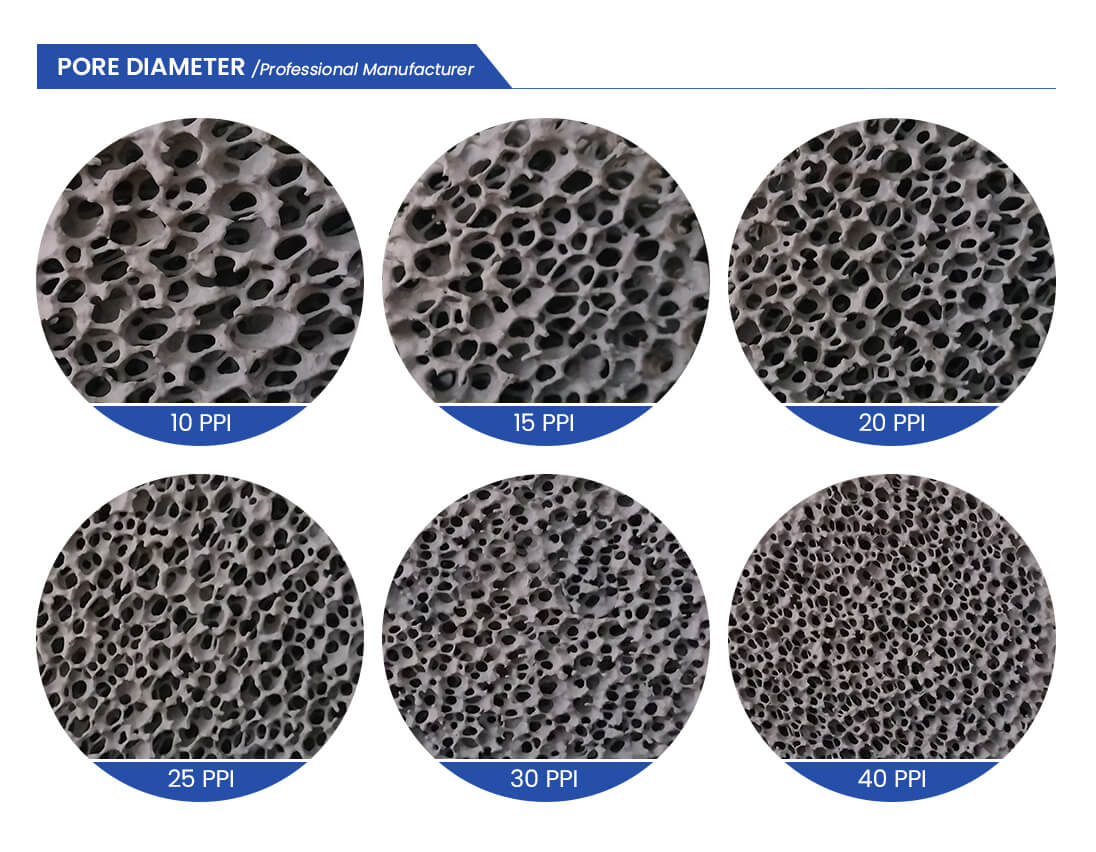
| Recommended PPI | 20–50 PPI | 10–30 PPI | 20–40 PPI for steel |
| Primary Applications | Aluminum, Magnesium, Zinc | Gray iron, Ductile iron, Copper alloys | Steel, Stainless steel, Superalloys |
| Relative Cost | Low | Medium | High-2 |
When to Use Each Material
Alumina (Al₂O₃) – For Non-Ferrous Casting
Alumina filters are the standard choice for aluminum and magnesium casting. They offer excellent resistance to attack and corrosion from molten aluminum while effectively removing inclusions and reducing trapped gas. The pouring temperature range (680–800°C) is well within the filter’s service limit, making them a cost-effective choice without over-specification.
Best for: Automotive wheels, engine blocks, transmission housings, and general aluminum castings.
Limitations: Not suitable for iron or steel casting. Requires proper preheating (typically 300–400°C) to avoid thermal shock.
Silicon Carbide (SiC) – For Iron and Copper
Silicon carbide filters are engineered for cast iron and copper alloys. They offer excellent thermal shock resistance, high-temperature strength, and chemical resistance to molten iron. SiC filters can be used at temperatures up to 1530°C.
SiC filters achieve documented scrap-rate reductions of 30–60% in typical iron and steel foundries, and have been shown to improve surface finish by 15–40% in downstream machining.
Best for: Gray iron, ductile iron, malleable iron, and copper alloy castings.
PPI selection: 10–15 PPI for larger castings and coarse inclusions; 20–30 PPI for general-purpose filtration.
Zirconia (ZrO₂) – For Steel and High-Temperature Alloys
Zirconi filters are the highest-performing ceramic foam filters, designed for steel and superalloy casting. They withstand temperatures up to 1700°C and maintain structural strength during prolonged steel casting.
Key advantages:
-
Thermal shock resistance exceeds 7 cycles under ΔT > 1000°C
-
Filtration efficiency ≥80% for inclusions below 10 μm
-
Non-wetting surface resists slag adhesion
-
Service life verified at >300 hours of cumulative casting operation
Zirconia filters are the best choice for high-quality grades of steel, alloy steel, and stainless steel.

Ceramic Foundry Filter Cost Comparison
Cost varies significantly by material:
-
Alumina — lowest cost, ideal for high-volume aluminum casting
-
Silicon Carbide — mid-range cost, excellent value for iron applications
-
Zirconia — highest cost, justified for critical steel castings
Selection should be based on total cost of ownership, not just filter price. A more expensive zirconia filter that reduces scrap by 5% may be more economical than a cheaper alternative–. For context, typical wholesale pricing ranges from approximately 0.80–3.20 for SiC filters up to several dollars for larger zirconia filters, depending on specifications and order quantities–.
Selection Guide by Alloy
| Your Alloy | Recommended Material | Why |
|---|---|---|
| Aluminum, Magnesium | Alumina | Perfect temperature match, cost-effective |
| Zinc | Alumina | Low-temperature application |
| Gray Iron | Silicon Carbide | Excellent thermal shock, high-temperature strength |
| Ductile Iron (S.G. Iron) | Silicon Carbide | Traps dross, handles nodularization reactions |
| Malleable Iron | Silicon Carbide | General-purpose iron filtration |
| Copper & Bronze | Silicon Carbide | Temperature range suitable |
| Carbon Steel | Zirconia | Withstands 1550–1650°C pours |
| Stainless Steel | Zirconia | Chemical stability, no contamination |
| Superalloys | Zirconia | Highest temperature requirement |
| Aluminum (high-purity, electronics) | Higher-purity Alumina | Standard grade may not be sufficient |
Common Mistakes to Avoid
-
Using alumina for iron or steel — the filter will soften or fail. Temperature exceeds limit.
-
Using silicon carbide for steel — while it can survive, zirconia offers better performance for critical applications.
-
Using zirconia for aluminum — it works, but you’re paying extra for capabilities you don’t need.
-
Skipping preheating — all materials require preheating to prevent thermal shock, especially for iron and steel.
-
Ignoring PPI — material selection is only half the choice; pore size must also match your inclusion type.
Conclusion
Three materials, three distinct applications:
| If you cast… | Choose… |
|---|---|
| Aluminum, Magnesium | Alumina – cost-effective, reliable |
| Iron, Copper | Silicon Carbide – high strength, excellent thermal shock |
| Steel, Superalloys | Zirconia – highest temperature resistance, best filtration efficiency |
When in doubt, ask your supplier: “What alloy are you casting?” is the first and most important question. The answer determines everything else.
Need a filter recommendation for your specific casting? Send us your alloy and casting details – we’ll help you choose the right material.
Email: info@sf-foundry.com
Tech support: 8618636913699
