


If you cast aluminum, you’ve probably worked with both A356 and A380. They’re two of the most common aluminum casting alloys—but they’re not interchangeable. A356 is your go-to for structural components that need heat treatment and good corrosion resistance. A380 is the workhorse of high‑pressure die casting, prized for its fluidity and castability.
Different alloys, different processes, different inclusion problems—and different filtration needs.
Quick Comparison – A356 vs. A380 at a Glance
| Feature | A356 | A380 |
|---|---|---|
| Alloy type | Al‑Si‑Mg (aluminum‑silicon‑magnesium) | Al‑Si‑Cu (aluminum‑silicon‑copper) |
| Silicon content | ~6.5‑7.5% | ~7.5‑9.5% |
| Copper content | Very low (<0.2%) | ~3‑4% |
| Magnesium content | ~0.25‑0.45% | Very low |
| Typical casting process | Sand casting, permanent mold, LPDC | High‑pressure die casting (HPDC) |
| Heat treatable? | Yes (T5, T6) | Usually not (risk of blistering) |
| Corrosion resistance | Excellent | Fair |
| Ductility | Good | Moderate |
| Fluidity | Good | Excellent |
| Typical applications | Wheels, structural parts, aerospace components | Transmission cases, housings, electronic enclosures |
A356 and A380 are both Al‑Si alloys, which are the most widely used group for casting because silicon improves fluidity, reduces shrinkage, and enhances castability–. But the differences in copper and magnesium content change everything—including how you filter them.
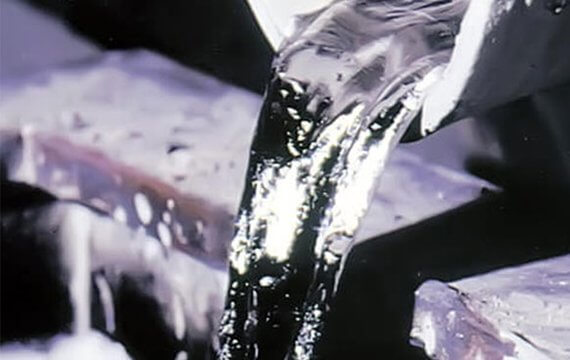
What Inclusions Are You Dealing With?
A356 – Oxide Films Are the Real Problem
A356 is typically cast in sand molds, permanent molds, or low‑pressure die casting (LPDC). These processes use gating systems with runners, which means you can place a filter directly in the runner. But A356 is sensitive to oxide films (bifilms) because of its magnesium content.
When A356 is poured, the magnesium reacts with oxygen to form magnesium oxide and spinel (MgAl₂O₄). These oxide films are thin, brittle, and act as internal cracks. They reduce mechanical properties—especially ductility and fatigue life—and are the primary reason A356 castings fail to meet quality standards.
A356 melts must possess optimum melt cleanliness, particularly because inclusions can be harmful to the alloy’s properties–. Research has shown that using ceramic foam filters in direct‑pour mode significantly improves the Weibull modulus of tensile properties of A356 castings–. In other words, filtration directly translates to more reliable mechanical performance.
Key point: For A356, your filter needs to be good at capturing fine oxide films. That means finer PPI and proper placement in the runner.
A380 – Dross, Slag, and Oxide Particles
A380 is almost always cast in high‑pressure die casting (HPDC). The injection speed is high (30‑60 m/s), and the metal fills the die in milliseconds. There’s no runner system to place a filter in—filtration must happen before the metal enters the shot sleeve, typically in the launder.
Because A380 contains copper (3‑4%), it’s more prone to dross formation. The copper‑rich phases can oxidize and create inclusions that are hard to remove. A380 also has excellent fluidity, which means it fills thin sections well—but that same fluidity can carry fine oxide particles into the casting if they’re not filtered out.
Key point: For A380, the challenge is capturing dross and oxide particles in the launder before they reach the shot sleeve, without restricting flow.
How to Choose the Right Filter
Step 1 – Choose the Right Material
Both A356 and A380 are aluminum alloys, so the filter material is the same: alumina (Al₂O₃). Alumina is chemically stable in aluminum melts, won’t contaminate the alloy, and handles the temperature range (680‑750°C) easily.
Don’t use: Silicon carbide or zirconia filters for aluminum. They work, but you’re paying for temperature resistance you don’t need.
Step 2 – Choose the Right PPI
This is where A356 and A380 diverge.
| Alloy | Recommended PPI | Why |
|---|---|---|
| A356 (sand/permanent mold/LPDC) | 20‑30 PPI | Finer pores capture thin oxide films before they reach the casting |
| A380 (HPDC – launder filtration) | 10‑20 PPI | Coarser pores maintain high flow rate while catching large dross and slag |
For A356, 20‑30 PPI is typical. Research on A356 alloy has used standard 30 PPI ceramic foam filters for laboratory‑scale continuous filtration tests–. For high‑integrity A356 castings, 30 PPI is often the sweet spot—fine enough to capture oxide films, but not so fine that it restricts flow.
For A380 in HPDC, the filter sits in the launder, and you need to maintain flow. 10‑20 PPI is more appropriate—coarse enough to keep metal moving, but still effective at removing large dross and oxide particles.
Step 3 – Choose the Right Placement
For A356 (sand/permanent mold/LPDC): Place the filter in the runner, as close to the casting cavity as possible. This minimizes reoxidation after filtration. A horizontal placement with proper sealing (ceramic fiber gasket or refractory paste) is the standard approach.
For A380 (HPDC): The filter must be placed in the launder between the holding furnace and the shot sleeve. There’s no runner to put it in. Use a filter box or filter seat in the launder, and ensure it’s sealed to prevent bypass.
Step 4 – Consider Your Quality Requirements
| If you need… | For A356… | For A380… |
|---|---|---|
| Maximum mechanical properties | 30 PPI, close to cavity | Not applicable (HPDC parts aren’t heat‑treated) |
| High production speed | 20 PPI (faster flow) | 10‑15 PPI (maintain launder flow) |
| Pressure‑tight castings | 30 PPI | 15‑20 PPI (depending on part) |
| Cost‑sensitive application | 20 PPI | 10‑15 PPI (larger pores = lower cost) |
The Role of Heat Treatment
This is where A356 and A380 are fundamentally different—and it affects your filtration choices.
A356 is heat‑treatable (T5, T6). Heat treatment improves mechanical properties but also reveals defects that were hidden in the as‑cast state. If oxide films are present, they can cause blistering, reduced ductility, or premature failure. That’s why filtration for A356 is about preventing defects that will show up after heat treatment.
A380 is typically not heat‑treated. The copper content and the gas porosity inherent in HPDC make heat treatment risky—trapped gas expands and causes surface blistering. Since A380 parts aren’t heat‑treated, the filtration goal is simpler: remove visible inclusions and dross that would cause machining or surface issues.
Common Mistakes
Using the same filter for both alloys. A 30 PPI filter that works beautifully for A356 will clog the launder in an A380 HPDC line. A 10 PPI filter that keeps the launder flowing will let fine oxide films pass into an A356 casting.
Placing the filter in the wrong spot. For A356, a filter under the sprue will clog from turbulence. For A380, a filter that’s not sealed in the launder will let metal bypass—zero filtration.
Skipping preheat. Cold alumina filters crack when hit by hot metal. Preheat to 300‑400°C for both alloys.
Assuming filtration replaces degassing. Filtration removes solid inclusions—not dissolved hydrogen. Both A356 and A380 need proper degassing regardless of filtration.
Quick Decision Guide
| If you’re casting… | Choose… |
|---|---|
| A356 in sand/permanent mold/LPDC | Alumina foam filter, 20‑30 PPI, placed in the runner close to the cavity |
| A380 in HPDC | Alumina foam filter, 10‑20 PPI, placed in the launder before the shot sleeve |
| A356 with high‑integrity requirements | 30 PPI, with larger filter area to maintain flow |
| A380 with high production speed | 10‑15 PPI, focus on sealing to prevent bypass |
| Both alloys in the same foundry | Stock both PPI grades – don’t try to use one for everything |
Conclusion
A356 and A380 are both aluminum alloys, but they demand different filtration approaches.
-
A356 is heat‑treatable and sensitive to oxide films. Use a 20‑30 PPI alumina foam filter in the runner, close to the casting, to capture fine oxides before they become defects.
-
A380 is a high‑pressure die casting alloy. Use a 10‑20 PPI alumina foam filter in the launder to remove dross and large particles without restricting flow.
The right filter—matched to your alloy and process—reduces scrap, improves mechanical properties, and lowers total cost.
At SF-Foundry, we manufacture alumina ceramic foam filters for both A356 and A380 applications. Available in 10, 20, and 30 PPI, in standard and custom sizes.
Need help selecting the right filter for your specific alloy and casting process? Contact us for a recommendation.
Contact SF-Foundry Technical Support:
Email: info@sf-foundry.com
Phone / WhatsApp: +86 18636913699
Website: www.sf-foundry.com