


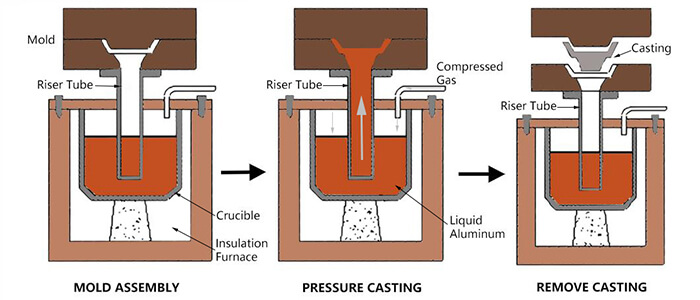
A riser tube, also called a lift tube or stalk tube, is a critical component in low pressure die casting (LPDC). It connects the molten aluminum holding furnace to the die and provides a controlled path for molten metal during the casting cycle.
Because the riser tube is repeatedly exposed to molten aluminum, pressure changes, and thermal cycling, choosing the correct material and specification is important for stable production.
So, how do you choose the right riser tube for a low pressure die casting system?
The answer depends on the casting process, molten aluminum temperature, tube dimensions, thermal cycling conditions, and required service life.
1. Confirm the Casting Process
The first step is to confirm that the riser tube is being used for low pressure die casting.
In an LPDC system, compressed gas is applied to the surface of molten aluminum in a sealed holding furnace. The pressure pushes the aluminum upward through the riser tube and into the die cavity.

This means the riser tube must withstand:
- Continuous contact with molten aluminum
- Repeated heating and cooling
- Internal molten-metal flow
- Pressure changes during each casting cycle
- Mechanical stress during installation and operation
The riser tube therefore needs both thermal shock resistance and sufficient mechanical strength.
2. Choose the Appropriate Riser Tube Material
Common ceramic materials used for aluminum casting riser tubes include:
- Aluminum titanate
- Silicon nitride
Both materials can be used in demanding aluminum casting environments, but their properties and application requirements are different.
Aluminum Titanate Riser Tubes
Aluminum titanate has a very low coefficient of thermal expansion and excellent thermal shock resistance.
It is widely used in LPDC applications where the riser tube experiences frequent thermal cycling.
SF-Foundry aluminum titanate riser tubes are designed for molten aluminum delivery in low pressure casting systems.
Silicon Nitride Riser Tubes
Silicon nitride provides a combination of high mechanical strength, thermal shock resistance, chemical stability, and resistance to molten aluminum.
SF-Foundry silicon nitride riser tubes are designed for demanding LPDC applications where dimensional stability and long service life are important.

3. Check the Riser Tube Dimensions
The riser tube must match the existing low pressure casting equipment.
Important dimensions include:
- Overall length
- Outside diameter
- Inside diameter
- Wall thickness
- Connection dimensions
- Mounting dimensions
The internal diameter is particularly important because it directly affects the molten aluminum flow path.
A replacement tube should not be selected based only on outside diameter.
If you are replacing an existing riser tube, provide a drawing or photograph together with the main dimensions.
4. Consider Molten Aluminum Temperature
The operating temperature of the molten aluminum affects the service conditions of the riser tube.
The selected material should maintain its structural integrity during repeated exposure to the actual operating temperature.
In addition to maximum temperature, consider:
- Normal operating temperature
- Heating and cooling rate
- Number of casting cycles
- Holding furnace conditions
- Thermal gradients along the tube
The actual operating conditions should be provided when discussing a customized riser tube.
5. Consider Thermal Shock
Thermal shock is one of the most important factors in riser tube selection.
During operation, a riser tube experiences repeated temperature changes as it moves between different thermal conditions.
If the material cannot tolerate these changes, cracking may occur.
A suitable riser tube should therefore have:
- Low thermal expansion
- Good thermal shock resistance
- Stable mechanical properties at high temperature
- Resistance to repeated thermal cycling
This is one reason advanced ceramic materials are widely used for LPDC riser tubes.
6. Check Resistance to Molten Aluminum
The riser tube is in direct contact with molten aluminum.
Material compatibility is therefore important.
A suitable riser tube should resist:
- Aluminum corrosion
- Chemical attack
- Erosion
- Metal adhesion
- Surface degradation
Excessive aluminum buildup inside the tube can reduce the effective flow area and affect casting stability.
For this reason, both material selection and surface condition should be considered.
7. Consider the Required Service Life
The service life of a riser tube depends on more than material alone.
Important factors include:
- Casting cycle frequency
- Molten aluminum temperature
- Thermal cycling
- Tube dimensions
- Furnace conditions
- Installation method
- Mechanical stress
- Cleaning and maintenance
If a riser tube fails prematurely, the resulting downtime and replacement work can be more costly than the initial tube price.
For high-volume LPDC production, service life should therefore be considered together with purchase price.
8. Check Compatibility With the Existing Equipment
Before ordering a replacement riser tube, confirm that it is compatible with the existing LPDC system.
Useful information includes:
- Casting machine model
- Furnace model
- Riser tube dimensions
- Mounting method
- Tube connection
- Molten aluminum temperature
- Existing tube material
- Current service life
A drawing or photo of the existing installation can help the supplier evaluate compatibility.
9. Aluminum Titanate vs. Silicon Nitride Riser Tubes
Both materials can be used in LPDC aluminum casting, but their material characteristics are different.
| Property | Aluminum Titanate | Silicon Nitride |
|---|---|---|
| Thermal shock resistance | Excellent | Excellent |
| Thermal expansion | Very low | Low |
| Mechanical strength | Moderate | High |
| Molten aluminum compatibility | Good | Excellent |
| Typical LPDC application | Riser tubes | Riser tubes and demanding components |
| Customization | Available | Available |
The correct material should be selected according to the actual operating conditions rather than simply choosing the material with the highest individual property.
10. What Information Should You Send to a Riser Tube Supplier?
If you need a quotation, provide as much of the following information as possible:
- Riser tube material
- Overall length
- Outside diameter
- Inside diameter
- Wall thickness
- LPDC machine model
- Holding furnace model
- Molten aluminum temperature
- Casting alloy
- Casting cycle
- Required quantity
A drawing or photograph of the existing riser tube is highly recommended.
If you do not know the material, send the existing tube photo and dimensions instead.
11. Can Riser Tubes Be Customized?
Yes.
LPDC systems can use different tube dimensions and mounting configurations, so standard specifications may not always fit an existing machine.
Customized riser tubes can be evaluated according to:
- Length
- Internal diameter
- External diameter
- Wall thickness
- Connection structure
- Material
- Installation requirements
When requesting a customized riser tube, a technical drawing is the best way to communicate the required dimensions.
12. SF-Foundry Riser Tubes for Low Pressure Die Casting
SF-Foundry supplies ceramic riser tubes for aluminum low pressure die casting.
Available material options include:
- Aluminum titanate
- Silicon nitride
Our riser tubes are designed for applications where thermal shock resistance, molten aluminum compatibility, dimensional stability, and service life are important.
Typical applications include:
- Aluminum alloy wheel casting
- Automotive aluminum components
- Structural aluminum castings
- Low pressure die casting systems
- Other aluminum casting applications
For a suitable specification, provide your existing riser tube dimensions, LPDC equipment information, and operating conditions.
Riser Tube Selection Checklist
Before ordering a riser tube, confirm:
☐ LPDC process
☐ Tube length
☐ Inside diameter
☐ Outside diameter
☐ Wall thickness
☐ Riser tube material
☐ Molten aluminum temperature
☐ Casting alloy
☐ Casting cycle
☐ Furnace or machine model
☐ Required quantity
☐ Existing tube photo or drawing
Need a Riser Tube for Your LPDC System?
If you are replacing an existing riser tube, you do not need to determine every specification yourself.
Send SF-Foundry:
Existing Riser Tube Dimensions + Material + LPDC Machine Model + Quantity
A photo or drawing of the current tube is also helpful.
SF-Foundry can evaluate the application and provide a suitable aluminum titanate or silicon nitride riser tube for your low pressure die casting system.