


The automotive industry is one of the largest and fastest-growing consumers of investment castings globally. With the global investment casting market projected to grow from USD 8.26 billion in 2024 to USD 12.29 billion by 2032 at a CAGR of 5.10%, and the automotive sector producing over 95 million vehicles annually, the demand for high-quality precision cast components has never been greater.
Yet producing defect-free automotive investment castings at scale remains a significant challenge. Engine components, turbocharger housings, exhaust manifolds, structural parts, and valve train components all demand exceptional dimensional accuracy, mechanical strength, and surface finish. One of the most effective—yet often overlooked—tools for achieving these quality standards is the ceramic pouring cup.
The Quality Challenges in Automotive Investment Casting
Automotive investment castings face a unique set of quality challenges:
Complex geometries – Turbocharger wheels, exhaust manifolds, and engine brackets often feature thin walls, intricate internal passages, and tight tolerances that make them highly sensitive to filling defects.
Demanding alloys – Heat-resistant steels, nickel-based alloys, and aluminum alloys used in automotive applications have specific fluidity and solidification characteristics that must be carefully managed.
High-volume production – Automotive foundries operate at scale, where even a small percentage of defects translates into significant scrap costs and delivery delays.
Stringent cleanliness requirements – Inclusions, porosity, and surface defects can compromise the fatigue life and performance of critical automotive components.
The most common defects in automotive investment castings include inclusions (slag, dross, and ceramic particles), porosity (gas porosity and shrinkage porosity), misruns (incomplete filling), and surface defects (roughness and cold shuts). Many of these defects originate at the very beginning of the casting process—during the transfer of molten metal from the ladle into the mold.
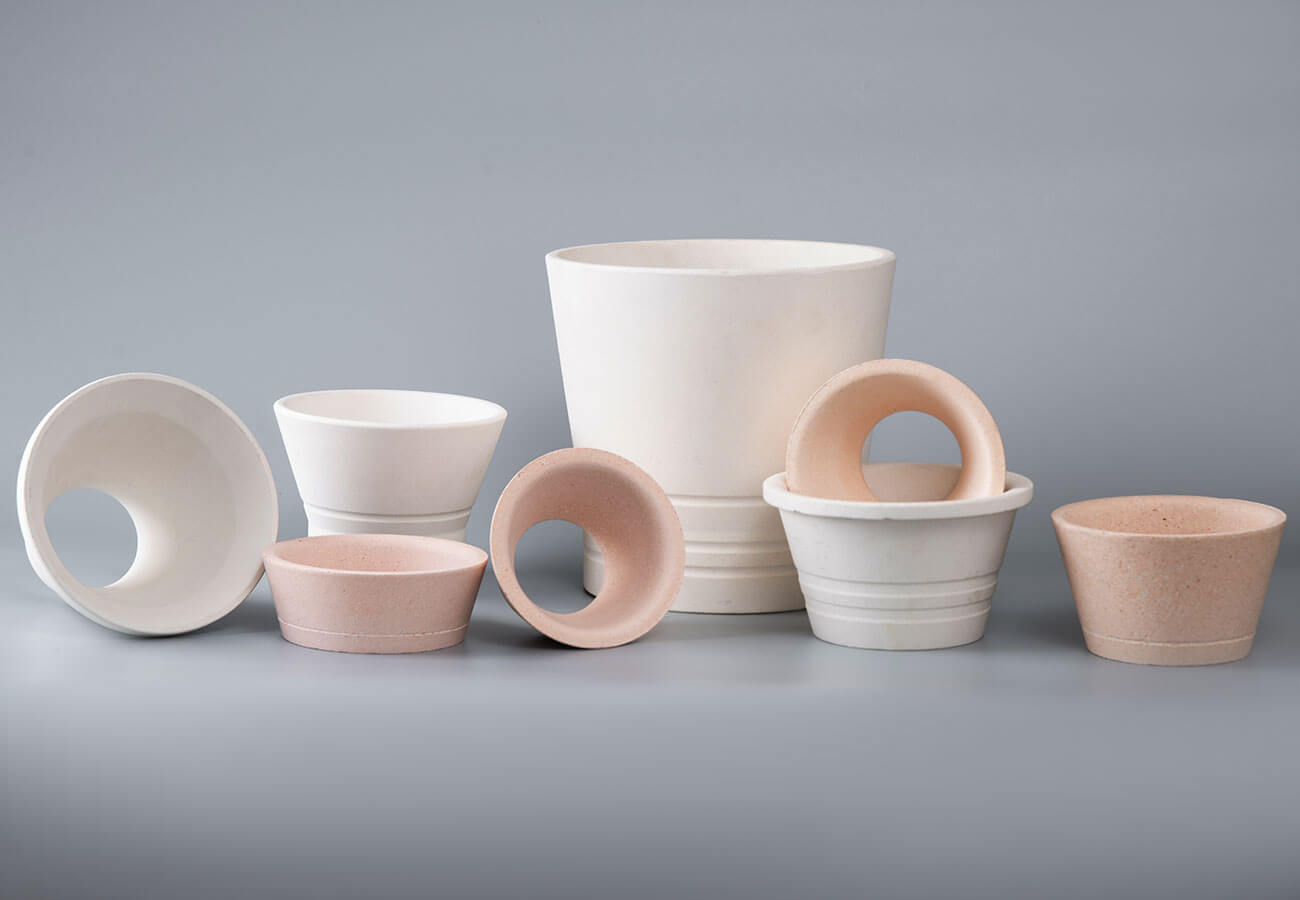
How Ceramic Pouring Cups Address These Challenges
Ceramic pouring cups serve as the critical interface between the pouring ladle and the ceramic shell mold. Their design and material properties directly influence the quality of the final casting in several key ways:
1. Controlled Metal Flow and Reduced Turbulence
When molten metal is poured directly into a mold without a proper pouring cup, it can splatter, create turbulence, and entrain air. This turbulence leads to:
-
Gas porosity – Air bubbles trapped in the molten metal become gas pores in the final casting
-
Oxide film formation – Turbulent flow breaks the surface oxide layer, creating new oxides that become inclusions
-
Mold erosion – High-velocity metal streams can erode the ceramic shell, introducing ceramic particles into the casting
Ceramic pouring cups are engineered with smooth internal surfaces that minimize erosion, improve metal flow, and ensure consistent cavity filling. Their optimized geometries are designed for controlled filling and improved directional flow. By channeling the molten metal smoothly into the gating system, pouring cups reduce splashing and turbulence, promoting laminar flow rather than turbulent flow.
As one industry expert notes: “Pouring cups combined with the use of reticulated ceramic filter ensures the metal is clean and enters the casting cavity in a smooth and controlled manner”.
2. Slag and Inclusion Removal
One of the primary functions of a ceramic pouring cup is to skim slag and trap inclusions before they enter the mold cavity. When molten metal is poured from a ladle, it inevitably carries surface oxides, refractory particles, and other contaminants. Without proper skimming, these inclusions become embedded in the casting, compromising mechanical properties and surface finish.
High-quality ceramic pouring cups are manufactured from high-purity ceramic formulations that reduce contamination and prevent ceramic inclusions in the final casting. The smooth, impurity-free working surface of the cup resists slag corrosion and prevents the release of particles into the metal stream.
Many pouring cups are also designed with integrated fitment positions for ceramic foam filters. These filter-compatible designs support cleaner metal flow into the mold cavity, intercepting oxides and inclusions that would otherwise reach the casting. The combination of a pouring cup with a ceramic filter ensures that the metal entering the casting cavity is as clean as possible.

3. Shell Protection and Impact Resistance
The ceramic pouring cup is installed at the top of the wax runner and becomes an integral part of the mold shell. This integration provides critical protection for the shell during pouring.
Without a pouring cup, the high-velocity stream of molten metal would impact directly on the fragile ceramic shell at the sprue entrance. This can cause:
-
Shell cracking – Thermal shock and mechanical impact can crack the shell, allowing metal to penetrate or causing shell fragments to break off
-
Slag inclusion – Cracks in the shell introduce ceramic debris into the molten metal
-
Misruns – A damaged sprue entrance can restrict metal flow, leading to incomplete filling
Ceramic pouring cups improve the impact resistance of the sprue cup against molten metal and avoid the slag inclusion phenomenon in castings caused by shell rupture. Their high mechanical strength allows them to withstand handling, firing, and molten metal impact without cracking.
4. Thermal Management and Consistent Filling
Automotive investment castings are poured at temperatures ranging from approximately 660°C for aluminum alloys to over 1,600°C for heat-resistant steels and superalloys. The pouring cup must maintain its structural integrity across this wide temperature range.
Ceramic pouring cups exhibit excellent resistance to thermal shock and sudden temperature changes. They withstand rapid temperature changes during pouring and preheat without cracking. This thermal stability ensures that the cup maintains its geometry throughout the pour, providing consistent metal flow from start to finish.
The high-temperature stability of ceramic pouring cups also means they do not react with molten metal. Chemical reactions between the cup material and the alloy can introduce contaminants that alter the alloy’s composition and compromise casting properties. High-purity and high-alumina grades are specifically suited to the most aggressive alloy chemistries.
5. Improved Casting Yield
Beyond quality improvement, ceramic pouring cups also contribute to improved casting yield—the ratio of finished casting weight to total metal poured.
Traditional gating systems with runners and gates consume significant amounts of metal that must be cut off and remelted. By implementing a direct pour system with pouring cups, foundries can eliminate gates and runner systems, reducing metal consumption. This not only lowers material costs but also reduces the energy and labor required for cutting and remelting.
As one foundry expert explains: “When improving casting yields and casting cleanliness, direct pouring cups become extremely useful”. The combination of pouring cups with filters and breaker cores gives foundries “the best chance to achieve the productivity and product quality results you seek”.
Material Considerations for Automotive Applications
Ceramic pouring cups for automotive investment castings are typically manufactured from high-alumina silicate compositions with refractoriness up to 1,650°C. Key material properties include:
| Property | Typical Value |
|---|---|
| Material | High Alumina Silicate |
| Operating Temperature | 1,650°C |
| Flexural Strength (Room Temp.) | >10 MPa |
| Coefficient of Thermal Expansion | 8–9 × 10⁻⁶/K |
| Applications | High Temperature Alloy, Stainless Steel |
These materials deliver consistent performance across ferrous, nickel, aluminum, and bronze-based alloy systems, making them suitable for the diverse range of alloys used in automotive investment casting—from aluminum engine components to heat-resistant steel exhaust manifolds.
Key advantages of high-quality ceramic pouring cups for automotive applications include:
-
Smooth surface finish – Erosion-resistant, reduces inclusions
-
High strength – Structural stability during the pour
-
High thermal shock resistance – Withstands rapid temperature changes
-
Chemical stability – No reaction with molten metal at high temperatures
Common Automotive Components That Benefit
Ceramic pouring cups are widely used in the production of precision castings for the automotive industry. Specific components that benefit from improved pouring cup quality include:
-
Turbocharger housings and wheels – Complex geometries requiring clean, controlled filling to avoid porosity and inclusions
-
Exhaust manifolds – Heat-resistant steel castings prone to shrinkage porosity and slag defects
-
Engine blocks and cylinder heads – High-integrity aluminum castings demanding exceptional cleanliness
-
Valve train components – Small, precision parts where surface finish and dimensional accuracy are critical
-
Structural chassis components – Load-bearing parts requiring high mechanical integrity
-
Transmission components – Parts subject to cyclic loading where inclusions can initiate fatigue failure
Conclusion
Ceramic pouring cups are far more than simple funnel-shaped components. They are critical enablers of casting quality in automotive investment casting, addressing the root causes of many common defects.
By promoting controlled, laminar metal flow, ceramic pouring cups reduce turbulence and gas entrapment. Their smooth, high-purity surfaces minimize erosion and prevent ceramic contamination. Their thermal stability ensures consistent performance across a wide range of alloys and pouring temperatures. And their integration with ceramic filters provides an additional layer of protection against inclusions.
For automotive foundries seeking to improve casting quality, reduce rejection rates, and increase yield, investing in high-quality ceramic pouring cups is one of the most effective—and easiest to implement—process improvements available.
When molten metal meets the mold, the journey begins at the pouring cup. Making that first point of contact as clean, controlled, and reliable as possible sets the foundation for a defect-free casting—and that is the difference between scrap and success in today’s competitive automotive market.