


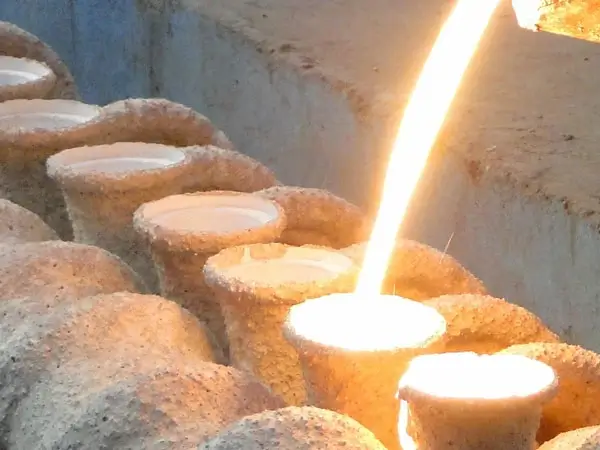
The aerospace industry demands the highest levels of quality, precision, and reliability from every component. Turbine blades, engine components, structural parts—each must meet exacting standards for dimensional accuracy, mechanical strength, heat resistance, and surface finish. In investment casting, the ceramic pouring cup—the first point of contact between molten metal and the gating system—plays a decisive role in determining whether a casting meets these standards.
Why Aerospace Casting Is Different
Aerospace investment casting operates under conditions far more demanding than general industrial casting. The stakes are higher, the alloys are more challenging, and the tolerances are tighter.
Extreme Alloy Temperatures
Aerospace castings typically use high-melting-point alloys such as nickel-based superalloys (e.g., Inconel, René, CMSX series) and cobalt-based alloys (e.g., Haynes, Stellite). During pouring, molten metal temperatures can exceed 1,500°C. The pouring cup must maintain structural integrity at these extreme temperatures without softening, cracking, or reacting chemically with the molten metal.
Stringent Quality Requirements
Aerospace castings require:
-
Precise dimensions with tight tolerances
-
High mechanical strength to withstand operational stresses
-
Excellent heat resistance for high-temperature service environments
-
Superior surface finish to meet aerodynamic and fatigue requirements
Any defect—inclusion, porosity, misrun, or chemical contamination—can render a component unusable. In critical applications like turbine blades, the cost of failure is measured not in dollars but in safety.
Thin-Walled, Complex Geometries
Aerospace components often feature thin walls, intricate internal cooling passages, and complex external contours. These geometries are highly sensitive to flow turbulence, re-oxidation, and inclusions during filling. The pouring cup must deliver molten metal smoothly and consistently to avoid defects that would compromise these delicate features.
Shell Strength and Stability
The ceramic shell used in aerospace investment casting must be exceptionally strong and stable. Any shell breakage at the sprue entrance introduces inclusions directly into the casting. The pouring cup must integrate seamlessly with the shell to provide a stable impact zone for the molten metal stream.
Core Technical Requirements for Aerospace Pouring Cups
Based on the extreme demands of aerospace casting, a ceramic pouring cup must meet five essential technical requirements.
Excellent High-Temperature Resistance
The pouring cup must withstand pouring temperatures exceeding 1,500°C without softening, deformation, or structural failure. For most aerospace applications, a maximum service temperature of 1,650°C is the industry standard.
This requires materials with high refractoriness—the ability to maintain mechanical properties at elevated temperatures. High-alumina silicate and mullite-based compositions are the proven solutions, offering refractoriness up to 1,650°C.
Superior Thermal Shock Resistance
During pouring, the cup experiences rapid heating as it contacts molten metal, followed by rapid cooling during solidification. This thermal cycling creates significant internal stresses. Materials with low coefficients of thermal expansion are less prone to cracking under these conditions.
The coefficient of thermal expansion for high-alumina silicate aerospace-grade pouring cups typically ranges from 8–9 × 10⁻⁶/K. Combined with good thermal shock resistance, this ensures the cup can withstand repeated preheat–pour cycles without premature failure.
Strong Chemical Stability (Inertness)
Aerospace alloys have complex chemical compositions and are highly reactive in the molten state. The pouring cup material must remain chemically inert to avoid:
-
Contaminating the molten metal
-
Causing inclusion defects
-
Altering the alloy’s chemical composition
-
Compromising the casting’s physical properties
Mullite and high-alumina silicate compositions are designed to show no reaction with molten metal at high temperatures. They are chemically compatible with typical silica and alumina-based investment shell systems, minimizing reaction at the metal–mold interface.
High Mechanical Strength
Molten metal impacts the pouring cup surface at high velocity during pouring. The cup must have sufficient mechanical strength to withstand this impact and the stresses of high-temperature, high-pressure conditions.
Aerospace-grade pouring cups typically demonstrate flexural strength at room temperature exceeding 10 MPa. This ensures structural stability during the pour and resistance to erosion from the metal stream.
Filtration and Impurity Control
To achieve the purity required for aerospace castings, ceramic pouring cups for aerospace applications are often integrated with filtering functions. These integrated filters effectively intercept:
-
Inclusions
-
Oxides
-
Other impurities in the molten metal
This ensures the purity and structural integrity of the casting. Filter cups—ceramic pouring cups with built-in filter elements—are the most common investment casting filtration solution.
Material Solutions for Aerospace Pouring Cups
High-Alumina Silicate: The Aerospace Standard
High-alumina silicate is the most widely used material for aerospace pouring cups. Its composition—typically alumina (Al₂O₃) combined with silica (SiO₂)—provides an optimal balance of properties for demanding aerospace applications.
Typical Specifications:
| Property | Value |
|---|---|
| Material | High-Alumina Silicate (Al₂O₃–SiO₂) |
| Maximum Operating Temperature | 1,650°C |
| Flexural Strength (Room Temp.) | > 10 MPa |
| Coefficient of Thermal Expansion | 8–9 × 10⁻⁶/K |
| Applications | High-Temperature Alloy, Stainless Steel |
High-alumina silicate cups combine refractoriness up to 1,650°C with good thermal shock resistance, enabling repeated preheat–pour cycles without premature cracking.
Key Benefits for Aerospace:
-
Stable geometry in the shell – The rigid body bonds well to the ceramic shell, providing a stable impact zone and lowering the chance of shell breakage
-
Controlled flow and fewer inclusions – The smooth inner surface and optimized profile reduce re-oxidation, air entrainment, and slag roll-in
-
Compatibility with investment molds – Chemically compatible with silica and alumina-based shell systems
-
Adaptability to multiple alloys – Supports ferrous, nickel-aluminum, bronze-based, and selected superalloy systems
High-Purity Alumina: For the Most Demanding Applications
For the most demanding aerospace and superalloy applications, high-purity alumina is the material of choice. High-purity alumina materials provide:
-
Exceptional thermal shock resistance – Critical for rapid thermal cycling
-
Superior durability – Reliable performance with superalloys and other critical metals
-
Higher refractoriness – Withstands even more extreme temperatures
SF-Foundry’s high-purity alumina pouring cups have been deployed to support production of high-integrity components for the aerospace and automotive sectors.
Mullite: Proven Performance
Mullite (3Al₂O₃·2SiO₂) compositions have been tested and qualified by aerospace sector foundries for over 50 years. Mullite pouring cups offer:
-
Good thermal shock resistance
-
Ultra-smooth surface finish
-
Higher mold process temperature capability for DS and SX (directional solidification and single crystal) processes (with customer verification/qualification)
-
Proven reliability across a range of aerospace alloys
Fused Silica: For Large Cups and SC/DS Applications
Fused silica cups are preferred for larger geometries, where differences in thermal expansion between the cup and mold must be minimized to prevent cracking or separation. Specialized fused silica formulations are also available for single crystal (SC) and directional solidification (DS) casting processes.
Design Considerations for Aerospace Pouring Cups
The complexity and high precision requirements of aerospace castings demand highly specialized pouring cup design.
Shape Optimization
-
Streamline design – The inner surface shape must be optimized to reduce turbulence, ensure smooth flow into the mold, and avoid bubble or inclusion formation
-
Buffer structure – A buffer zone at the bottom of the cup reduces molten metal flow rate and protects the mold surface from impact
Size and Capacity
The cup capacity must be large enough to accommodate the required metal volume for one pour and provide space for gas discharge. Industry practice recommends capacity exceeding the required metal volume by 20–30% to ensure complete filling.
The cup must match the sprue size to avoid flow restrictions–. Standard sizes are available, but custom geometries are often required for specific gating systems.
Integration with Filtering Devices
Ceramic filters are typically integrated into aerospace pouring cups to intercept impurities and oxides. The filter aperture must be selected based on molten metal characteristics to ensure effective filtration without compromising flow rate.
High Surface Finish
The inner wall of the pouring cup must achieve high finish to reduce friction resistance, minimize turbulence, and avoid secondary oxidation. A smooth surface also reduces erosion and wear during the pour.
Mechanical Keying with the Shell
Pouring cups are placed directly onto the wax gating system before ceramic shell coating, becoming an integral part of the mold structure. Pressed grooves on the cup surface provide a mechanical key, improving adhesion and cohesion between the cup and the shell. The number and depth of these grooves are adjusted according to cup size and geometry.
Isostatic Pressing
High-quality aerospace pouring cups are manufactured using high-pressure isostatic pressing. This process ensures:
-
Consistent density throughout the cup
-
High mechanical strength
-
Uniform material properties
-
Reliable performance in demanding casting conditions
SF-Foundry Solutions for Aerospace Investment Casting
SF-Foundry specializes in designing and manufacturing refractory ceramic products for investment casting, including pouring cups for aerospace applications.
Product Specifications
SF-Foundry’s investment casting pouring cups are made from high-alumina silicate with high refractoriness, fired at high temperature. They can withstand the conditions of high-temperature alloy casting in the aviation industry.
Technical Parameters:
| Parameter | Value |
|---|---|
| Material | High Alumina Silicate |
| Operating Temperature | 1,650°C |
| Flexural Strength (Room Temp.) | > 10 MPa |
| Coefficient of Thermal Expansion | 8–9 × 10⁻⁶/K |
| Application | High-Temperature Alloy, Stainless Steel |
Key Features
-
Smooth surface finish – Erosion-resistant, reduces inclusions
-
High strength – Structural stability during the pour
-
High thermal shock resistance – Withstands rapid temperature changes
-
No reaction with molten metal – Chemical stability at high temperatures
-
Custom sizes – Available to customer specifications
Quality Assurance
SF-Foundry’s pouring cups are manufactured with advanced production equipment under a complete quality management system. The surface is smooth and free of impurities, ensuring no inclusions during use. The cups can be used directly—no slag drop issues affect casting quality during the shell mold baking process.
Industry Proven
SF-Foundry’s pouring cups are widely used in automatic investment casting lines for aerospace manufacturing and automotive investment castings. They improve the impact resistance of the sprue cup and avoid slag inclusion phenomena caused by shell rupture.
Customization available – SF-Foundry can produce pouring cups according to customer requirements.
Conclusion
Aerospace investment casting places extraordinary demands on every component of the gating system, and the ceramic pouring cup is no exception. It must withstand extreme temperatures exceeding 1,500°C, resist thermal shock from rapid heating and cooling, remain chemically inert to reactive superalloys, and deliver molten metal with minimal turbulence and inclusions.
High-alumina silicate and mullite-based materials—with proven performance over decades of aerospace use—provide the optimal balance of refractoriness, thermal shock resistance, chemical stability, and mechanical strength. For the most demanding applications, high-purity alumina offers even greater performance.
With rigorous quality control, advanced isostatic pressing, and a commitment to customization, SF-Foundry’s ceramic pouring cups are engineered to meet the stringent requirements of aerospace investment casting—delivering the reliability and consistency that the industry demands.