


When selecting a honeycomb ceramic filter for foundry use, one of the most critical decisions is the filter material. The two most common material options are cordierite and mullite—both widely used, but with distinct properties that make them suitable for different casting conditions.
Choosing the wrong material can lead to premature filter failure, thermal cracking, or reduced filtration efficiency. Choosing the right material, however, ensures reliable performance, consistent casting quality, and optimal cost-effectiveness.
This guide provides an objective, data-driven comparison of cordierite and mullite honeycomb ceramic filters, helping you understand their strengths, limitations, and ideal application ranges.
What Is Cordierite?
Cordierite is a magnesium aluminum silicate ceramic with the chemical composition 2MgO·2Al₂O₃·5SiO₂. It is valued primarily for its exceptionally low coefficient of thermal expansion, which gives it outstanding resistance to thermal shock.
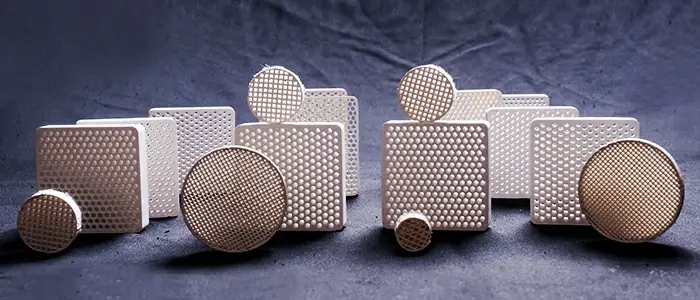
Key properties of cordierite honeycomb filters:
| Property | Typical Value |
|---|---|
| Al₂O₃ content | 32–37% |
| Thermal expansion coefficient (CTE) | ≤1.8 × 10⁻⁶/°C |
| Softening temperature | ~1,390°C |
| Maximum working temperature | 1,350–1,450°C (depending on formulation) |
| Compressive strength | ≥12 MPa |
| Cell diameter | 2–3 mm |
| Wall thickness | 0.3–0.6 mm |
Cordierite‘s extremely low thermal expansion allows it to withstand rapid temperature changes with minimal stress, making it highly resistant to thermal shock cracking—a critical advantage in casting applications where the filter is suddenly exposed to molten metal.
What Is Mullite?
Mullite is an aluminum silicate ceramic with the chemical composition 3Al₂O₃·2SiO₂. It has a significantly higher alumina content than cordierite, which gives it superior high-temperature strength and refractoriness.
Key properties of mullite honeycomb filters:
| Property | Typical Value |
|---|---|
| Al₂O₃ content | 46–60% (depending on grade) |
| Thermal expansion coefficient (CTE) | 4.0–5.5 × 10⁻⁶/°C |
| Softening temperature | ~1,550°C |
| Maximum working temperature | ~1,500°C |
| Compressive strength | ≥15 MPa |
Mullite‘s higher alumina content and higher working temperature make it suitable for more demanding applications, particularly where pouring temperatures exceed 1,450°C or where extended solidification times require maximum refractoriness.
Direct Material Comparison
| Property | Cordierite | Mullite | Advantage |
|---|---|---|---|
| Al₂O₃ content | 32–37% | 46–60% | Mullite |
| Thermal expansion coefficient | ≤1.8 × 10⁻⁶/°C | 4.0–5.5 × 10⁻⁶/°C | Cordierite |
| Softening temperature | ~1,390°C | ~1,550°C | Mullite |
| Maximum working temperature | 1,350–1,450°C | ~1,500°C | Mullite |
| Compressive strength | ≥12 MPa | ≥15 MPa | Mullite |
| Thermal shock resistance | Excellent | Moderate | Cordierite |
| Relative cost | Lower | Higher | Cordierite |
The trade-off is clear: Cordierite offers superior thermal shock resistance due to its much lower thermal expansion. Mullite offers higher temperature capability and greater mechanical strength, but at the cost of higher thermal expansion—which makes it more susceptible to thermal shock cracking if not handled properly.
It is also worth noting that cordierite-mullite composite materials are available, blending the two to achieve a middle ground. These composites typically contain 40–50% Al₂O₃ and have thermal expansion coefficients around 3.0 × 10⁻⁶/°C, offering a balance between thermal shock resistance and high-temperature strength.
Application Ranges
When Cordierite Is Typically Chosen
Cordierite honeycomb filters are generally selected for applications involving lower to medium pouring temperatures where thermal shock resistance is a primary concern.
Typical applications for cordierite filters include:
| Metal | Pouring Temperature Range | Suitability |
|---|---|---|
| Aluminum and aluminum alloys | 680–780°C | Excellent |
| Zinc and zinc alloys | 420–480°C | Excellent |
| Gray iron | 1,350–1,400°C | Good (with appropriate formulation) |
| Ductile iron | 1,380–1,420°C | Good (with appropriate formulation) |
| Malleable iron | 1,350–1,400°C | Good |
| Copper and copper alloys (lower temperature grades) | 1,100–1,200°C | Good |
For iron casting, cordierite-mullite composite formulations are often used to extend the working temperature to 1,450°C while retaining good thermal shock resistance. Pure cordierite may be more limited, but optimized grades are widely used in iron foundries.
When Mullite Is Typically Chosen
Mullite filters are generally preferred for higher-temperature applications or very heavy-section castings where maximum refractoriness and strength are required.
Typical applications for mullite filters include:
| Metal | Pouring Temperature Range | Suitability |
|---|---|---|
| Steel (carbon, alloy, stainless) | 1,550–1,600°C | Required (cordierite cannot handle these temperatures) |
| High-alloy iron | 1,400–1,450°C | Preferred |
| Very large, heavy-section iron castings | 1,380–1,420°C | Often preferred for extended solidification |
| Copper alloys (higher temperature grades) | 1,200–1,300°C | Good |
Mullite is also used in applications where the filter must withstand prolonged exposure to high temperatures during slow solidification, as its higher refractoriness provides an extra margin of safety.
Common Misconceptions
“Cordierite is only for aluminum, not iron.”
Reality: This is not accurate. While cordierite is certainly well-suited for aluminum, cordierite and cordierite-mullite filters are also widely used in gray iron, ductile iron, and malleable iron casting. Their working temperature range (up to 1,450°C for composite grades) covers typical iron pouring temperatures. Many foundries successfully use cordierite-based filters for iron applications.
“Mullite is always better for iron.”
Reality: Mullite has higher temperature capability, but it also has higher thermal expansion, making it more susceptible to thermal shock cracking. For standard iron casting, cordierite‘s superior thermal shock resistance often provides better reliability. Mullite is only necessary when the casting temperature exceeds cordierite’s safe operating range or when very heavy sections demand maximum refractoriness.
“Mullite is stronger, so it‘s more durable.”
Reality: Mullite does have higher compressive strength, but durability in casting is also about thermal shock resistance. A mullite filter with higher strength may still crack if subjected to rapid temperature changes, while a cordierite filter with lower strength may survive intact due to its low thermal expansion. The right choice depends on the dominant failure mode in your application.
Decision Factors
When choosing between cordierite and mullite, consider these key factors:
1. Pouring Temperature
This is the most important factor. If your pouring temperature is below 1,450°C, cordierite (especially cordierite-mullite composites) is a viable option. If temperatures exceed 1,450°C, mullite or even zirconia-mullite should be considered.
2. Thermal Shock Severity
If the filter is subjected to rapid temperature changes (e.g., directly placed in the gating system without extensive preheating), cordierite’s low thermal expansion gives it a distinct advantage. Mullite requires more careful preheating to avoid thermal shock cracking.
3. Casting Section Size
For large, heavy-section castings that solidify slowly, the filter may be exposed to high temperatures for longer periods. In such cases, mullite‘s higher refractoriness provides a safety margin. For thinner sections that solidify quickly, cordierite is usually sufficient.
4. Cost Considerations
Cordierite is generally less expensive than mullite due to its lower alumina content and simpler processing. If both materials can meet your technical requirements, cordierite often offers better cost efficiency.
5. Handling and Installation
Mullite’s higher strength can be advantageous in rough handling conditions, but its lower thermal shock resistance means preheating procedures must be more strictly controlled. Cordierite is more forgiving in thermal shock but requires care to avoid mechanical damage during installation.
Decision Matrix
| Your Application | Pouring Temperature | Recommended Material | Key Reason |
|---|---|---|---|
| Aluminum casting | 680–780°C | Cordierite | Excellent thermal shock; ideal for low temperatures |
| Standard gray iron | 1,350–1,390°C | Cordierite or cordierite-mullite | Sufficient temperature; better thermal shock |
| Standard ductile iron | 1,380–1,420°C | Cordierite-mullite | Good balance of temperature and thermal shock |
| Heavy-section iron | 1,380–1,420°C | Mullite | Extended solidification; higher refractoriness |
| Steel casting | 1,550–1,600°C | Mullite (or zirconia-mullite) | Cordierite cannot handle these temperatures |
| Copper alloys | 1,100–1,300°C | Cordierite or mullite (depending on exact temperature) | Both are viable at mid-range temperatures |
Summary of Key Differences
| Aspect | Cordierite | Mullite |
|---|---|---|
| Best suited for | Aluminum, iron, and mid-temperature alloys | Steel, high-temperature alloys, heavy sections |
| Primary strength | Thermal shock resistance | High-temperature strength |
| Primary weakness | Lower max temperature | Lower thermal shock resistance |
| Preheating requirement | Less critical | More critical |
| Cost | Lower | Higher |
Neither material is universally superior—the right choice depends on your specific pouring temperature, section size, thermal shock conditions, and budget. Cordierite offers excellent thermal shock resistance and cost efficiency for the majority of aluminum and iron casting applications. Mullite provides the high-temperature capability needed for steel and very demanding iron castings, but requires more careful preheating and comes at a higher cost.
By understanding these trade-offs, you can make an informed decision that balances performance, reliability, and cost for your particular foundry operation.