


Non-metallic inclusions are among the most common and damaging defect sources in steel castings. Oxides, slag, refractory particles, and deoxidation products – if not effectively removed – become stress raisers that compromise mechanical properties, surface finish, pressure tightness, and machinability. The filtration choice you make determines whether those inclusions end up in your casting or stay trapped in the gating system.
Three filtration technologies are widely used in foundries: ceramic foam filters, fiberglass mesh filters, and sand filters. However, for steel casting – where pouring temperatures exceed 1550°C and quality demands are severe – not all filters are fit for purpose. This article compares these three options from the perspectives of working principle, thermal resistance, filtration efficiency, flow control, and chemical stability, and explains why zirconia ceramic foam filters are the superior choice for steel applications.
Technical Fundamentals of Each Filter Type
1. Ceramic Foam Filters (CFFs)
Ceramic foam filters are three-dimensional, open-cell reticulated structures with a sponge‑like morphology. They are typically manufactured by impregnating polyurethane foam with a ceramic slurry, followed by drying and high‑temperature firing, during which the organic foam burns out and leaves a rigid ceramic skeleton with interconnected pores. Typical porosity ranges from 80% to 90%.
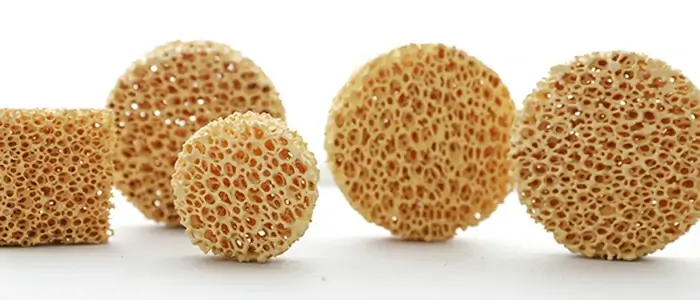
Filtration mechanism: CFFs operate as depth filters. Their filtration action combines three simultaneous mechanisms:
-
Mechanical interception – particles larger than pore openings are physically blocked.
-
Depth filtration – inclusions follow tortuous paths and become trapped deep within the filter structure.
-
Adsorption – fine oxide films adhere to the ceramic surface due to surface energy effects.
Because the molten metal travels through a complex three‑dimensional maze, inclusions are captured throughout the entire thickness of the filter, not merely on its surface. This distinguishes CFFs from simple strainers.
For steel casting, the ceramic material is zirconia (ZrO₂). Key technical parameters for zirconia CFFs include:
-
Maximum service temperature: 1700–1760°C
-
Porosity: 80–90%
-
Pore density (PPI): 10–60 (customizable)
-
Compressive strength: ≥ 1.2 MPa
-
Thermal shock resistance: withstanding 6 air‑cool cycles from 1100°C without cracking
2. Fiberglass Mesh Filters
Fiberglass mesh filters are two‑dimensional woven screens made from high‑silica glass fibre yarns, typically coated with heat‑resistant resins. They act as simple sieves.
Filtration mechanism: Mesh filters work by surface straining – they mechanically intercept only particles larger than the mesh opening. Any inclusion smaller than the opening passes straight through. As one experienced foundry engineer succinctly put it: “To me, mesh is not a filter, it is a strainer.”
Temperature limitations vary significantly by grade:
-
E‑glass (standard) : service temperature 700–800°C, softening point ~900°C
-
High‑silica glass : service temperature ≤1450°C, softening point ~1700°C; some products claim short‑duration exposure up to 1620°C
-
At 1400–1450°C, the maximum holding time is less than 10 minutes
Critical limitations: Mesh filters cannot capture fine oxide films (typically <0.1 mm thick); once the surface becomes blocked, flow stops – they offer no depth filtration capability.

3. Sand Filters
The term “sand filter” in foundry practice refers to either:
-
Granular sand beds placed in the pouring system (e.g., a layer of refractory sand in the sprue cup), through which molten metal passes and where inclusions larger than the interstitial gaps are mechanically trapped.
-
Moulding sand itself acting as a passive barrier in certain runner designs.
Key limitations: Sand filters are usually placed outside the mould cavity, not directly in the gating system – unlike CFFs, which can be installed in‑mould. At steel pouring temperatures (>1550°C), common foundry sands approach or exceed their refractoriness limits – they soften, fuse, and can be eroded into the melt, turning the filter medium into an inclusion source. Additionally, the metal flow through a sand bed can become turbulent and prone to channelling, bypassing much of the filtration media.
Side‑by‑Side Comparison
| Feature | Zirconia Ceramic Foam Filter | Fiberglass Mesh Filter | Sand Filter |
|---|---|---|---|
| Structure | 3D reticulated foam (depth filtration) | 2D woven mesh (surface straining) | Granular packed bed |
| Filtration Mechanism | Interception + depth trapping + adsorption | Mechanical sieving (> mesh opening only) | Inter-particle entrapment |
| Max Service Temperature | 1700–1760°C | ≤1450°C (high‑silica) / 700–800°C (E‑glass) | Typically ≤1450°C (sand softening) |
| Porosity | 80–90% | 50–60% | Depends on grain size distribution |
| Filtration Efficiency | High (>80% for <10 µm inclusions) | Only macro‑inclusions (> mesh size) | Only coarse particles |
| Flow Control | Promotes laminar flow, reduces turbulence | Minimal flow conditioning | May generate turbulence |
| Preheating Required | Yes (200–400°C) | No | No |
| In‑mould Placement | Directly in gating system | Directly in gating system | Usually external to mould |
| Chemical Stability | Inert to Fe, Ni, Cr, Co alloys | Limited – reacts with some alloys at high T | Poor – sand can erode into melt |
| Typical Applications | Steel, stainless steel, superalloys | Aluminium, non‑ferrous alloys | Non‑critical, low‑temperature |
| Unit Cost | High | Very low | Low |
Why Zirconia Wins for Steel
1. Thermal Resistance – The Non‑Negotiable Requirement
Steel casting requires pouring temperatures of 1550–1650°C, with investment casting of steel reaching 1750°C.
-
Zirconia ceramic foam filters are engineered for service up to 1700–1760°C. They are designed specifically for demanding steel casting conditions, maintaining structural integrity throughout the pour.
-
Fiberglass mesh filters – even high‑silica grades – are rated for ≤1450°C sustained, with only brief exposure possible at 1620°C. At steel pouring temperatures, fibreglass softens, degrades, and can introduce contamination instead of removing it. Standard E‑glass fails at 700–800°C.
-
Sand filters lose effectiveness above approximately 1450°C as sand grains begin to sinter and fuse. At steel temperatures, sand can erode and become an inclusion source itself.
Bottom line: At steel pouring temperatures, fibre mesh and sand filters simply cannot survive. Zirconia foam filters are built for the job.
2. Filtration Efficiency – Surface vs. Depth
The distinction between surface straining and depth filtration is not academic – it directly impacts casting quality.
Fibreglass mesh captures only particles larger than the mesh opening. Fine oxide films – typically <0.1 mm thick – pass right through. Once the surface is blocked, flow stops.
Zirconia ceramic foam filters, by contrast, capture inclusions throughout the entire 3D structure. The tortuous path provides multiple capture opportunities: mechanical interception at pore throats, adsorption onto ceramic surfaces, and cake filtration that progressively refines removal. For inclusions <20 µm, removal efficiencies exceed 80% ; in pure iron melts, efficiencies can reach 90%. For 42CrMo steel, filtration with zirconia foam has been shown to significantly reduce inclusions <20 µm and increase elongation notably.
Sand filters offer even less precision. As granular media, they cannot match the fine particle capture of a well‑designed ceramic foam structure. Moreover, sand beds are prone to channelling – the molten metal finds preferential flow paths, bypassing much of the media.
3. Flow Conditioning – Laminar vs. Turbulent
Turbulent metal flow entrains air, creates oxide films, and leads to defects.
Zirconia ceramic foam filters calm the metal stream, promoting laminar flow as the melt passes through the complex 3D network. This reduces reoxidation – a major cause of slag defects and rework. The result is cleaner metal, fewer gas‑related defects, and more predictable solidification.
Fibreglass mesh offers minimal turbulence reduction. It acts primarily as a strainer, not a flow conditioner.
Sand filters can actually increase turbulence as metal flows through and around sand grains, potentially promoting oxide formation rather than suppressing it.
4. Chemical Stability – Inert vs. Reactive
Steel contains elements that can react with filter materials at high temperatures.
Zirconia (ZrO₂) is chemically inert to Fe, Ni, Cr, and Co alloys. It does not react with molten steel, does not introduce contamination, and maintains its integrity throughout the pour.
Fibreglass contains silica (SiO₂), which can react with molten steel – especially at the high temperatures required for stainless and alloy steels. This reaction can introduce silicate inclusions into the casting.
Sand filters are inherently problematic: the sand itself can erode into the melt, transforming from a filtration medium into a source of inclusions.
5. Economic Reality
The higher upfront cost of zirconia ceramic foam filters is often cited as a drawback. However, the total cost of ownership tells a different story:
| Cost Factor | Zirconia CFF | Fibreglass Mesh | Sand Filter |
|---|---|---|---|
| Unit cost | High | Very low | Low |
| Scrap reduction | 30–60% documented | Limited | Minimal |
| Rework reduction | Significant | Limited | None |
| Tool life impact | Extended | Neutral | Neutral |
| Total cost of ownership | Lowest | Moderate | High (maintenance + contamination) |
In iron casting, ceramic foam filtration has been documented to reduce inclusion defects by over 50%, drop reject ratios from 6% to 1%, extend machining tool life by over 30%, and improve mechanical properties by more than 10%. For steel casting with zirconia filters, similar or even greater benefits are achievable.
Globally, fewer than 8% of steel casting tonnage currently uses filtration – meaning the vast majority of steel foundries are still incurring unnecessary scrap losses. A fibreglass mesh may cost 5‑15 times less per piece, but if it fails to remove the inclusions that cause scrap, rework, and customer rejections, the apparent savings quickly evaporate.
6. Application Breadth
Zirconia ceramic foam filters are suitable for all types of steel:
-
Unalloyed carbon steel
-
Low‑alloy steel
-
Stainless steel
-
High‑alloy steel
-
Nickel‑based and cobalt‑based superalloys
Pore densities from 10 to 35 PPI allow precise matching to specific steel grades and quality requirements. Common sizes: 50×50×20 mm filters handle 35–110 kg of steel; 75×75×25 mm handle 85–255 kg; custom designs can exceed 300 mm in dimension.
Fibreglass mesh remains best suited for aluminium and low‑temperature alloys. Although some high‑silica mesh products are marketed for small‑scale steel casting, their temperature limitations and short service life make them unsuitable for production‑scale steel foundry operations.
Conclusion: For Steel, Zirconia Is the Answer
| If You Are Casting… | Recommended Filter | Why |
|---|---|---|
| Aluminium (<750°C) | Fibreglass mesh or alumina foam | Cost‑effective, adequate performance |
| Cast iron (~1400°C) | Silicon carbide foam or mesh | Temperature‑appropriate options exist |
| Steel (1550–1650°C) | Zirconia ceramic foam | The only option that withstands the temperature, provides true depth filtration, and maintains chemical stability |
| Stainless steel | Zirconia ceramic foam | Essential for oxide control and surface quality |
| Superalloys | Zirconia ceramic foam | Chemical inertness to Ni/Co alloys is critical |
Fibreglass mesh filters and sand filters have their places in the foundry – but steel casting is not one of them. At 1550°C and above, fibreglass softens, sand erodes, and only zirconia ceramic foam delivers the thermal resistance, depth filtration, laminar flow promotion, and chemical stability that steel castings demand.
When the goal is clean steel, reduced scrap, and consistent quality, the choice is clear: zirconia ceramic foam filters win.
For technical assistance in selecting the right PPI, size, and configuration for your specific steel casting application, contact our engineering team.
Email: info@sf-foundry.com
WhatsApp: 8618636913699