


If you’ve ever machined a casting and found tiny pinholes or voids staring back at you, you’re not alone. Here’s what causes them—and how to stop them.
The Frustration of Porous Castings
You’ve poured the metal, waited for solidification, and sent the part to machining. Then it comes back: dark spots, tiny voids, or surface blisters that shouldn’t be there. The casting fails pressure testing. The customer rejects the batch. And you’re left wondering—what went wrong?
Porosity is one of the most common and frustrating defects in aluminum casting. In aluminum castings alone, shrinkage and gas porosity are estimated to account for approximately 35% of total defects in high-pressure die-cast components. But here’s the good news: porosity is preventable.

Two Types of Porosity: Know What You’re Dealing With
Porosity in aluminum castings generally falls into two categories:
1. Gas Porosity (Hydrogen Porosity)
This is caused by hydrogen gas that dissolves in the molten aluminum and then comes out of solution during solidification.
The science: Hydrogen solubility in molten aluminum is about 20 times higher than in solid aluminum. When the metal is liquid, it can hold a large amount of dissolved hydrogen. But as it solidifies, the excess hydrogen has nowhere to go—it precipitates out, forming tiny gas pores that become trapped in the casting.
What it looks like: Small, round, smooth-walled bubbles, often just under the surface. Under a microscope, gas porosity appears as spherical or elongated voids with smooth internal surfaces.
Common sources of hydrogen:
-
Moisture in charge materials (wet scrap, damp ingots)
-
Atmospheric humidity absorbed by the melt
-
Oils and lubricants from recycled scrap
-
Moisture from furnace lining or tools
2. Shrinkage Porosity
This occurs when there isn’t enough molten metal to feed the casting as it solidifies and shrinks.
The science: Most metals, including aluminum, contract as they cool from liquid to solid. If the casting design or gating system doesn’t provide a continuous supply of liquid metal to compensate for this shrinkage, voids form in the last areas to solidify.
What it looks like: Irregular, jagged voids with rough internal surfaces—different from the smooth, round appearance of gas porosity. Shrinkage porosity often appears in thicker sections of the casting or near the center of the cross-section.
The Reality: They Often Happen Together
In practice, gas porosity and shrinkage porosity frequently occur together. Hydrogen pores can form within shrinkage cavities, and the presence of inclusions can exacerbate both types of porosity. That’s why a comprehensive approach—addressing both hydrogen and inclusions—is essential.
The Hidden Culprit: Inclusions Make Everything Worse
Here’s something many foundry operators don’t realize: non-metallic inclusions are not just a defect themselves—they actively promote porosity formation.
Oxide films, slag, and refractory particles in the melt serve as nucleation sites for hydrogen pores. Inclusions and impurities formed during the casting process reduce material properties and create sites where gas can accumulate. The result? More pores, more scrap, and more frustration.
This is why removing inclusions is one of the most effective ways to reduce porosity—even if the root cause is hydrogen.
How to Fix Porosity: A Practical Approach
Step 1: Degas the Melt
Since hydrogen is the primary cause of gas porosity, degassing is your first line of defense.
Degassing involves introducing an inert gas (typically argon or nitrogen) into the molten aluminum to remove dissolved hydrogen. The most effective tool for this is a graphite degassing rotor, which breaks the gas into fine bubbles and circulates them throughout the melt.
Key degassing practices:
-
Use a rotor degassing system for thorough hydrogen removal
-
Monitor hydrogen levels with a reduced pressure test (RPT)
-
Ensure your degassing time and gas flow rate are adequate for your melt size
-
Keep furnace atmospheres dry to prevent re-absorption of hydrogen
Step 2: Filter the Melt
While degassing removes dissolved hydrogen, filtration removes the inclusions that promote porosity formation.
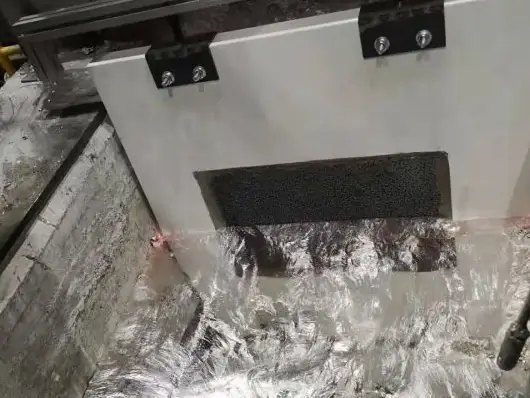
Ceramic foam filters have been a proven process in aluminum casting for many years. When placed in the gating system, they:
-
Remove inclusions – The three-dimensional porous structure mechanically screens out oxide films, slag, and other non-metallic impurities. Research has shown that using ceramic foam filters contributes primarily to a decrease in porosity.
-
Calm the melt flow – Filtration alone already helps prevent areas of increased macroporosity by calming the melt flow. A stable, laminar flow reduces the risk of gas entrapment and oxidation.
-
Provide rectification – Ceramic foam filters convert turbulent flow into laminar flow. The filter increases flow resistance, and the liquid metal slowly flows into the mold cavity without generating eddy currents. This means significantly less re-oxidation within the mold.
For best results:
-
Choose the right PPI (pores per inch) for your application: 10-20 for large castings, 20-30 for most applications, 30-50 for thin-wall or precision castings
-
Preheat filters to ≥600°C for 30-45 minutes before use
-
Ensure proper sealing around the filter to prevent bypass flow
Step 3: Control Your Process
Beyond degassing and filtration, several process factors affect porosity:
-
Keep scrap clean – Wet or contaminated scrap is a major source of hydrogen. Dry and preheat scrap before charging.
-
Control furnace atmosphere – Moisture in the furnace atmosphere is absorbed by the melt. Keep furnaces covered and use dry air or inert gas blankets.
-
Design gating systems properly – Ensure adequate feeding to prevent shrinkage porosity. Avoid turbulent filling that entraps gas and creates oxides.
-
Monitor melt temperature – Prolonged exposure at high temperatures increases hydrogen solubility.
Real Results: What Filtration Can Do
Studies have demonstrated the effectiveness of ceramic foam filtration in reducing porosity:
-
Research on secondary AlSi7Mg0.3 alloy showed that using 20 PPI ceramic foam filters in the inlet system contributed primarily to a decrease in porosity.
-
Filtration helps prevent areas of increased macroporosity by calming the melt flow.
-
The use of ceramic foam filters removes inclusions, reduces trapped gas from liquid metal, and provides laminar flow—and the filtered metal significantly becomes cleaner.
The bottom line: If you’re struggling with porosity, adding ceramic foam filtration to your process can make a dramatic difference—not by replacing degassing, but by complementing it.
Summary: Your Porosity Action Plan
| Problem | Solution |
|---|---|
| Dissolved hydrogen | Degas with inert gas (rotor degassing) |
| Oxide inclusions and slag | Ceramic foam filtration |
| Turbulent flow causing re-oxidation | Filter rectification (converts to laminar flow) |
| Shrinkage porosity | Proper gating design and feeding |
| Contaminated scrap | Dry, clean, and preheat charge materials |
Conclusion
Porosity doesn’t have to be an inevitable part of aluminum casting. By understanding the root causes—hydrogen gas, shrinkage, and the inclusions that make both problems worse—you can take targeted action to eliminate holes from your castings.
Degassing removes the hydrogen. Filtration removes the inclusions and calms the flow. Good process control prevents problems from recurring.
If your castings are failing pressure tests, coming back from machining with pinholes, or showing surface blisters that shouldn’t be there, take a hard look at your melt treatment process. The solution might be simpler—and more cost-effective—than you think.
Still struggling with porosity? Our technical team can help you diagnose the root cause and recommend the right filtration solution for your specific casting application. Contact us for a consultation.
Email: info@sf-foundry.com
WhatsApp: 8618636913699