


V‑Process casting (vacuum sealed molding) is a specialized molding technique that uses a plastic film and vacuum‑sealed sand to create the mold. Unlike conventional green sand molding, the mold strength in V‑Process comes from vacuum pressure—not from clay binders or chemical binders.
This makes V‑Process highly sensitive to one factor: gas and air evacuation.
If gases cannot escape properly from the mold cavity during pouring, the result is gas defects—pinholes, blisters, and surface porosity—that ruin casting quality. While filters remove solid inclusions (slag, dross, sand), they cannot solve gas entrapment problems caused by poor venting.
Why Venting Is Critical in V‑Process Casting
In V‑Process casting, the mold is sealed by a plastic film on both the cope and drag sides. Vacuum is applied to hold the sand in place and maintain mold strength. During pouring, the film burns away, and the sand remains in place due to the vacuum pressure.
But here’s the challenge: the sealed nature of the mold makes it harder for gases to escape.
When molten metal fills the cavity, it displaces air. If that air cannot escape through designed venting paths, it gets trapped in the casting as gas porosity. Additionally, gases generated from the burning film, core binders, and any coatings must also be evacuated.
The principle is simple: the total cross‑sectional area of vents should be 2–3 times the total cross‑sectional area of the ingates —and larger is better. Vents should be placed at the highest points of the mold cavity, where gases naturally accumulate.
Common Venting Methods in V‑Process Casting
Venting in V‑Process casting can be achieved through several methods:
- Open risers (open feeders) – These serve dual purposes: they provide feed metal for solidification shrinkage and also act as vents for gases. In V‑Process, open risers are typically formed by placing a pre‑wrapped riser sleeve on a raised boss on the pattern, then sealing it with tape.
- Blind risers (closed feeders) – These must include a vent hole at the top, often using a cored vent or a special venting core to allow gases to escape while still providing feed metal.
- Vent holes – Small holes drilled or formed in the mold to allow air to escape. These are typically placed at the highest points of the cavity.
- Vent channels – Grooves or channels cut into the parting line or mold surface to direct gases to the outside.
In practice, a combination of these methods is used to ensure adequate gas evacuation.
The Relationship Between Venting and Filtration
Filtration and venting serve different purposes—but they work together.
Filtration removes solid inclusions—slag, dross, sand grains, and oxide films—from the molten metal before it enters the cavity. This prevents inclusion‑related defects.
Venting removes gases—air displaced from the cavity, gases from burning film, and gases from core binders—from the mold during pouring. This prevents gas‑related defects.
If you filter perfectly but have poor venting, you’ll get gas defects. If you vent perfectly but don’t filter, you’ll get inclusion defects.
For V‑Process casting, where the sealed mold makes gas evacuation more challenging, both filtration and venting are essential.
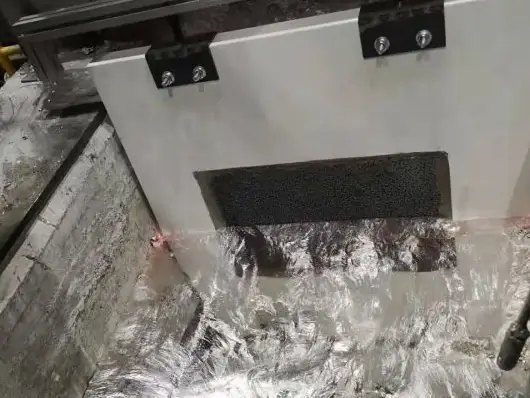
How Filters Can Help Reduce Gas Defects
While filters do not remove dissolved gases from the metal (that requires degassing), they do help reduce gas defects in two ways:
1. Removing oxide films that nucleate gas porosity
Dissolved hydrogen in aluminum or nitrogen/oxygen in iron needs a nucleation site to form a gas bubble. Oxide films and inclusions are the preferred nucleation sites. When you remove these inclusions with a ceramic foam filter, you remove the places where gas bubbles would otherwise form. The result is fewer gas defects—even if your degassing is not perfect.
2. Promoting laminar flow to reduce gas entrapment
When molten metal flows turbulently, it entrains air and creates gas bubbles that become trapped in the casting. A ceramic foam filter breaks a single turbulent stream into many small, laminar streams—reducing turbulence and, therefore, reducing gas entrapment.
In V‑Process casting, where the mold is sealed and gas evacuation is more challenging, this laminar flow benefit is particularly valuable.
Practical Recommendations for V‑Process Foundries
For Venting
| Practice | Why |
|---|---|
| Place vents at the highest points of the cavity | Gases naturally rise; vents should be where gases accumulate |
| Maintain total vent area ≥ 2× ingate area | Adequate gas evacuation capacity |
| Use open risers with sealed tops | Provides both venting and feeding—add insulating material after pouring |
| For blind risers, include a vent hole at the top | Prevents gas entrapment in the riser |
For Filtration
| Practice | Why |
|---|---|
| Use ceramic foam filters in the runner | Removes inclusions before they reach the cavity |
| Place filters as close to the cavity as possible | Minimizes reoxidation after filtration |
| Match filter PPI to your alloy | 10–15 PPI for ductile iron; 15–20 PPI for gray iron |
| Ensure proper filter sealing | Prevents bypass flow—unfiltered metal entering the cavity |
Conclusion
V‑Process casting is a powerful technique for producing high‑quality castings with excellent surface finish and dimensional accuracy. But its sealed nature makes gas evacuation a critical factor.
The two essential tools for defect‑free V‑Process castings are:
-
Proper venting – adequate vent area, placed at the highest points of the cavity, using a combination of risers, vent holes, and channels
-
Effective filtration – ceramic foam filters to remove inclusions and promote laminar flow, reducing both inclusion defects and gas porosity
When venting and filtration work together, the result is cleaner metal, fewer defects, and higher casting yield.
At SF-Foundry, we manufacture ceramic foam filters for all casting processes—including V‑Process. Our silicon carbide and alumina filters are designed to remove inclusions while promoting smooth, laminar flow. Contact us to learn more about integrating filtration into your V‑Process casting operation.
Contact SF-Foundry Technical Support:
Email: info@sf-foundry.com
Phone / WhatsApp: +86 18636913699
Website: www.sf-foundry.com