


If you’re casting aluminum in permanent molds, you already know the frustration. You’ve got a good mold, a clean melt, and a solid process. But sometimes, after machining, you still see dark spots, porosity, or surface defects that shouldn’t be there.
The culprit is almost always inclusions – non-metallic particles that get trapped in the casting.
In permanent mold casting, removing inclusions is not optional. It’s the difference between reliable, high-quality parts and a scrap pile that eats your margin. This article explains what you’re dealing with, where inclusions come from, and – most importantly – how to get them out.

What Are You Actually Dealing With?
Inclusions in aluminum castings fall into three main categories:
Oxides – The most common and most damaging. Aluminum oxidizes readily, forming a thin film on the melt surface. When that film gets folded into the melt by turbulence, it becomes a bifilm – a double layer of oxide that acts like a crack in the metal. These defects reduce effective cross-sectional strength and compromise fatigue resistance.
Dross and slag – A mixture of oxides, flux residues, and other non-metallic materials that float on the melt surface. If not properly skimmed or if turbulence pulls it in, dross becomes an inclusion.
Refractory particles – Tiny fragments from furnace linings, ladle refractories, or mold coatings that break loose and end up in the metal.
The aluminum industry has known about these problems for decades. Most foundries understand the importance of removing inclusions, and techniques like sedimentation, flotation, filtration, degassing, and fluxing are commonly used.
But in permanent mold casting, there’s a specific challenge: you’re working with steel molds and often complex gating designs. You can’t just dump a filter anywhere and expect it to work.
Where Do Inclusions Come From in Permanent Mold Casting?
Turbulence during pouring
Permanent mold casting involves pouring molten aluminum from a ladle into a mold. The metal drops, splashes, and flows through runners and gates. Every time the surface breaks or folds, new oxides form.
Most of the damage happens during transfer and pouring – the most turbulent operations in the foundry.
Poor gating design
If your sprue is too tall, the metal falls too fast. If your runner has sharp corners, the metal scours and erodes. If your ingate velocity exceeds what’s considered critical, you’re creating oxide films faster than you can remove them.
Incomplete melt treatment
Fluxing, degassing, and skimming remove some inclusions, but they don’t catch everything. Fine oxide particles, especially those below 50 microns, can remain suspended in the melt and only become a problem when the metal solidifies.
Reoxidation after the filter
Even if you filter the metal, if the gating system after the filter is turbulent, you’ll create new oxides that enter the casting unfiltered.
How Do You Remove Inclusions in Permanent Mold Casting?
There’s no single magic bullet. Effective inclusion removal in permanent mold casting is a combination of melt treatment and in‑mold filtration.
Melt Treatment Methods
Fluxing – Fluxes containing chlorine, fluorine, or boron separate oxides and other inclusions from the melt. Covering fluxes protect magnesium-rich alloys, while carbon and graphite retard oxidation. Fluxing improves casting integrity by removing impurities that would otherwise weaken mechanical properties.
Degassing – Dissolved hydrogen is a separate problem (it causes porosity), but degassing with inert gases like nitrogen or argon also helps float out solid inclusions.
Skimming – Simple but essential. Removing dross from the melt surface before pouring prevents it from being pulled into the mold.
These methods are necessary, but they’re not sufficient. The most effective way to remove inclusions in permanent mold casting is filtration.
Filtration in Permanent Mold Casting
Filtration is widely recognized as the most effective step in eliminating or reducing the level of inclusions – even those dissolved in the aluminum melt–. Ceramic foam filters are the industry standard, and they’ve been used in aluminum foundries since 1974.
Ceramic Foam Filters
Alumina (Al₂O₃) ceramic foam filters are the workhorse for permanent mold casting. They are placed in the gating system, and when molten aluminum passes through, inclusions are trapped inside the complex pore network.
They remove inclusions through three mechanisms:
-
Mechanical sieving – particles larger than the pore openings get stuck on the surface
-
Depth filtration – smaller particles follow tortuous paths through the foam and become attached to the ceramic struts
-
Adsorption – oxide films and fine inclusions stick to the ceramic surface
In addition, filters control the fluidity during mold filling, reduce turbulence, and promote laminar flow. Research has shown that the velocity of the molten metal decreases and flows more laminarly after passing through a casting filter.
Fiberglass Mesh Filters
Fiberglass mesh filters are also used in permanent mold casting. They work as a strainer – catching larger particles on the surface. While they don’t offer the depth filtration of ceramic foam, they’re cost‑effective and easier to install in certain gating configurations.
Where and How to Place Filters in Permanent Mold Casting
Placement is everything. A great filter in the wrong spot won’t do much.
Runner placement (recommended)
Place the filter in the runner system, as close to the casting cavity as possible. This catches inclusions just before they enter the mold – minimizing reoxidation after filtration.
The filter should be placed where the metal flow is stable, not directly under the sprue where the impact is highest.
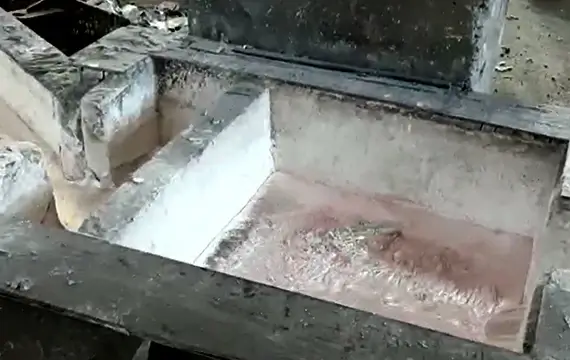
Under the sprue (less recommended)
Some foundries place filters at the bottom of the sprue. This works in theory – the metal passes through the filter immediately after dropping – but the high‑velocity impact can clog the filter prematurely or even push it out of position.
Filter sizing
The filter must be large enough to handle the flow rate without excessive pressure drop. As a rule of thumb, the filter area should be 3–5 times the choke area (the smallest cross‑section in your gating system).
For permanent mold casting, 10–30 PPI (pores per inch) filters are typical. A 10 PPI filter is coarser and allows higher flow – suitable for large castings. A 20–30 PPI filter provides finer filtration for thinner sections or higher quality requirements.
Sealing
If metal flows around the filter instead of through it, you get zero filtration. The gap between the filter and the filter seat should be 0.5–1 mm. Use ceramic fiber gaskets or refractory paste to seal the edges.
Special Considerations for Permanent Mold Casting
Reusable molds, single‑use filters
The mold itself is permanent, but ceramic foam filters are single‑use. You install a fresh filter for every pour – and that’s fine, because the filter does its job once and is full of trapped inclusions.
Tilting molds
In tilting permanent mold casting, the metal flows through a ladle and into the mold as it rotates–. Filter placement must accommodate the tilt angle – typically in the runner just before the cavity.
Low‑pressure permanent mold
In low‑pressure permanent mold casting, the metal is pushed up from below. Filters are often placed in the launder system before the metal enters the riser tube, or in the runner between the riser tube and the casting.
Common Mistakes to Avoid
Placing the filter too far from the cavity – If there’s a long runner after the filter, turbulence can create new oxides that enter the casting unfiltered.
Using the wrong PPI – A 10 PPI filter on a thin‑wall casting will let fine inclusions through. A 30 PPI filter on a large casting will restrict flow and cause misruns.
Skipping preheating – Cold ceramic filters crack when hit by hot metal. Preheat to 300–400°C.
Ignoring the seal – If metal flows around the edge, the filter is useless. Seal it properly.
Relying only on filters – Filtration is the most effective step–, but it works best when combined with good melt practice (fluxing, degassing, skimming) and low‑turbulence gating design.
Conclusion
Removing inclusions in permanent mold casting of aluminum is a combination of good melt practice and effective in‑mold filtration.
-
Melt treatment (fluxing, degassing, skimming) removes the bulk of inclusions.
-
Ceramic foam filtration removes the rest – including fine oxides that other methods miss.
-
Proper placement (in the runner, close to the cavity) ensures the filter does its job without causing flow problems.
The aluminum industry has known for decades that clean metal is the foundation of quality castings. The tools to achieve it – ceramic foam filters, fiberglass mesh, and better gating design – are all available.
At SF-Foundry, we manufacture alumina ceramic foam filters specifically for permanent mold casting – available in 10, 20, and 30 PPI, in a range of standard and custom sizes. Our filters are used by foundries around the world to remove inclusions, reduce scrap, and produce cleaner, more reliable castings.
Need help selecting the right filter for your permanent mold casting application? Contact us for a recommendation.
Contact SF-Foundry Technical Support:
Email: info@sf-foundry.com
Phone / WhatsApp: +86 18636913699
Website: www.sf-foundry.com