


If you’ve ever held a ceramic foam filter in your hand, you’ve probably wondered: how does a soft, squishy piece of foam turn into a rigid, high‑temperature ceramic that can handle molten aluminum at 700–800°C? The answer is a multi‑step process that combines materials science, careful process control, and high‑temperature firing.
Raw Materials – Where It All Begins
The main ingredient is high‑purity alumina powder (Al₂O₃). The exact purity varies by manufacturer and application, but typical grades used for aluminum casting contain 85–95% Al₂O₃. The balance consists of other refractory oxides and binders that help shape the filter and give it strength after firing.
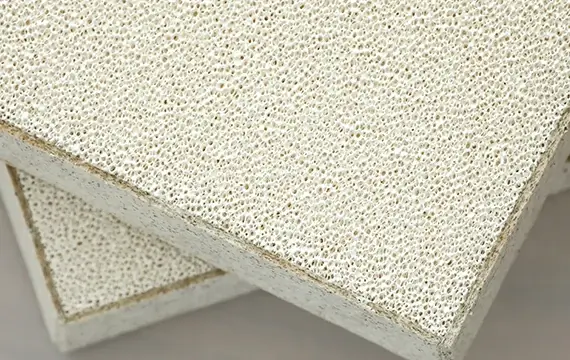
Other materials include:
-
Binders – Help the ceramic slurry stick to the foam template.
-
Sintering aids – Promote bonding between alumina particles during firing.
-
Water – Forms the liquid base of the slurry.
-
Surfactants – Reduce surface tension so the slurry wets the foam evenly.
-
Polyurethane (PU) foam – The sacrificial template that gives the filter its open‑cell structure.
The PU foam is not ordinary packing foam. It’s a specially manufactured reticulated foam with a controlled pore size (measured in PPI – pores per inch). The foam’s structure determines the final filter’s pore structure. A 20 PPI filter starts with a 20 PPI PU foam template.
Making the Ceramic Slurry
The alumina powder, binders, sintering aids, and water are mixed together to form a creamy, uniform slurry. The consistency is critical: too thin, and it won’t coat the foam properly; too thick, and it will clog the foam’s open pores instead of coating the struts.
What happens in this step:
-
Powders are weighed and added to a mixing tank.
-
Water and additives are blended in gradually.
-
The mixture is stirred for several hours until it reaches a stable, homogeneous state.
-
Viscosity and density are checked against the target specifications.
This is one of the most closely guarded parts of the process. Small changes in the slurry formula can significantly affect the filter’s strength, porosity, and thermal shock resistance.
Impregnating the Foam Template
The PU foam sheets or blocks are dipped into the ceramic slurry. The foam is then squeezed (usually by passing through rollers) to remove excess slurry. The goal is to coat the foam struts with a thin, even layer of ceramic – without filling in the open pores.
Key points at this stage:
-
The amount of slurry left on the foam determines the final filter’s density and strength.
-
Too much slurry fills pores and restricts flow.
-
Too little slurry results in weak, fragile filters.
-
Multiple dips and squeezes may be used, depending on the desired thickness.
After impregnation, the coated foam is dried to remove water. This makes the ceramic coating rigid enough to hold its shape in the next steps.
Drying and Curing
The wet, coated foam enters a drying oven. Water evaporates, and the binder hardens, locking the ceramic particles in place around the foam struts. At this stage, the filter is still fragile – like chalk.
Drying is done carefully because:
-
Too fast drying can cause cracks.
-
Uneven drying can warp the filter.
-
Residual moisture can cause problems during firing (steam explosions).
After drying, the filter is rigid but still contains the PU foam core. That foam must be removed before final sintering.
Burnout – Removing the Foam Template
This is where the magic happens. The dried filters are loaded into a kiln and heated to a temperature (typically 400–600°C) that burns out the polyurethane foam, but does not yet sinter the ceramic. The organic material turns into gases that escape, leaving behind a negative replica of the original foam – a three‑dimensional network of hollow ceramic struts.
What’s happening at a chemical level:
-
The PU foam decomposes into CO₂, water vapor, and other gases.
-
The binder also burns out, leaving only the inorganic ceramic particles.
-
The filter becomes extremely fragile – it’s just a “green” ceramic skeleton.
Proper burnout is critical. If the foam is not completely removed, residual carbon can cause defects in the final filter or contaminate the molten metal.
Sintering – The Final Strengthening
After burnout, the filters are heated to a much higher temperature, typically 1400–1600°C (depending on the ceramic composition). This process, called sintering, causes the alumina particles to bond together at their points of contact.
During sintering:
-
Individual alumina particles fuse together, creating strong necks between them.
-
Porosity decreases slightly, and the filter shrinks (typically 15–20% linear shrinkage).
-
The filter gains its final strength, rigidity, and high‑temperature stability.
-
After sintering, the filter is a single, cohesive ceramic piece.
The sintering cycle – how fast the temperature rises, how long it’s held at peak temperature, and how fast it cools – is tuned to achieve the right balance of strength, porosity, and thermal shock resistance.

Quality Control and Inspection
After sintering, every batch of filters is inspected. Typical QC checks include:
| Test | What It Measures |
|---|---|
| Visual inspection | Cracks, chips, blocked pores, surface defects |
| Dimensional check | Length, width, thickness – within tolerance |
| Weight / density measurement | Consistency from batch to batch |
| PPI check | Pore size uniformity (visual or image analysis) |
| Crush strength (sample) | Mechanical strength |
| Thermal shock test (sample) | Resistance to cracking |
Some suppliers also provide batch‑specific test reports (mill certificates) that document these measurements. If you require this level of traceability, ask your supplier.
Packaging and Shipping
Once the filters pass inspection, they are packaged to prevent damage during shipping and storage.
Packaging considerations:
-
Filters are fragile – they need cushioning.
-
Moisture is a problem – filters absorb humidity, which can cause gas defects during pouring. Many suppliers seal filters in plastic bags with desiccant.
-
Boxes are labeled with size, PPI, batch number, and sometimes a “use‑by” recommendation (though alumina filters don’t technically expire if kept dry).
The finished product is now ready to be shipped to your foundry.
Why This Matters to You
Understanding the manufacturing process helps you appreciate why not all filters are the same:
-
Slurry formulation affects chemical purity and strength.
-
Sintering temperature affects density and thermal shock resistance.
-
Quality control ensures batch‑to‑batch consistency.
A filter that is poorly made – irregular pores, weak struts, or uneven shrinkage – will perform inconsistently in your foundry. That’s why experienced foundries choose suppliers who control each step carefully.
At SF-Foundry, we manufacture alumina ceramic foam filters using this proven process, with rigorous in‑process checks and final inspection. Our filters are designed to give you consistent performance, pour after pour.
Have questions about the manufacturing process or our quality controls? We’re happy to share more.
Contact SF-Foundry Technical Support:
Email: info@sf-foundry.com
Phone / WhatsApp: +86 18636913699
Website: www.sf-foundry.com