


You’ve probably heard the term “ceramic foam filter” if you’ve been around a foundry. But what exactly does it do? Is it just a fancy screen? Or is there more going on inside that piece of black (or white) foam?
Let me give you a straight answer.
A ceramic foam filter sits in your gating system. Molten metal flows through it before entering the mold cavity. And while it’s passing through, the filter does two critical jobs:
-
It removes non‑metallic inclusions – things like oxides, slag, dross, and loose sand that would otherwise end up in your casting.
-
It straightens out the flow – turning a chaotic, turbulent stream into a smooth, laminar one. That alone cuts down on reoxidation.
In short, a ceramic foam filter gives you cleaner metal and a smoother fill. And those two things directly translate to fewer defects, less scrap, and better mechanical properties.
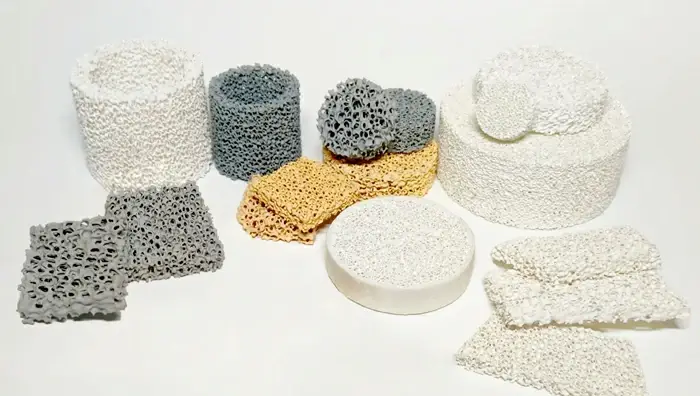
How Does Ceramic Filter Actually Remove Inclusions?
It’s not just a sieve. A ceramic foam filter has a three‑dimensional, tortuous path – like a sponge made of ceramic. When molten metal winds through that maze, three things happen.
Mechanical sieving – This is the most obvious. Particles that are larger than the pore openings simply cannot fit through. They get stuck on the surface. Think of it like a coarse strainer catching big chunks.
Cake filtration – As more and more inclusions pile up on the inlet side, they form a “filter cake.” This cake becomes a finer filter itself, trapping even smaller particles that might have slipped through the pores. That’s one reason a filter can actually become more efficient during the pour – up to the point it clogs.
Adsorption – This is the subtle one. The ceramic material (alumina, silicon carbide, or zirconia) has a natural affinity for oxide films and other non‑metallic particles. Those inclusions stick to the ceramic struts, even if they’re much smaller than the pores. It’s like dust sticking to a wet sponge.
Between these three mechanisms, a well‑sized ceramic foam filter can remove inclusions down to well below the pore opening.
What About That “Flow Straightening” Benefit?
Here’s something many people overlook.
When metal rushes through a gating system, it’s often turbulent. That turbulence churns the surface, folding oxide films back into the melt – creating new inclusions even after the metal has been filtered.
A ceramic foam filter breaks the single turbulent stream into hundreds of tiny, parallel streams. Each tiny stream has a much lower Reynolds number (a measure of turbulence). They flow out of the filter smoothly, in a more laminar state.
Less turbulence after the filter means fewer new oxides are formed. So the filter doesn’t just clean the metal that arrives – it also helps keep the metal clean on its way to the cavity.
What Kinds of Defects Does It Prevent?
If you pour without a filter, you’re rolling the dice on several common defects:
-
Inclusion defects – hard spots from slag or sand, dark dross patches on machined surfaces, internal oxide films that weaken the part.
-
Machining issues – hard inclusions dull cutting tools, cause breakage, and leave poor surface finishes.
-
Leaks – in pressure‑tight castings (valves, pumps, engine blocks), a string of inclusions can create a leak path.
-
Reduced mechanical properties – inclusions act as stress risers, lowering fatigue life and impact resistance.
A good filter dramatically reduces all of these. It doesn’t make them impossible – no filter is 100% perfect – but it moves the needle from “we have a scrap problem” to “we have a process we can trust.”
What a Ceramic Foam Filter Cannot Do
I should also be clear about its limits.
-
It does not remove dissolved gases like hydrogen in aluminum. You still need degassing.
-
It cannot fix a badly designed gating system – if turbulence is extreme, you’ll create oxides after the filter.
-
It will not compensate for dirty melt – if your furnace has mountains of slag, the filter will clog immediately.
-
It cannot be reused – after one pour, it’s full of trapped inclusions and loses strength.
Think of the filter as a partner to good melting and gating practice, not a replacement for them.
How Do You Know If It’s Working?
After a pour, look at the used filter.
-
Heavy, dark, clogged – it captured a lot of junk. Good. It did its job.
-
Clean, light‑colored – either your melt was very clean, or metal bypassed the filter. Check for bypass.
-
Cracked – usually from thermal shock (not preheating enough) or mechanical stress.
Also, track your defect rates before and after installing filters. Most foundries see a significant drop in inclusion‑related scrap – often 30‑60% within the first month.
Final Takeaway
A ceramic foam filter is not a magic wand. It’s a tool – but a very powerful one. It removes solid inclusions by three mechanisms, straightens out turbulent flow, and protects your casting from a host of defects.
If you’re already filtering, great. If you’re not, try it on one casting line. The improvement in scrap and surface quality will almost certainly convince you.
Got a specific alloy or casting shape in mind? Tell us about it. We’ll recommend a filter type and size – no obligation.
Email: info@sf-foundry.com
Tech support: +8618636913699
– SEFU technical team