


Walk into any aluminum foundry, and you’ll almost certainly find one type of filter being used more than any other: alumina (Al₂O₃) ceramic foam filters.
It’s not by accident. Among the three dominant filter materials—alumina, silicon carbide, and zirconia—alumina is the undisputed workhorse for aluminum casting. But why? What makes this particular ceramic so well‑suited to the job?

What Makes a Good Filter Material?
Before we dive into alumina specifically, let’s quickly review what any filter material must do to be successful:
-
Withstand pouring temperature without softening or melting
-
Resist thermal shock – sudden contact with molten metal should not cause cracking
-
Be chemically stable – must not react with the melt or introduce contaminants
-
Have adequate strength to handle metal pressure and mechanical handling
-
Provide cost‑effective performance – the filter must make economic sense
Alumina scores well across all five. But let’s see exactly how.
What Is Alumina (Al₂O₃)?
Alumina – aluminum oxide – is one of the most widely used advanced ceramics in industry. It is produced from bauxite through the Bayer process, refined into a high‑purity white powder, and then formed and sintered into finished shapes.
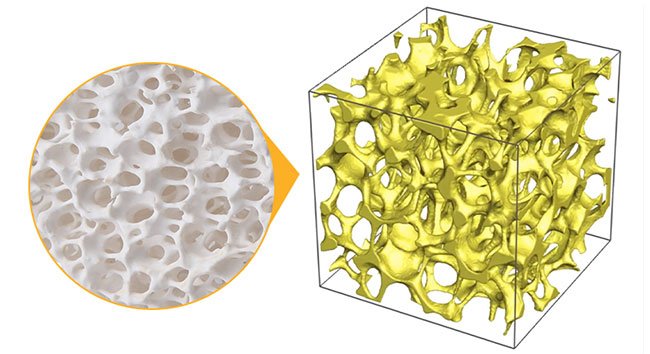
For foam filters, alumina powder is mixed into a slurry that impregnates a polyurethane foam “skeleton.” After drying and high‑temperature sintering (typically above 1500°C), the organic foam burns away, leaving a three‑dimensional, open‑cell ceramic structure with high porosity and interconnected pores. That final structure is your ceramic foam filter.
Key Material Properties – And What They Mean for Your Foundry
Temperature Resistance
Alumina foam filters typically have a maximum working temperature of 1100–1200°C (depending on purity and manufacturer).
For aluminum casting, where typical pouring temperatures are 680–800°C, this provides ample margin. The filter will not soften, deform, or break down under normal operating conditions. In fact, the temperature margin is so generous that thermal failure of a properly handled alumina filter in aluminum service is extremely rare.
Key takeaway: Alumina’s temperature limit is well above aluminum’s pouring range, giving you a wide safety margin.
Porosity and Pore Structure
Standard alumina foam filters have porosity in the range of 80–90% with bulk density typically 0.35–0.55 g/cm³.
That high porosity means three things:
-
The filter is lightweight and easy to handle
-
It provides large surface area for inclusion capture
-
It maintains low resistance to flow – metal passes through without excessive pressure drop
Key takeaway: High porosity balances inclusion capture with easy flow.
Thermal Shock Resistance
Alumina’s thermal shock resistance is rated as moderate – certainly not as high as zirconia, but fully adequate for aluminum casting when proper preheating is used.
A typical specification for an 85‑92% alumina filter is 5 thermal shock cycles from 800°C to room temperature.
For aluminum: with pouring temperatures around 700–800°C and proper preheating to 300–400°C, thermal shock cracking is rarely an issue.
Key takeaway: Alumina performs reliably for aluminum when preheated correctly.
Chemical Stability (Corrosion Resistance)
This is where alumina truly shines in aluminum applications. Alumina filters exhibit excellent resistance to attack and corrosion from molten aluminum. They are chemically stable and do not react with the melt. The main component is Al₂O₃, which will not react with aluminum at high temperatures.
Why does this matter? If a filter degrades in the melt, particles can break off and become secondary inclusions – defeating the entire purpose of filtration. Alumina’s stability means:
-
No filter particles enter your casting
-
No contamination of the melt chemistry
-
No unexpected reactions
Key takeaway: Alumina’s chemical stability means it filters without contaminating or reacting with the melt.
Mechanical Strength
Alumina foam filters typically provide a cold compressive strength around 1.0 MPa at room temperature.
That’s more than sufficient for normal handling and installation. Alumina filters are not fragile (despite being ceramic), and with proper handling, they withstand the stresses of transport, placement in a filter box, and the pressure of molten metal flow.
Key takeaway: Adequate strength for reliable handling and consistent performance.
Alumina vs. Other Filter Materials – A Quick Comparison
| Property | Alumina (Al₂O₃) | Silicon Carbide (SiC) | Zirconia (ZrO₂) |
|---|---|---|---|
| Maximum Service Temperature | ~1100–1200°C | ~1500°C | ~1700°C |
| Thermal Shock Resistance | Moderate | Good | Excellent |
| Chemical Stability vs. Aluminum | Excellent | Good | Excellent |
| Density | ~3.9 g/cm³ | ~3.2 g/cm³ | ~5.7 g/cm³ |
| Relative Cost | Low | Medium | High |
| Primary Applications | Aluminum, Magnesium | Gray iron, Ductile iron, Copper alloys | Steel, Stainless steel, Superalloys |
Key takeaway: For aluminum, alumina matches the temperature requirement perfectly without the added expense of higher‑temperature ceramics. No over‑specification. No unnecessary cost.

The Economics – Why Alumina Makes Business Sense
Alumina filters typically cost significantly less than zirconia or high‑grade silicon carbide filters for equivalent sizes.
For a foundry producing thousands of castings per week, this cost difference adds up quickly. And because alumina’s properties are perfectly matched to aluminum’s requirements, you’re not sacrificing performance to get that lower cost.
But cost is only half the story. The real value of any filter is measured by defect reduction and yield improvement.
Using the right filter – and for aluminum, that often means alumina – allows you to:
-
Reduce inclusion‑related scrap – Oxide films (bifilms) and other non‑metallic inclusions are captured before they reach the casting–
-
Reduce machining rejects – Cleaner castings mean fewer hard spots, longer tool life, less rework
-
Increase casting yield – Lower defect rates mean more good castings from every pour
-
Lower downstream costs – Fewer returns, less grinding, less rework, faster production
These savings consistently exceed the cost of the filter itself – often by a substantial margin.
When Not to Use Alumina – And What to Use Instead
Alumina is not a universal solution. It’s the right choice for aluminum, magnesium, zinc, and some low‑temperature copper alloys.
Alumina is not suitable for ferrous metals (iron and steel). At typical iron pouring temperatures (1350–1450°C), alumina approaches or exceeds its temperature limit. It can soften, deform, or react with the melt.-1
Frequently Asked Questions
Q: Can I use an alumina foam filter for recycled aluminum scrap with high inclusion load?
A: Yes. Alumina filters are excellent for recycled melts, as they effectively capture oxides and other impurities. For very heavy inclusion loads, consider using a coarser PPI (e.g., 10–20 PPI) first, or a two‑stage filtration system.
Q: What purity of Al₂O₃ do I need?
A: Most standard alumina foam filters have 80–90% Al₂O₃ content, which is perfectly adequate for typical aluminum casting. Higher purity (up to 99%) is used only for very demanding applications and adds cost without significant benefit for most foundries.
Q: Does alumina filter release particles into the melt?
A: No, when properly sintered and handled, alumina filters are dimensionally stable and will not shed particles into the melt.
Q: How do I know if I need a finer or coarser PPI?
A: For thick‑section castings, use 10–20 PPI for high flow; for thin‑wall components, 30–40 PPI for cleaner metal. When in doubt, start with 20–30 PPI and adjust based on results.
Q: What’s the maximum temperature for alumina foam filters?
A: Typically 1100–1200°C – well above aluminum’s 680–800°C range. Do not use alumina filters for steel.
Q: Do I need to preheat alumina filters for aluminum?
A: Yes–light preheating to 300–400°C is strongly recommended. This prevents thermal shock (the filter cracking when hit by hot metal), removes moisture, and improves first‑pour performance. Foundries that preheat properly see far fewer filter‑related defects.
Conclusion
Alumina foam filters are not exotic. They are not the newest technology. But they are the proven, reliable, cost‑effective choice for aluminum casting – and for good reason:
-
Temperature resistance matched perfectly to aluminum’s needs
-
High porosity for efficient filtration with good flow
-
Excellent chemical stability – no reaction with the melt
-
Adequate thermal shock resistance when properly preheated
-
Good mechanical strength for handling
-
Low cost – without compromising performance
Recommendation: Unless you have a specific reason to choose otherwise, start with an alumina ceramic foam filter for your aluminum castings. Choose the PPI based on your casting type, preheat properly before use, and you’ll get clean metal, fewer defects, and strong economic returns.
At SF-Foundry, we manufacture high‑quality alumina ceramic foam filters in a full range of PPI ratings (10, 20, 30, 40+), sizes, and shapes. All filters are produced with consistent pore structure and clean edges for reliable performance in your aluminum foundry.
Contact us:
-
Email: info@sf-foundry.com
-
Technical Support: +8618636913699
-
Website: www.sf-foundry.com
For application‑specific recommendations, please consult with our technical team.