


Recently, I posted a short article on LinkedIn about common mistakes when using fiberglass mesh filters. An experienced foundry engineer – someone who was involved in iron filter development back in the 1980s – left a thoughtful comment. I want to quote part of it here, because it raises an important technical distinction that many casting professionals still debate:
“To me, mesh is not a filter, it is a strainer. The tortuous metal path through a ceramic foam filter will give the cleanest metal. We always used to recommend 30 ppi for cast iron and 10 ppi for ductile iron.”
He’s right. And his comment highlights a confusion that runs through our industry: we often use the word “filter” for everything that removes inclusions, but not all of them work the same way.
This article explains the difference between a strainer, a mesh filter, and a true depth filter – and why the distinction matters for your casting quality.
The Basic Difference Between Filters and Strainer
| Term | How It Works | Analogy |
|---|---|---|
| Strainer | Removes only particles larger than the hole size. Particles are caught on the surface. | A kitchen sieve – tea leaves stay on top, water passes through. |
| Screen / Mesh “Filter” | Same principle, but with finer openings. Still surface retention. | A window screen – bugs are blocked, air goes through. |
| True Filter (Ceramic Foam) | Traps particles inside a complex, tortuous path – not just on the surface. | A forest – air moves through, but dust gets trapped on many branches and leaves. |
In everyday language, we call all three “filters”. But in technical casting terms, only ceramic foam is a true depth filter. The others are strainers or sieves.
What Is a Strainer?
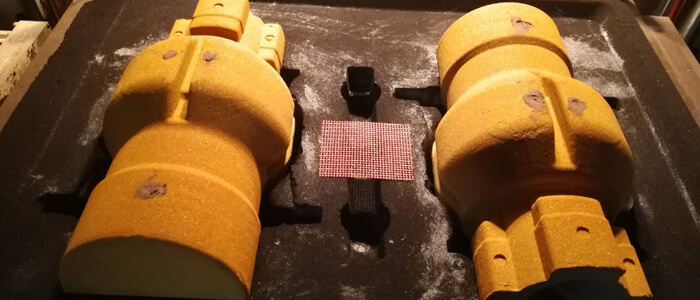
A strainer (like a fiberglass mesh or a metal wire screen) works by mechanical sieving. If an inclusion is larger than the mesh opening, it gets stuck on the surface. If it’s smaller, it passes right through.
What a Strainer Does Well
-
Catches large slag, dross, and sand particles (e.g., > 1 mm)
-
Very low flow resistance
-
Low cost
-
Easy to cut and install
What a Strainer Does Not Do
-
It does not capture fine oxide films (which are often below 0.1 mm thick)
-
It does not have depth – once the surface is blocked, flow stops
-
It does not reduce turbulence or promote laminar flow (a benefit of foam filters)
The commenter is correct: mesh is a strainer, not a true filter.
That does not mean it has no place in a foundry. For many aluminum castings with moderate quality requirements, a strainer is perfectly adequate and cost‑effective. But for critical iron and steel castings where fine oxides and dross are killers, a strainer is simply not enough.
What Is a True Filter (Ceramic Foam)?
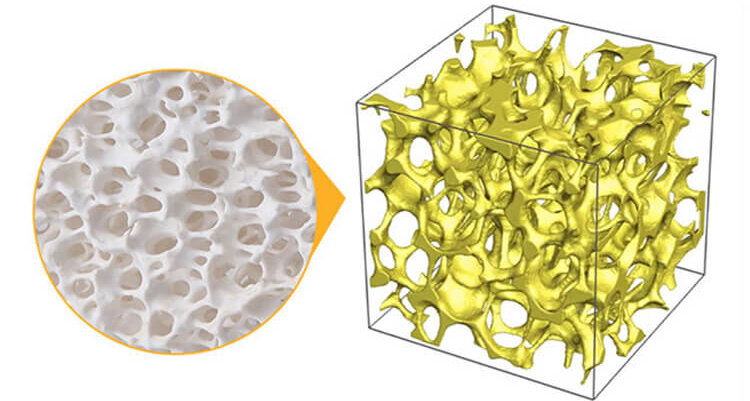
A ceramic foam filter has a three‑dimensional, interconnected network of pores. When molten metal passes through, inclusions are captured inside the structure by three mechanisms:
-
Mechanical interception – larger particles hit the ceramic struts.
-
Depth filtration – particles follow tortuous paths and become trapped deep within the filter.
-
Adsorption – fine oxide films stick to the ceramic surface.
Why Ceramic Foam Filter Matters for Iron and Steel
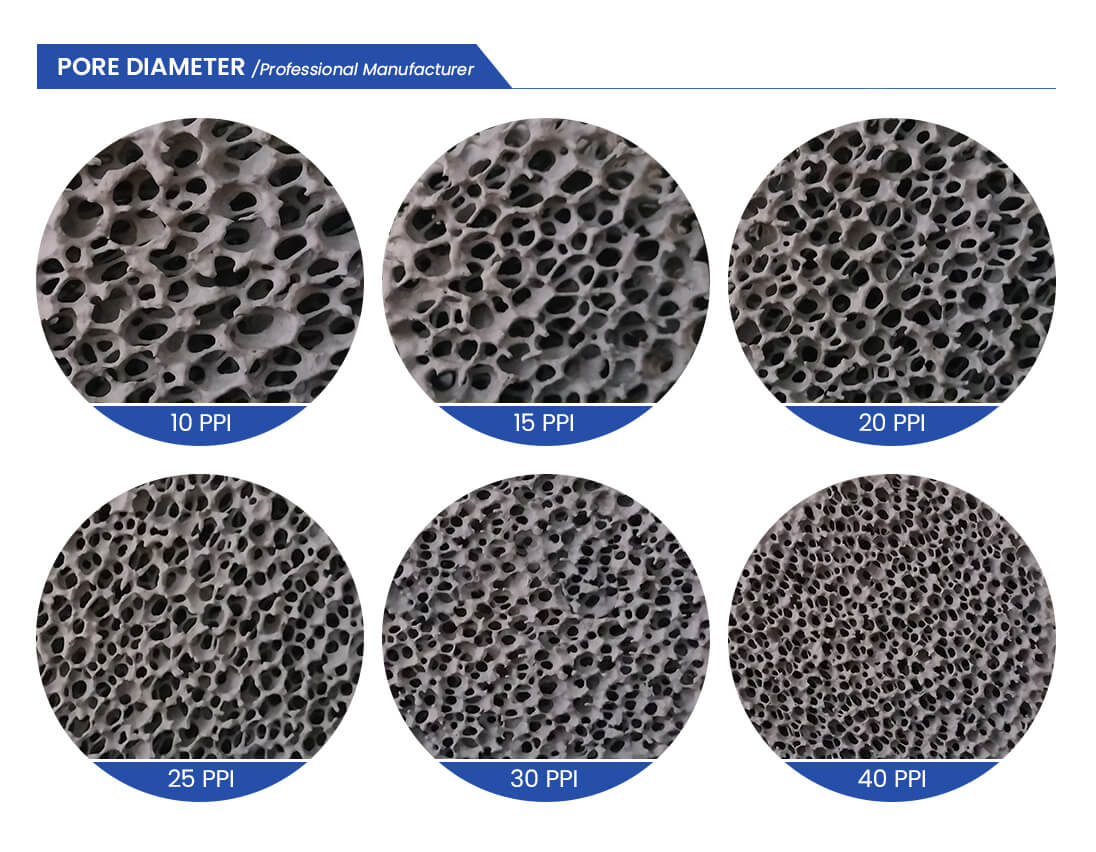
The commenter recommends 30 PPI for cast iron and 10 PPI for ductile iron. At first glance, that seems reversed (tighter filter for iron? coarser for ductile?). But he has a good reason:
-
Gray iron is prone to fine oxides and sand inclusions. A finer filter (30 PPI) helps remove them.
-
Ductile iron contains magnesium‑based dross that is more “sticky” and larger. A 10 or 20 PPI filter captures dross without clogging too fast. Very fine filters (30 PPI) may block immediately with ductile iron dross.
This is exactly the kind of nuance that a strainer cannot offer. With mesh, you only have opening size. With foam, you can tailor PPI to the specific inclusion type.
Where Do We Use Each?
| Application | Recommended Product | Why |
|---|---|---|
| Small aluminum castings, non‑critical | Fiberglass mesh (strainer) | Cost‑effective, removes large slag |
| Critical aluminum castings (wheels, structural parts) | Ceramic foam (20‑30 PPI) | Removes fine oxides, improves mechanical properties |
| Gray iron (thin wall, intricate) | Ceramic foam (20‑30 PPI) | Fine filtration for sand and oxides |
| Ductile iron (valves, large sections) | Ceramic foam (10‑20 PPI) | Catches dross without early clogging |
| Steel castings | Ceramic foam (zirconia, 10‑20 PPI) | Highest temperature, depth filtration needed |
| Very large, low‑quality iron castings | Fiberglass mesh or no filter | Cost‑driven, not quality‑driven |
The commenter’s advice – 30 PPI for cast iron, 10 PPI for ductile iron – aligns with experienced practice. It’s not about “higher PPI is always better”. It’s about matching the filter to the defect type.
A Shared Principle – Non‑Pressurized Filling
The commenter also stressed an important principle: design running systems to be non‑pressurized and non‑turbulent. I completely agree.
No filter, whether strainer or ceramic foam, can fix a gating system that creates excessive turbulence or reoxidation. Filters are helpers, not miracle workers.
-
Use a non‑pressurized gating system (sprue:runner area ratio increasing gradually).
-
Place the filter in the runner, close to the casting cavity.
-
Ensure metal flows smoothly, without abrupt changes in direction or velocity.
When you combine a well‑designed gating system with the correct filter (true depth filter for critical alloys), you get the cleanest metal.
Conclusion
I appreciate the commenter’s decades of experience. He is right on two counts:
-
Mesh is a strainer, not a true filter. We should be careful with our terminology, especially when recommending filters for high‑quality iron and steel castings.
-
Ceramic foam filters provide the cleanest metal because of their tortuous path and depth filtration.
His specific PPI recommendations (30 for cast iron, 10 for ductile iron) are a valuable reminder that one size does not fit all – even within the same alloy family.
At SF-Foundry, we supply both fiberglass mesh (strainers) and ceramic foam filters (true filters). We always ask about your alloy, casting size, and quality requirements before recommending a product. Because the right choice depends on what you need to remove – and where you can afford to spend.
Have a question about strainers vs. filters for your application? Let’s discuss.
-
Email: info@sf-foundry.com
-
Technical Support: 8618636913699
-
Website: www.sf-foundry.com
This article is written in response to a thoughtful LinkedIn comment. We thank the experienced engineer for sharing his knowledge. If you would like to continue the technical discussion, please reach out.