


You’ve just finished machining a casting, and you see them – small, hard, light‑coloured spots. Your cutting tools feel dull. Some spots flake out, leaving tiny pits. You’re looking at sand inclusions.
Sand inclusions are one of the most frustrating defects in sand casting. Unlike slag or dross (which come from the melt), sand inclusions come from the mold itself. Eroded sand grains are carried by the molten metal into the casting, where they become trapped.
Sand inclusions are completely preventable. This guide covers the five most common causes and exactly how to eliminate them – without guesswork.
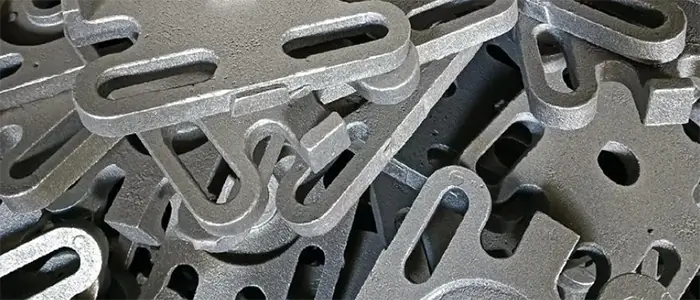
What Sand Inclusions Look Like (vs. Other Defects)
| Feature | Sand Inclusion | Slag/Dross | Gas Porosity | Shrinkage |
|---|---|---|---|---|
| Colour | Light (tan, brown, gray) | Dark (gray, black) | N/A | Dark cavity |
| Hardness | Very hard – dulls tools | Soft to moderate | N/A | N/A |
| Surface | Gritty, irregular | Smooth, flaky | Round voids | Rough, crystalline |
| Location | Near gates, changes in section | Top surfaces, under sprue | Throughout | Thick sections |
Simple test: If you can scratch it with a steel tool, it’s probably slag. If it’s hard and gritty, it’s sand.
Cause 1 – Poor Mold or Core Strength
Why It Happens
-
Sand has low green strength or inadequate binder
-
Mold under‑compacted, leaving loose sand on surface
-
Cores are fragile – they crack or crumble during pouring
-
Resin‑bonded sand not fully cured
How to Eliminate
| Action | Why It Works |
|---|---|
| Increase green strength (add bentonite or improve mixing) | Sand resists erosion better |
| Ensure uniform compaction (use proper ramming or squeeze pressure) | No loose spots; dense surface |
| Test core hardness (use a core hardness tester) | Identify weak cores before use |
| Fully cure resin‑bonded sand (adequate time/temperature) | Maximum strength |
Quick fix: For problem areas, apply a refractory coating (zircon or graphite‑based) to protect the sand surface.
Cause 2 – High Metal Velocity or Turbulence
Why It Happens
-
Excessive pouring height – metal impacts mold with too much force
-
Un‑pressurized gating system – metal accelerates in runner
-
Sharp corners in the runner – create localized erosion
-
Long drop from sprue – metal gains speed before hitting runner
How to Eliminate
| Action | Target Values |
|---|---|
| Reduce pouring height | Keep as low as practical (use a pouring basin) |
| Increase runner cross‑section | Lower velocity |
| Round sprue bottom | Eliminate sharp 90° turn |
| Use a tapered sprue | Maintain full metal condition |
| Place choke at runner or gate | Not at sprue bottom |
Recommended velocities:
| Alloy | Maximum Runner Velocity |
|---|---|
| Gray iron | 30‑40 cm/s |
| Ductile iron | 20‑30 cm/s |
| Steel | 30‑50 cm/s |
| Aluminum | 40‑50 cm/s |
Cause 3 – Poor Gating Design
Why It Happens
-
Sprue bottom not rounded – sand erodes at the junction
-
Runner too narrow – high velocity scours walls
-
Gate velocity too high – erosion at ingate
-
Abrupt changes in direction – metal impacts sand
How to Eliminate
| Gating Element | Good Practice | Avoid |
|---|---|---|
| Sprue base | Raised or rounded | Sharp step |
| Runner | Wide and shallow | Narrow and deep |
| Direction changes | Gradual curves | 90° elbows |
| Ingate | Tapered, tangential entry | Perpendicular entry |
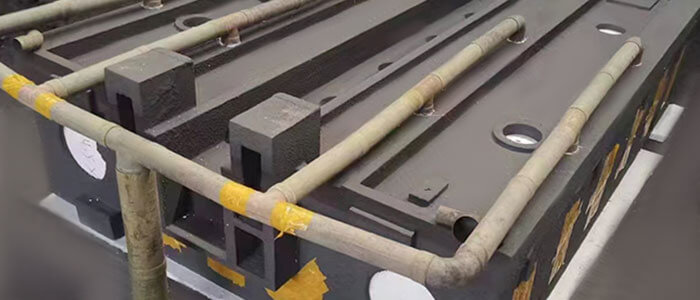
Design principle: Keep metal moving smoothly – no sudden accelerations or sharp turns. Use paper casting runners (for iron/steel) to eliminate sand entirely from the runner system.
Cause 4 – Inadequate or Improperly Applied Coatings
Why It Happens
-
No mould coating – sand directly exposed to metal
-
Coating too thin – erodes locally
-
Coating not dried – steam causes disruption
-
Coating contains large particles or lumps
How to Eliminate
| Action | Details |
|---|---|
| Apply coating to all surfaces that contact metal | Mould cavity, runner, gates, cores |
| Use correct coating for alloy | Zircon for steel; graphite for iron; refractory wash for general |
| Ensure consistent thickness | Spray or brush evenly – 0.3‑0.5 mm |
| Dry thoroughly | Use torch or oven; no moisture remains |
| Avoid puddling | No thick spots that can flake off |
Pro tip: For cores, dip coating (immersion) gives a uniform, pinhole‑free layer.
Cause 5 – Erosion in the Runner System (Even with Good Sand)
Why It Happens
-
Long runner length – metal erodes sand over distance
-
Runner made of sand – inherently erosive
-
Metal purity low – inclusions themselves can erode sand
How to Eliminate
Option A: Use Paper Casting Runners (for Iron/Steel)
Paper runners replace the sand runner entirely. No sand, no erosion.
| Benefit | Impact |
|---|---|
| Smooth surface, zero erosion | No sand grains released |
| Consistent geometry | Predictable flow |
| Easy to install | Cut and place |
Option B: Ceramic Fiber Runners (for Aluminum)
For aluminium foundries, ceramic fibre launders or pre‑formed ceramic runners eliminate sand erosion.
Option C: Improve Runner Design
If you must use sand runners:
-
Shorten runner length
-
Use wide, shallow profile
-
Apply heavy coating
-
Place filters before the runner to trap inclusions that could erode sand
How Filters Help – But Don’t Rely on Them Alone
Ceramic foam or honeycomb filters can capture sand particles that have already been eroded. However:
| Approach | Effectiveness |
|---|---|
| Only filter, no other changes | Captures some sand, but filter may clog quickly |
| Fix erosion source + filter | Very effective – residual sand captured |
Recommendation: Fix the root causes first, then use a filter as a secondary safeguard. For iron and steel, place a ceramic foam filter (10‑20 PPI) in the runner after the sprue.

Summary – 5 Causes & Fixes at a Glance
| Cause | Fix | Priority |
|---|---|---|
| 1. Poor mould/core strength | Increase compaction, use coating | High |
| 2. High metal velocity | Reduce pour height, enlarge runner | High |
| 3. Poor gating design | Round sprue base, smooth curves | High |
| 4. Inadequate coating | Apply and dry properly | Medium |
| 5. Runner erosion | Use paper or ceramic runner | Medium |
Remember: Filters capture inclusions but don’t stop erosion. Stop erosion at the source, and your castings will be cleaner, your tools will last longer, and your scrap rate will drop.
At SF-Foundry, we supply:
-
Ceramic foam filters – capture sand and slag particles
-
Paper casting runners – eliminate sand from runner system (for iron/steel)
Contact us for a free gating audit or sample request:
-
Email: info@sf-foundry.com
-
Technical Support: 8618636913699
-
Website: www.sf-foundry.com
For application‑specific recommendations, please consult with our technical team.