


Aluminum alloy wheels are everywhere in today‘s automotive industry. Lightweight, stylish, and strong, they’ve become the standard for passenger vehicles around the world. The global market for cast aluminum wheels was valued at over $13 billion in 2024 and is projected to reach nearly $25 billion by 2032–. That’s a lot of wheels—and a lot of casting.
But with high volume comes high pressure. Wheel manufacturers face relentless demands for:
-
Zero defects – especially in cosmetics, air‑tightness, and mechanical performance
-
Lower costs – every rejection eats into tight margins
-
Faster production – downtime is simply not an option
In this environment, filtration isn‘t a luxury. It’s a necessity. And for most aluminum wheel foundries, fiberglass mesh filters offer the best balance of performance, cost, and ease of use.
This article explains why.
Why Wheel Casting Is Different
The Dominant Process: Low‑Pressure Die Casting (LPDC)
Most aluminum wheels are produced by low‑pressure die casting (LPDC). In this process, the die sits above a sealed furnace. Regulated pressure—typically around 0.5–1 bar—pushes molten aluminum upward through a riser tube into the die.
LPDC is widely used for aluminum wheels because it produces strong, low‑porosity parts with good dimensional stability. It’s capable of producing complex designs and achieves a material utilization rate of over 90%.
However, even this controlled process is vulnerable to defects caused by inclusions and turbulence.
The Three Quality Criteria for Wheels
Casting defects in aluminum wheels are judged against three main criteria:
| Criterion | What It Means | Why Filtration Matters |
|---|---|---|
| Cosmetics | Surface finish, paint adhesion | Inclusions near the surface cause visible blemishes |
| Air‑tightness | No leaks under pressure | Porosity and oxide films create leak paths |
| Mechanical performance | Strength, fatigue life, impact resistance | Internal inclusions act as stress risers |
Fail any of these, and the wheel is scrap.
The Most Common Defects in Aluminum Wheels
Studies of industrial wheel‑casting facilities have identified the major defects as:
| Defect | Description | Primary Cause |
|---|---|---|
| Inclusions | Trapped slag, dross, or oxides | Contaminated melt, turbulence |
| Porosity / gas holes | Tiny voids from dissolved hydrogen | Moisture in charge, atmospheric humidity |
| Shrinkage | Internal cavities | Insufficient feed metal |
| Cracks | Hot tears or stress fractures | Improper cooling, residual stress |
Fiberglass mesh filters directly address the first two—inclusions and porosity—by removing solid contaminants before they enter the die and by stabilizing flow to reduce reoxidation.
How Fiberglass Mesh Filters Work in Wheel Casting
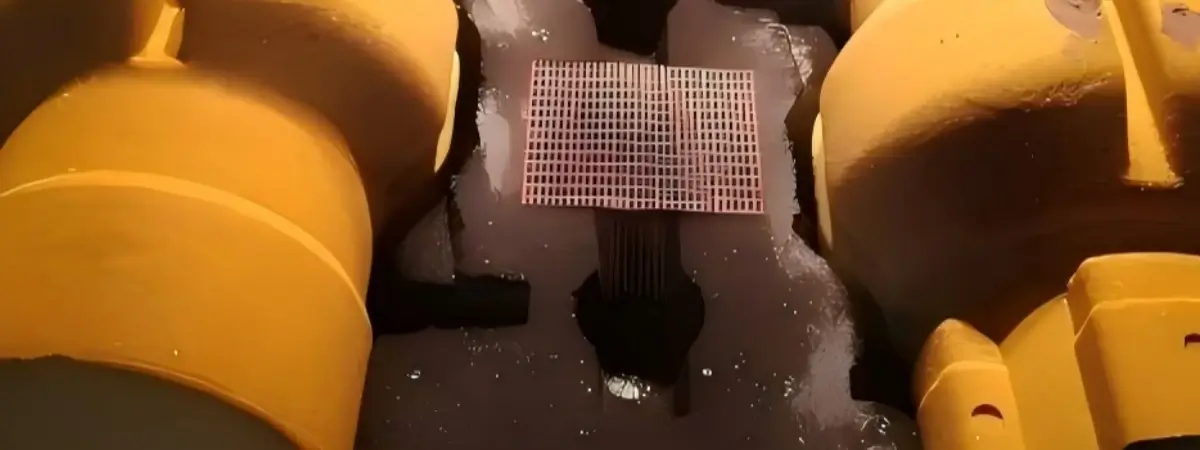
In low‑pressure die casting, the filter is typically placed in the gating system—often a cap‑style filter (also called a cone or hat filter) that sits over the sprue or pouring cup.
When molten aluminum passes through the filter:
-
Mechanical filtration – Particles larger than the mesh opening are trapped on the surface.
-
Adsorption – Fine non‑metallic inclusions stick to the glass fiber surface.
-
Flow stabilization – The mesh breaks the metal stream into many small units, reducing the Reynolds number and promoting laminar flow. This minimizes turbulence and secondary oxidation within the die.
The result? Cleaner metal, fewer inclusions, and more consistent wheels.
5 Reasons Fiberglass Mesh Is Ideal for Wheel Casting
1. Cost‑Effective – Up to 60% Less Than Ceramic
Wheel foundries operate on thin margins. Every component cost matters.
| Filter Type | Typical Cost | Notes |
|---|---|---|
| Fiberglass mesh | $0.8‑1.2 / kg | High‑volume, cost‑sensitive |
| Ceramic foam | $2‑3.5 / kg | Higher performance, higher cost |
Glass fiber filters cost 40‑60% less than ceramic alternatives. For a high‑volume wheel foundry producing thousands of wheels per day, that difference adds up fast.
2. No Preheating – Simpler Operation
Ceramic foam filters typically require preheating to 200‑400°C before use. Fiberglass mesh filters do not. This means:
-
Faster filter changes (under 5 minutes vs. 15‑25 minutes for ceramic)
-
No special preheating equipment
-
Less operator training
-
Lower energy consumption
3. No Iron Contamination – Purity Preserved
This is critical. Fiberglass mesh filters are made from amorphous silica and alumina—no iron, no metals that can dissolve into aluminum.
Unlike stainless steel wire mesh, fiberglass does not introduce iron into the melt. For wheel castings, where iron content must be tightly controlled to maintain mechanical properties, this is a major advantage.
As one industry source puts it: “The glass fiber cap filter ensures the final iron content in the aluminum wheel remains at the original aluminum level, because the glass fiber itself has a uniform and minimal iron content”–.
4. Easy Recycling – No Filter Removal Required
This is perhaps the biggest hidden saving.
When you use stainless steel mesh filters, the steel does not melt at aluminum furnace temperatures. You must manually remove every filter before recycling the sprue and runner returns. That takes time—and time is money.
With fiberglass mesh filters, the glass fibers soften and disintegrate in the melt. Aluminum scrap containing the filter can be directly returned to the furnace for remelting.
-
No manual filter removal
-
No special iron‑removal treatment
-
Higher yield, lower handling cost
5. Smokeless, Odorless, and Low Gas Emission
For wheel foundries with strict environmental or workplace standards, carbonized fiberglass mesh filters offer an additional benefit. They undergo a special high‑temperature treatment that eliminates smoke, odor, and flame during the pour. Gas emission is typically ≤30 cm³/g.
Standard vs. Carbonized – Which One Do You Need?
| Feature | Standard (Brown/Yellow) | Carbonized (Black) |
|---|---|---|
| Appearance | Brown or yellow | Black |
| Smoke/odor | Minimal | Smokeless, odorless, flameless |
| Gas emission | Low | ≤30 cm³/g |
| Best for | General wheel casting | High‑quality requirements, precision casting |
| Temperature limit | ~800°C | ~900°C |
Both are widely used in automobile and motorcycle wheels, cylinder pistons, aluminum rods, ingots, plates, and precision casting of all types of aluminum alloy castings.
Recommendation: For standard automotive wheels, standard brown mesh is usually sufficient. For high‑end wheels, precision applications, or facilities with strict environmental standards, choose carbonized black mesh.
Cap‑Style vs. Flat Mesh – Which Form Factor?
In low‑pressure die casting, cap‑style filters are the most common choice. They fit directly over the sprue or pouring cup, creating a mechanical seal that prevents bypass.
| Form Factor | Best For | Advantages |
|---|---|---|
| Cap‑style (cone/hat) | LPDC wheel casting | Secure fit, no bypass, easy installation |
| Flat mesh disc | In‑runner filtration | Can be placed closer to the cavity |
| Roll goods | Continuous casting | Custom lengths for launders |
For most wheel foundries, cap‑style filters are the simplest and most reliable choice.
Installation Tips for Wheel Casting
-
Choose the right mesh size – 1.0‑1.5 mm for most wheel castings.
-
Place the filter over the sprue – ensure a snug fit.
-
No preheating needed – but store in a dry place to avoid moisture.
-
Pour as usual – the filter will do its job.
-
Recycle the entire gating system – filter included.
Fiberglass vs. Ceramic – A Quick Comparison for Wheel Casting
| Decision Factor | Fiberglass Mesh | Ceramic Foam |
|---|---|---|
| Cost | 40‑60% lower | Higher |
| Preheating | Not required | Required (200‑400°C) |
| Filter change time | <5 minutes | 15‑25 minutes |
| Iron contamination | None | None (alumina grade) |
| Recycling | Can remelt with scrap | Must remove before recycling |
| Filtration efficiency | Good for inclusions > mesh size | Excellent for fine inclusions |
| Best for | High‑volume wheel casting | Aerospace, critical components |
For most wheel foundries, fiberglass mesh offers the better total cost of ownership.
Frequently Asked Questions
Q1: Can fiberglass mesh filters be used for all wheel casting processes?
A: Yes. They are suitable for low‑pressure die casting (most common for wheels), gravity die casting, and sand casting of aluminum wheels.
Q2: What mesh size should I use for wheel casting?
A: 1.0‑1.5 mm is typical. For larger wheels or higher flow rates, 1.5‑2.0 mm may be appropriate.
Q3: Do fiberglass filters affect the mechanical properties of the wheel?
A: Only positively. By removing inclusions, they improve tensile strength, ductility, and fatigue life.
Q4: Can I reuse a fiberglass mesh filter?
A: No. They are single‑use. After pouring, they are brittle and should be discarded with the gating system.
Q5: What‘s the difference between standard brown mesh and carbonized black mesh?
A: Carbonized mesh undergoes a special high‑temperature treatment that makes it smokeless, odorless, and lower in gas emission. It’s ideal for high‑quality or environmentally sensitive applications.
Conclusion
Aluminum wheel casting is high‑volume, high‑pressure, and unforgiving of defects. Fiberglass mesh filters offer a proven, cost‑effective way to:
-
Remove inclusions before they reach the die
-
Reduce turbulence and secondary oxidation
-
Lower operating costs through easier handling and recycling
-
Preserve metal purity with no iron contamination
For most wheel foundries, the choice is clear: fiberglass mesh delivers the best balance of performance and cost.
At SF-Foundry, we manufacture a complete range of fiberglass mesh filters for aluminum wheel casting—standard brown mesh, carbonized black mesh, cap‑style filters, and custom sizes.
Contact us:
-
Email: info@sf-foundry.com
-
Technical Support: 8618636913699
-
Website: www.sf-foundry.com
For application‑specific recommendations, please consult with our technical team.