


Gray iron occupies a unique position in the world of metal casting. Unlike steel, which shrinks relentlessly during solidification, or ductile iron, which expands but in a complex mushy mode, gray iron offers foundry engineers something rare: a built-in compensation mechanism. When properly understood and harnessed, the graphitization expansion that occurs during gray iron solidification can dramatically reduce—or even eliminate—the need for conventional risers.
This article explores the science behind graphitization expansion, its implications for riser design, and practical strategies for leveraging this phenomenon to produce sound castings with maximum yield.
The Unique Solidification Behavior of Gray Iron
The Graphite Advantage
Gray iron’s self-compensation ability stems from its microstructure. During eutectic solidification, carbon precipitates as graphite flakes, and this precipitation is accompanied by a volumetric expansion. This expansion can offset the natural contraction that occurs as liquid metal cools and solidifies.
The significance of this phenomenon cannot be overstated. While steel castings require substantial risers to compensate for 3-4% solidification shrinkage, gray iron’s graphitization expansion can theoretically eliminate shrinkage defects when conditions are optimal. In practice, for many gray iron castings, the expansion can offset 60-80% of the volume shrinkage that would otherwise occur.
The Phase Transformation Sequence
Understanding exactly when expansion occurs is critical for riser design. The solidification of gray iron proceeds through distinct phases:
Phase 1: Liquid Cooling and Initial Shrinkage
Immediately after pouring, the liquid iron begins to cool and its density increases. This liquid contraction must be compensated, typically by risers.
Phase 2: Dendritic Solidification
Solidification begins at the liquidus temperature with the formation of austenite dendrites growing inward from the mold walls. During this stage, dendritic shrinkage occurs, and as long as the supply channel remains open and the permeability of the dendritic region is sufficient, shrinkage is compensated by flow from risers.
Phase 3: Eutectic Solidification and Graphite Expansion
After reaching maximum undercooling, rapid formation of the eutectic begins. This shifts the emphasis from dendritic shrinkage to graphitic expansion. The expansion of graphite may or may not continue until the end of solidification.
Phase 4: Final Solidification
When the amount of eutectic formed decreases toward the end of solidification, there is a risk of micro-shrinkage if graphite expansion becomes insufficient to compensate for remaining contraction.
The Equilibrium Solidification Concept
Modern understanding of gray iron solidification has evolved from traditional sequential solidification theory to equilibrium solidification principles. This paradigm recognizes that gray iron solidification involves a balance between liquid contraction and graphite expansion.
Initially, the casting requires external feeding from risers to compensate for liquid shrinkage. However, as solidification progresses, graphite precipitation generates internal expansion pressure that can self-compensate for residual shrinkage. The key insight is that risers must provide limited and timely feeding—supplementing the deficit before the equilibrium point is reached, after which the feeding channel should seal to prevent pressure loss.
This principle, known as limited feeding, is crucial for gray iron. Excessive riser size or improper placement can actually exacerbate thermal disturbances and waste the self-compensation potential.
The Implications for Riser Design
Rethinking Traditional Approaches
Traditional riser design for gray iron often followed the same “sequential solidification” principles used for steel—large risers placed directly on hot spots to ensure directional solidification toward the riser. However, this approach fails to leverage gray iron’s unique characteristics and can actually be counterproductive.
Why traditional approaches fall short:
-
Large risers create excessive thermal interference
-
Direct placement on hot spots wastes the self-compensation potential
-
Oversized risers reduce yield without improving quality
-
The feeding channel may remain open too long, releasing valuable expansion pressure
The Limited Feeding Principle
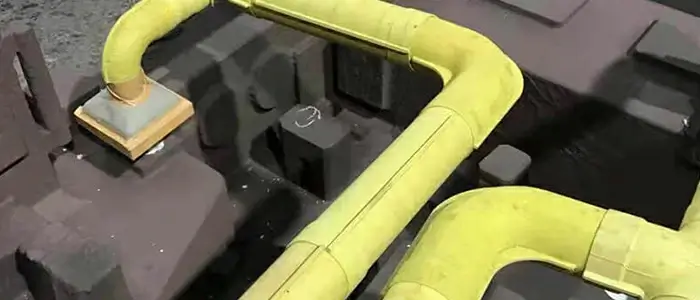
The equilibrium solidification approach advocates for placing risers between hot spots rather than directly on them. This minimizes thermal interference while maintaining proximity for effective feeding during the early stages of solidification.
For example, in a gray iron bracket casting with multiple hot sections, positioning risers at the midpoint between two hot spots—using a gating system that introduces molten metal through the riser into one side—creates a “hot riser” that can feed two adjacent casting sections simultaneously. This approach reduces thermal concentration and improves feeding efficiency.
Optimizing Riser Geometry
Research and practical experience have yielded specific geometric guidelines for gray iron risers:
| Parameter | Traditional Approach | Optimized for Gray Iron | Improvement |
|---|---|---|---|
| Riser Placement | Directly on hot spots | Between hot spots | Reduces thermal interference by 30% |
| Riser Height (H) | H = 1.5D | H = 2D | Ensures adequate feeding pressure |
| Riser Diameter (D) | Variable | D = 1.2 × d_h (hot spot diameter) | Optimizes volume |
| Modulus Ratio (M_r/M_c) | 1.5-2.0 | 1.3-1.5 | Prevents overdesign |
| Riser Neck Width (W_n) | Flat, arbitrary | W_n = 0.8 × D (trapezoidal) | Adaptive sealing |
| Riser Neck Height (H_n) | Flat, arbitrary | H_n = 0.6 × D | Prevents premature freeze |
The Critical Role of the Riser Neck
The riser neck is perhaps the most critical element in gray iron riser design. It must serve a dual function:
-
Allow hot metal flow during the early feeding stage
-
Seal rapidly at the equilibrium point to harness graphite expansion pressure
A flat neck design often solidifies too early, causing shrinkage cavities. Research has demonstrated that a trapezoidal neck with width W_n = 0.8D and height H_n = 0.6D provides optimal performance, ensuring seamless feeding during the required period and timely closure afterward.
The neck modulus can be expressed as M_n = A_n / P_n, where A_n is cross-sectional area and P_n is perimeter. This should be tailored to delay solidification until feeding is complete. For gray iron, the neck should incorporate a taper to facilitate directional solidification toward the riser.
The Economic Impact: Quantifying the Benefits
Yield Improvements
The shift to equilibrium-based riser design delivers substantial economic benefits. A documented case study involving a thick-plate gray iron counterweight (approximately 200 kg, with wall thickness up to 80 mm) illustrates the potential:
-
Original process: Top risers at thermal hot spots, resulting in shrinkage cavities and low yield
-
Optimized process: Risers relocated to adjacent areas, reduced size, trapezoidal necks
-
Results: Casting yield increased from 65% to 80%; defects eliminated
For annual production of 10,000 pieces, this represents savings of over 50 tons of gray iron metal, with corresponding reductions in energy consumption and environmental impact.
The “Limited Riser” Success Story
Historical practice confirms these findings. In the 1980s, a foundry producing crank weights for pumping units adopted limited top risers to leverage gray iron’s self-compensation capability. By effectively utilizing the volume expansion from graphite precipitation, they achieved a remarkable casting yield of 94.6%.
This demonstrates that the principle of limited feeding is not new—it has been successfully applied for decades, though its systematic implementation remains underutilized.
Enabling Factors for Graphitization Expansion
Chemical Composition Control
To maximize graphitization expansion, careful control of composition is essential:
Carbon Equivalent (CE)
The carbon equivalent should be controlled near the eutectic point (4.2-4.3%). During eutectic transformation, graphite precipitation generates approximately 3% volumetric expansion. When carbon equivalent is sufficiently high, this expansion can fully offset liquid contraction, eliminating shrinkage cavities.
Carbon-to-Silicon Ratio (C/Si)
A C/Si ratio of 1.8-2.5 is generally recommended. Higher silicon content promotes graphitization, increasing expansion and reducing shrinkage porosity.
Controlling Harmful Elements
-
Sulfur: Should be kept below 0.12%, as sulfur hinders graphitization and increases shrinkage tendency
-
Manganese: Beneficial in appropriate amounts—it counteracts sulfur’s harmful effects, though excessive amounts stabilize pearlite and reduce graphite expansion
Mold Rigidity: The Hidden Factor
Mold rigidity is perhaps the most underappreciated factor in successful gray iron riser design. The logic is straightforward but critical:
If the mold is too soft (low stiffness) :
-
The casting “expands” outward during graphitization
-
Expansion pressure is dissipated in moving mold walls
-
The pressure cannot be directed inward to feed shrinking regions
-
Shrinkage cavities actually worsen because the expansion “pulls” the cavity larger rather than filling it
If the mold is sufficiently rigid:
-
Expansion pressure is contained
-
Pressure is redirected inward toward still-liquid regions
-
Self-feeding occurs naturally
This is why resin-bonded sand or properly compacted green sand with adequate clay content is essential for high-yield gray iron castings. The sand layer between riser and casting should be 20-30 mm, with vigorous ramming to ensure thermal stability.

Pouring Temperature Control
Pouring temperature significantly affects feeding requirements:
-
1350-1400°C is generally recommended for gray iron
-
Lower temperatures increase viscosity and hinder feeding
-
Higher temperatures increase liquid shrinkage and prolong solidification, exacerbating shrinkage tendencies
Gating System Design
For gray iron, bottom gating through the riser is preferred. This approach:
-
Reduces turbulence and temperature loss
-
Ensures the hottest metal reaches the regions requiring feeding
-
Minimizes dross formation
An optimized gating ratio (sprue:runner:gate) of 1:1.5:1.2 has been shown effective for gray iron.
When Risers Are Still Necessary
Limitations of Self-Compensation
Despite gray iron’s remarkable self-compensation ability, there are situations where risers remain essential:
Thick Sections
In sections exceeding approximately 80-100 mm, the volume of liquid contraction may exceed the expansion available from graphite precipitation, particularly if cooling rates are slow.
Complex Geometries
Junctions, intersections, and areas with isolated hot spots may require additional feeding even when the overall carbon equivalent is adequate.
High-Grade Irons
Higher-strength gray irons (with lower carbon equivalents) have less graphite expansion available and may require more conventional risering.
Strategic Use of Chills
Chills serve as important partners to risers in gray iron casting. While risers provide feeding, chills accelerate cooling in specific regions to:
-
Strengthen directional solidification
-
Extend the effective feeding range of risers
-
Eliminate shrinkage in areas where risers cannot be placed
Important caveat: Chills never compensate for shrinkage themselves—they only transfer shrinkage to other areas. The “surrounding” part of the riser cannot be chilled, and the closer to the riser, the smaller the chill thickness should be.
Practical Design Methodology
Step-by-Step Approach
Step 1: Analyze the Casting Geometry
-
Identify hot spots and potential feeding zones
-
Calculate section moduli
Step 2: Determine Carbon Equivalent
-
Verify CE is near eutectic (4.2-4.3%)
-
Adjust if necessary for self-compensation potential
Step 3: Apply Equilibrium Solidification Principles
-
Place risers between hot spots rather than directly on them
-
Use the optimized geometric ratios: H = 2D, D = 1.2 × d_h
-
Design trapezoidal necks with W_n = 0.8D, H_n = 0.6D
Step 4: Verify Modulus Requirements
-
Ensure riser modulus ratio M_r/M_c = 1.3-1.5
-
Calculate using Chvorinov’s rule: t_s = k·(V/A)²
Step 5: Design Gating System
-
Use bottom gating through riser
-
Target gating ratio 1:1.5:1.2
Step 6: Ensure Mold Rigidity
-
Use appropriate sand system
-
Maintain 20-30 mm sand layer with vigorous ramming
Step 7: Control Pouring
-
Target 1350-1400°C pouring temperature
-
Adjust speed based on section thickness
Key Formulas
For quick reference, essential formulas for gray iron riser design include:
| Parameter | Formula | Notes |
|---|---|---|
| Riser Diameter | D = 1.2 × d_h | d_h = hot spot diameter |
| Riser Height | H = 2D | Ensures feeding pressure |
| Riser Modulus Ratio | M_r / M_c = 1.3-1.5 | M_c = casting modulus |
| Neck Width | W_n = 0.8 × D | Trapezoidal shape |
| Neck Height | H_n = 0.6 × D | Prevents premature freeze |
| Distance to Casting | L = 20-30 mm | Balance feeding and sand compactness |
| Solidification Time | t_s = k·(V/A)² | Chvorinov’s rule |
| Net Volume Change | ΔV = V_c – V_e | V_c = contraction, V_e = expansion |
Conclusion
Gray iron offers foundry engineers a unique opportunity. Unlike other ferrous alloys that fight against shrinkage, gray iron provides a built-in compensation mechanism through graphitization expansion. The key to successful riser design is not fighting this mechanism with oversized risers, but working with it through equilibrium solidification principles.
The evidence is clear: when carbon equivalent is properly controlled, mold rigidity is adequate, and risers are designed according to limited feeding principles, gray iron can achieve casting yields exceeding 90%. Defect rates can drop from over 20% to near zero. The economic and environmental benefits are substantial.
For foundry engineers, the message is simple: gray iron is different. Design for it differently. Leverage its graphitization expansion. Place risers strategically, size them appropriately, and ensure they seal at the right moment. By understanding and harnessing this fundamental characteristic, you can produce sound castings with minimal waste—the ultimate goal of every foundry operation.