


Aluminum alloys present unique challenges and opportunities in casting design. Their low density, high thermal conductivity, and tendency to form oxide films require gating systems specifically tailored to these characteristics. Unlike ferrous alloys, aluminum’s reactivity with oxygen means that turbulence during filling directly creates defects—oxide bifilms that become crack initiation sites and compromise mechanical properties.
This article provides practical tips for designing effective gating systems for aluminum castings, drawing on research, case studies, and established foundry principles across various processes including sand casting, permanent mold, and high-pressure die casting.
Understanding Aluminum’s Unique Casting Characteristics
Before designing a gating system, it is essential to understand how aluminum behaves differently from other casting alloys.
Oxide Formation Sensitivity
Aluminum alloys are highly reactive with oxygen. When turbulent flow exposes fresh metal surfaces to air, a thin, tenacious oxide film (primarily Al₂O₃) forms instantly. If this film becomes folded into the bulk metal—a phenomenon called entrainment—it creates bifilms that act as crack initiation sites and reduce ductility.
Design implication: The gating system must maintain laminar, non-turbulent flow throughout filling to prevent surface entrainment.
Fluidity Characteristics
Research on AA6063 aluminum alloy demonstrates a linear relationship between pouring temperature and fluidity length. Higher temperatures increase fluidity, but also increase gas absorption and shrinkage. The optimal pouring temperature must balance these competing factors.
Design implication: Gating calculations must account for the specific fluidity of the alloy at the intended pouring temperature.
Solidification Shrinkage
Aluminum alloys exhibit significant volumetric shrinkage during solidification (typically 3.5–8.5%, depending on alloy and section thickness). The gating system must work in concert with risers to ensure adequate feeding.
Design implication: Gates should be positioned to feed thick sections directly and maintain a favorable temperature gradient toward risers.
Choose the Right Gating System Type
Research on AA2024 alloy for aerospace applications compared three gating system designs and found that anti-gravity gating produced castings with minimum defects. For most aluminum castings, the choice depends on the process and geometry:
| System Type | Characteristics | Best Applications |
|---|---|---|
| Bottom gating | Metal enters at lowest point, rises gently | Tall castings, oxidation-sensitive alloys |
| Anti-gravity gating | Metal pushed upward from below under controlled pressure | Thin-walled, high-integrity castings |
| Top gating | Simple, promotes directional solidification | Shallow castings with minimal drop height |
| Split or tangential gates | Multiple entry points for uniform filling | Thin-walled, large-area castings |
Key finding for thin-wall aluminum: Research on notebook computer housings (less than 1mm thickness) demonstrated that tangential and split-type gating designs allowed uniform flow into the cavity, while finger gates produced inferior results. Split-type designs were preferable from the perspective of casting soundness and distortion control after solidification.
Critical Velocity Control: The 0.5 m/s Rule
Perhaps the most important principle in aluminum gating design is controlling gate velocity. Campbell’s research established that a critical velocity exists—approximately 0.5 m/s—above which the molten metal surface becomes unstable, folding over and entraining oxide films.
Why Velocity Matters
Above this threshold:
-
Surface turbulence creates waves and droplets
-
Fresh metal surfaces oxidize instantly
-
Oxide films become folded into the bulk liquid as bifilms
-
Bifilms act as crack initiation sites and reduce ductility
-
Gas entrainment increases porosity
Design rule: For aluminum alloys, gate velocities should ideally remain below 0.5 m/s. This requires sufficient gate cross-sectional area to keep velocity low while maintaining adequate fill time.
Calculating Required Gate Area
For a given casting volume and desired fill time:
Agate=Vvgate×tfill
Where:
-
Agate = total gate cross-sectional area (mm²)
-
V = casting volume (mm³)
-
vgate = target gate velocity (≤0.5 m/s = 500 mm/s)
-
tfill = desired fill time (s)
Fill time for aluminum castings depends on section thickness and can be estimated from established charts or simulation.
Expanding vs. Pressurized Systems: Evidence Supports Expanding
A critical decision in aluminum gating design is whether to use a pressurized or expanding (unpressurized) system.
The Research Evidence
A study on AA6063 aluminum alloy directly compared expanding and pressurized systems through experimentation and regression analysis. The findings were clear:
-
Expanding systems (where total cross-sectional area increases toward the cavity) produced better quality castings
-
True stress-strain graphs confirmed the superiority of expanding systems
-
The gating system design strongly depends on fluid characteristics of the specific alloy
-
Fracture elongation appeared more dependent on melt quality than on in-gate design alone
Why Expanding Systems Work Better for Aluminum
Expanding systems place the choke (the narrowest cross-section controlling flow rate) early in the system—typically at the sprue exit or sprue well. After this point, cross-sectional areas increase, which:
-
Reduces flow velocity progressively
-
Maintains laminar flow conditions
-
Allows any remaining turbulence to dissipate before metal enters the cavity
-
Prevents the high-velocity jets associated with pressurized gates
Design rule: For aluminum, use an unpressurized (expanding) system with area ratios typically in the range of 1:2:2 to 1:4:4 (sprue:runner:gates).
Gate Design and Placement Strategies
Gate Type Selection for Thin Sections
For thin-walled aluminum castings (under 1mm thickness), gate design becomes critical. Research comparing three gate types for notebook computer housings found:
| Gate Type | Performance |
|---|---|
| Finger gate | Poor—uneven flow, defects |
| Tangential gate | Good—uniform flow into cavity |
| Split gate | Best—uniform flow plus reduced distortion after solidification |
Split-type gating was preferred because it provided both sound casting quality and minimized distortion—a critical factor for thin, large-area components.
Gate Location Principles
General principles for aluminum gate placement include :
-
Avoid direct impingement on cores or mold walls—design gates so metal strikes at glancing angles rather than perpendicularly
-
Position gates to feed thick sections directly—the hottest metal should enter regions requiring the most feeding
-
Consider parting line closure—the parting surface should not close immediately, which is beneficial for pressure transfer and exhaustion
-
Multiple gates for large parts—ensure even distribution across the cavity
Ring, Center, and Outer Runner Systems
For die casting of aluminum, several specialized gating configurations exist based on component structure:
-
Ring pouring runner—for cylindrical or annular parts
-
Center expanding runner—for parts gated at the center
-
Outer runner—for parts gated at the periphery
-
Collection wasteway—for trapping cold metal and air
Each has specific applications, but all share the common principle that the liquid aluminum should flow as smoothly as possible.
Filtration: Essential for Aluminum Quality
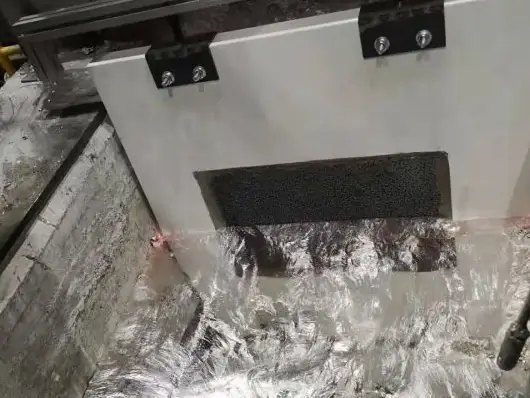
Ceramic foam filters are particularly important for aluminum castings due to the alloy’s tendency to form oxide inclusions.
Filter Mechanisms
Filters remove inclusions through four mechanisms:
-
Floating separation—increased flow resistance keeps the system full, allowing low-density inclusions to float
-
Cake filtration—inclusions larger than pore size are mechanically blocked; captured inclusions form a “cake” that traps smaller particles
-
Adsorption—inclusions adhere to the ceramic mesh
-
Rectification—flow is divided into small streams, reducing Reynolds number and promoting laminar flow
Filter Selection and Placement
| Pore Size (PPI) | Application |
|---|---|
| 10-15 PPI | Coarse inclusions, sand casting |
| 20-30 PPI | Fine oxide films, permanent mold and die casting |
Placement rule: Install filters horizontally in the main runner, as close to the casting as possible. The filter’s cross-sectional area should be 2.5-3 times larger than the choke area to prevent flow restriction.
For critical applications, the trident gate design incorporating multiple filters and bubble traps has demonstrated the ability to produce defect-free aluminum castings routinely.
Temperature Control and Fluidity
Pouring Temperature Optimization
Research on AA6063 alloy demonstrates that fluidity increases linearly with pouring temperature. However, higher temperatures also increase:
-
Gas absorption in the melt
-
Oxidation rate
-
Shrinkage volume
-
Mold thermal shock
Practical approach: For each alloy and casting geometry, establish the minimum temperature that achieves complete filling. This balances fluidity against the negative effects of overheating.
Fluidity Measurement
The same study used a ceramic spiral mold to measure fluidity index—the length of metal flow before solidification. This technique can be used to:
-
Characterize different alloy batches
-
Establish optimal pouring temperature ranges
-
Verify melt quality before production
Simulation: Essential for Modern Aluminum Gating Design
Trial-and-error development of aluminum gating systems is expensive and time-consuming. Casting simulation has become an essential tool.
What Simulation Reveals
Modern simulation software (Cast-Designer, MAGMAsoft, ProCAST, FLOW-3D) can predict:
-
Liquid metal filling time
-
Molten metal flow behavior and velocity distribution
-
Air entrainment locations
-
Temperature distribution during filling
-
Solidification sequences
-
Shrinkage porosity formation
Case Study: Aluminum Valve Cover
A study on aluminum alloy valve covers used simulation to evaluate both high-pressure die casting and sand casting options. Key parameters analyzed included:
-
Mold and part temperature distribution
-
Liquid metal flow rates
-
Cold shut possibilities
-
Final air quantities
-
Microporosity values
Based on simulation results, high-pressure die casting was selected and successfully implemented.
Case Study: Three-Way Pipe
Research on aluminum three-way pipe castings used Cast-Designer software to analyze multiple design variables including pouring height, pouring basin area, and runner cross-sections. Simulation results guided design decisions, and actual casting experiments confirmed that the simulated approach produced complete castings. The authors note that simulation results can serve as “a guideline for future improvements to reduce the shrinkage of actual cast workpieces.”
Process-Specific Considerations
Sand Casting
For aluminum sand castings:
-
Use unpressurized systems with generous gates
-
Incorporate runner extensions for slag trapping
-
Consider bottom gating for taller castings
-
Design sprue wells with height approximately twice runner height
Permanent Mold (Gravity Die)
For permanent mold aluminum casting:
-
Gates are typically larger than sand casting due to faster heat extraction
-
Coordinate gating with die heating/cooling channels
-
Consider tilt-pour designs for improved filling control
High-Pressure Die Casting
For HPDC of aluminum:
-
Gates are necessarily narrower due to high injection pressures
-
Critical parameters include low-pressure velocity (ideally 0.2 m/s in the chamber) and high-pressure velocity (optimally 2.0 m/s)
-
Overflow systems are essential for trapping cold metal and air
-
Multi-gate configurations (e.g., 5 gates) improve filling uniformity for complex parts
Semi-Solid Die Casting
For semi-solid aluminum processing (A356 with electromagnetic stirring), die design rules include specific gate positioning strategies:
-
Two-step die system: Lower-positioned gate
-
Three-step die system: Center-positioned gate
These systems, combined with controlled injection speeds, produced suspension parts with excellent mechanical properties after T6 heat treatment: UTS of 330 MPa, YS of 250 MPa, and elongation of 7.5%.
Practical Design Checklist for Aluminum Gating Systems
| Design Element | Requirement | Verification Method |
|---|---|---|
| System type | Expanding (unpressurized) preferred | Area ratio calculation (1:2:2 to 1:4:4) |
| Gate velocity | ≤0.5 m/s | Calculate from gate area and fill time |
| Gate type | Split or tangential for thin sections | Match to part geometry |
| Gate location | Avoid core impingement; feed thick sections | Visual review |
| Sprue | Tapered (10-15% area reduction) | Calculate area ratio |
| Sprue well | Height = 2× runner height; width = 2× sprue base | Measure dimensions |
| Filter | 20-30 PPI ceramic foam; area = 2.5-3× choke | Confirm sizing |
| Pouring temp | Optimized for fluidity vs. quality | Fluidity spiral testing |
| Simulation | Validate before tooling | CFD analysis |
| Multiple gates | For large or complex parts | Ensure flow balancing |
Summary: Key Tips for Aluminum Gating Success
-
Respect the 0.5 m/s rule—gate velocity below this threshold prevents oxide entrainment
-
Choose expanding systems—evidence confirms they outperform pressurized systems for aluminum
-
Select gate type by application—split gates excel for thin sections; tangential works well; finger gates underperform
-
Filter everything—ceramic foam filters (20-30 PPI) remove oxides and condition flow
-
Position gates strategically—avoid direct impingement, feed thick sections directly
-
Optimize temperature—use fluidity testing to find the minimum temperature that ensures complete filling
-
Simulate before cutting tooling—modern software predicts flow, temperature, and defects accurately
-
Consider anti-gravity—for highest integrity, anti-gravity gating produces minimum defects
-
Match gate to process—sand, permanent mold, HPDC, and semi-solid each have unique requirements
-
Validate with experimentation—combine simulation with actual casting trials to refine designs
By applying these tips—grounded in research and proven in practice—foundry engineers can design gating systems that reliably produce sound, high-quality aluminum castings with minimal defects and maximum mechanical properties.