


Choosing the right gating system is one of the most critical decisions in casting design. The way molten metal enters the mold cavity fundamentally affects filling behavior, temperature distribution, and ultimately, the quality of the finished part. Different casting geometries, materials, and quality requirements demand different gating approaches.
This article examines the four main types of gating systems—top, bottom, side, and step gating—their working principles, advantages, limitations, and typical applications. Understanding these fundamental types will help you select the most appropriate system for your specific casting needs.
Top Gating System
How It Works
In a top gating system, molten metal is poured directly into the top of the mold cavity through a sprue located above the casting. The metal enters at the highest point and fills the cavity from the top down, driven by gravity. This is one of the oldest and simplest gating methods.
Advantages
-
Simple Design: The straightforward configuration makes it easy to manufacture and implement, reducing tooling costs.
-
High Filling Speed: Gravity accelerates the metal downward, enabling rapid cavity filling—beneficial for high-volume production.
-
Promotes Directional Solidification: The hottest metal remains at the top of the casting, which encourages solidification to proceed from the bottom upward toward the gate and riser—ideal feeding conditions.
-
Good Feeding Efficiency: Particularly effective for castings of substantial height when poured directly into the riser.

Disadvantages
-
Turbulence and Splashing: Metal falling from a height can cause significant turbulence, splashing, and air entrapment, leading to porosity defects.
-
Mold Erosion Risk: The high-velocity metal stream can erode the mold bottom or core surfaces.
-
Oxidation Concerns: Turbulent flow exposes more metal surface area to air, maximizing oxide formation—especially problematic for reactive metals like ductile iron.
Applications
-
Shallow and wide castings where drop height is minimal.
-
Castings with low dimensional tolerance requirements.
-
Ductile iron castings of substantial height (cylinders, liners, sleeves, drums, rotors) when combined with floating ceramic filters to control inclusions.
-
High-volume production where speed is prioritized over absolute quality.
Bottom Gating System
How It Works
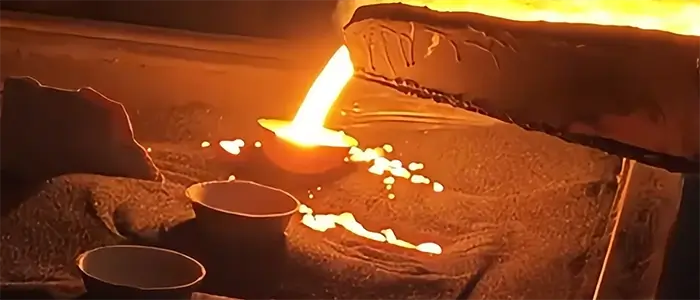
The bottom gating system introduces molten metal through gates located at or near the bottom of the mold cavity. Metal enters at the lowest point and rises gently upward, filling the cavity from the bottom—similar to filling a bathtub.
Advantages
-
Minimized Turbulence: Metal enters quietly and rises smoothly, dramatically reducing splashing, air entrapment, and oxidation.
-
Reduced Mold Erosion: The gentle filling action protects mold walls and cores from erosive damage.
-
Improved Filling Uniformity: Runner systems distribute metal evenly, ensuring consistent filling of complex geometries.
-
Ideal for Critical Applications: Particularly preferred for castings where internal quality and freedom from dross defects are paramount.
Disadvantages
-
Unfavorable Temperature Gradient: The hottest metal enters at the bottom and rises, leaving cooler metal at the top as filling progresses. This creates an inverse temperature gradient that does not promote directional solidification.
-
Reduced Riser Effectiveness: Since the riser is filled with cooler metal that has already been in contact with the mold, its feeding efficiency is diminished.
-
Slower Filling: The controlled flow typically results in longer fill times, which may not suit high-speed production.
-
More Complex Design: Requires carefully engineered runner channels to ensure even distribution.
Applications
-
Deep and narrow castings where metal must flow upward against gravity.
-
Critical castings with high dimensional tolerance requirements (aerospace, medical, high-performance automotive).
-
Castings made from reactive metals prone to oxidation and dross formation (ductile iron, aluminum alloys).
-
Large, complex castings where quality outweighs production speed.
Side Gating System
How It Works
Side gating introduces molten metal through gates located at the side of the mold cavity, typically at the parting line. This is the most commonly used gate type in many casting processes, representing a compromise between top and bottom gating. Metal enters horizontally and fills the cavity from the side.
Advantages
-
Balanced Flow: Provides good control over filling patterns while avoiding the extremes of top or bottom gating.
-
Parting Line Convenience: Gates are naturally located at the mold parting line, simplifying pattern and mold construction.
-
Versatile Application: Suitable for a wide range of casting geometries and sizes.
-
Good Compromise: Offers reasonable filling speeds with moderate turbulence control.
Disadvantages
-
Not Optimized for Either Extreme: Does not achieve the perfect directional solidification of top gating nor the perfect tranquility of bottom gating.
-
Moderate Temperature Gradient: Provides intermediate thermal conditions that may not suit castings with severe feeding requirements.
Applications
-
General-purpose castings where special filling conditions are not required.
-
Shallow and simple castings with vertical walls.
-
Die casting applications where side gating is particularly common.
-
Most parting line-gated production castings.
Step Gating System
How It Works
The step gating system (also called multi-level or progressive gating) uses multiple gates at different vertical levels in the mold. Metal enters progressively through lower gates first, then through higher gates as the mold fills. This creates a controlled, layered filling pattern that combines benefits of both top and bottom approaches.
Advantages
-
Reduced Turbulence and Air Entrapment: The progressive filling controls metal velocity and minimizes splashing.
-
Improved Temperature Distribution: Hotter metal can be introduced at higher levels later in the fill, improving the temperature gradient.
-
Excellent for Thick Sections: Multiple gates ensure even filling of heavy-section castings.
-
Suitable for Complex Geometries: Can fill intricate shapes with varying wall thicknesses uniformly.
Disadvantages
-
Complex Design: Requires careful calculation of each gate’s size and position to ensure proper sequential filling.
-
Higher Tooling Cost: More complex pattern and mold construction.
-
Difficult to Optimize: May require simulation software (MAGMA, FLOW-3D) to verify performance.
Applications
-
Complex and irregularly shaped castings where uniform filling is essential.
-
Thick-section castings requiring controlled filling to prevent shrinkage defects.
-
High-quality castings where both internal soundness and surface finish are critical.
-
Large castings with significant vertical height variations.
Additional Specialized Gating Types
While the four types above represent the primary classification, several specialized gating configurations deserve mention:
Horn Gate
A curved gate that is part of the pattern with smooth, progressive dimensional changes. Designed specifically to minimize mold erosion and oxidation of molten metal during entry.
Tangential Gating
Used for circular or cylindrical castings (pipes, tubes, rings). Metal enters tangentially to the circumference, creating a swirling motion that ensures even distribution around the part.
Horizontal Gating
Suitable for large, flat castings (plates, panels). Metal flows horizontally into the cavity, offering simple design with reduced turbulence.
Multi-Gate Configurations
Research has identified specific multi-gate arrangements like Side Sprue Parallel Connection (SSPC) and Center Sprue Parallel Connection (CSPC) for optimizing flow distribution in multi-cavity molds.
How to Choose the Right Gating System
Selecting the appropriate gating system requires evaluating several factors:
| Factor | Consideration |
|---|---|
| Casting Geometry | Deep/narrow castings favor bottom gating; shallow/wide castings may suit top gating; complex shapes often need step gating |
| Material Properties | Reactive metals (ductile iron, aluminum) demand bottom gating to minimize oxidation; less sensitive materials may tolerate simpler systems |
| Quality Requirements | Critical/high-tolerance applications justify bottom or step gating; general-purpose parts may use side or top gating |
| Production Volume | High-volume production may prioritize top gating speed; lower volumes can accommodate slower, higher-quality approaches |
| Cost Constraints | Simple top/side gating minimizes tooling costs; complex step/multi-gate systems increase expenses |
| Solidification Requirements | Directional solidification needs favor top gating; less demanding thermal conditions allow other options |
The Role of Modern Simulation
Today, foundries increasingly use Computational Fluid Dynamics (CFD) simulation tools like MAGMAsoft and FLOW-3D to evaluate gating system performance before building tooling. These simulations can predict:
-
Air entrainment and porosity risk
-
Surface defect concentration
-
Flow velocity and turbulence patterns
-
Temperature distribution during filling
-
Solidification sequences
Multi-Criteria Decision-Making (MCDM) approaches, combined with CFD, enable systematic selection of optimal gating designs based on sustainability, quality, and cost criteria.
Conclusion
The four main gating system types—top, bottom, side, and step—each offer distinct advantages and limitations. Top gating provides simplicity and directional solidification but risks turbulence. Bottom gating ensures tranquility at the cost of unfavorable temperature gradients. Side gating offers a convenient compromise. Step gating delivers controlled filling for complex geometries at the price of design complexity.
The right choice depends on your specific casting geometry, material, quality requirements, and production constraints. When in doubt, modern simulation tools can help evaluate options before committing to tooling, saving both time and material in the long run.