


In the high-stakes, high-efficiency world of modern metalcasting, the drive for greater purity, precision, and profitability has fundamentally transformed operations. While advancements in automation and process control often take center stage, a quiet revolution has occurred at the very point where molten metal meets equipment: the strategic adoption of advanced ceramic components. Far from being passive consumables, today’s engineered ceramics are active enablers of performance, directly addressing the core challenges of contemporary foundries and die-casting operations.
This article explores how advanced ceramic components, particularly silicon nitride, have evolved from simple refractory parts into critical system elements that enhance quality, boost efficiency, and reduce total operational cost.
The Modern Foundry Challenge – Why Materials Matter More Than Ever
Today’s foundries operate under unprecedented pressures:
-
Demand for Higher Metal Purity: Automotive and aerospace grades of aluminum and superalloys require extremely low levels of impurity and oxide inclusion.
-
Relentless Focus on OEE: Maximizing Overall Equipment Effectiveness means minimizing unplanned downtime and extending maintenance cycles.
-
Precision Process Control: Consistent, accurate temperature and metal handling are non-negotiable for repeatable part quality.
-
Economics of Scale & Lightweighting: High-volume production of complex, thin-wall castings demands flawless process stability.
Traditional metallic and conventional refractory materials often become the weak link in this chain, succumbing to corrosion, thermal shock, and wear, which in turn leads to contamination, downtime, and variable quality.
The Ceramic Arsenal – Key Components and Their Strategic Functions
Modern foundries deploy a suite of advanced ceramic components at critical contact points. Each is designed to solve specific problems.
Thermocouple & Heater Protection Tubes: The Guardians of Measurement
Role: Provide an impervious, insulating barrier for temperature sensors and heating elements immersed in molten metal.
Material Shift: From porous alumina to high-density Silicon Nitride (Si₃N₄).
Impact:
- Accuracy: Si₃N₄’s non-wetting surface prevents molten aluminum adhesion, eliminating the insulating dross layer that causes temperature drift.
- Reliability: Exceptional thermal shock resistance prevents cracking during rapid thermal cycling (e.g., in die casting holding furnaces).
- Longevity: Superior corrosion resistance against aggressive alloys extends service life from months to years, transforming a consumable into a reliable component.
Riser Tubes, Transfer Troughs, and Launders: The Highways of Molten Metal
Role: Channel and transfer molten metal from furnace to ladle, distribution system, or shot sleeve with minimal heat loss, turbulence, and contamination.
Material Shift: From cast iron or coated steels to monolithic or lined Silicon Carbide (SiC) and Silicon Nitride.
Impact:
- Purity: Ceramics eliminate iron pickup in aluminum and resist corrosion, preserving alloy chemistry.
- Efficiency: Excellent thermal insulation maintains superheat, reducing energy costs.
- Durability: Withstand erosive metal flow and thermal fatigue far better than metals, reducing maintenance.
Pouring Cups, Nozzles, and Filters: The Architects of Metal Flow
Role: Control the speed, direction, and cleanliness of molten metal as it enters the mold.
Material Shift: Widespread use of fused silica, alumina, and advanced foam ceramics.
Impact:
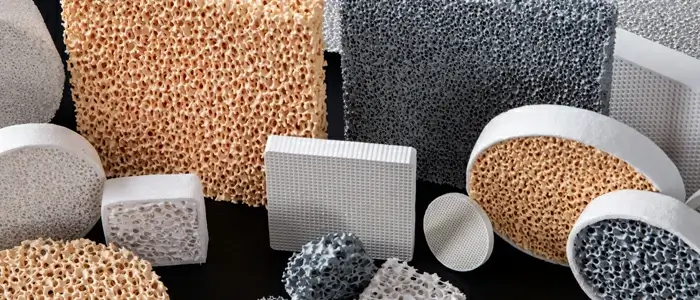
- Quality: Ceramic foam filters trap oxides and inclusions, dramatically improving mechanical properties and reducing scrap.
- Yield: Precision-engineered pouring systems minimize turbulence and air entrainment, leading to sounder castings.
Liners and Wear Parts: The Protectors of Capital Equipment
Role: Shield furnace walls, impellers, pump housings, and other critical equipment from corrosive/erosive wear.
Material Shift: Use of SiC, Al₂O₃, and Si₃N₄ in high-wear zones.
Impact:
- Asset Protection: Extend the life of expensive furnace and pump components.
- Uptime: Reduce the frequency and scope of major refractory overhauls.
The Performance Paradigm – How Ceramics Drive Foundry KPIs
The integration of these components creates a compound positive effect on key performance indicators:
| Foundry KPI | How Advanced Ceramics Drive Improvement |
|---|---|
| Metal Quality & Scrap Rate | Direct Impact. Non-reactive surfaces and effective filtration reduce inclusions and contamination, directly lowering defect rates. |
| Process Control & Consistency | Direct Impact. Stable, accurate temperature measurement (via robust protection tubes) and controlled metal flow enable repeatable processes. |
| Equipment Uptime (OEE) | Direct Impact. Durable components resist failure, turning unplanned downtime for replacements into scheduled, predictable maintenance. |
| Maintenance & Consumable Costs | Direct Impact. Longer component lifespan (e.g., 3-5x for Si₃N₄ vs. Al₂O₃ tubes) reduces part count and labor, lowering Total Cost of Ownership. |
| Energy Efficiency | Indirect Impact. Improved thermal management in transfer systems reduces heat loss, lowering energy required to maintain temperature. |
The Silicon Nitride Advantage – The Pinnacle for Aluminum Processing
While various ceramics have roles, Gas Pressure Sintered Silicon Nitride (GPS-Si₃N₄) has emerged as the gold standard for the most demanding applications, particularly in aluminum. Its unique property portfolio makes it indispensable:
-
Non-Wetting & Corrosion Resistance: Fundamentally inert to molten aluminum, even with magnesium additions.
-
Extreme Thermal Shock Resistance: Withstands the thermal transients of die casting and batch processing.
-
High Fracture Toughness: Resists chipping and crack propagation from mechanical impact.
For a modern aluminum foundry, standardizing on Si₃N₄ for protection tubes and critical metal transfer parts is a strategic decision for achieving top-tier performance.
Ceramics as Enablers of Future Innovation
The role of ceramics will continue to expand, enabling next-generation foundry technologies:
Support for New Alloys: Enabling the processing of novel, more corrosive high-performance alloys for electrification and aerospace.
Digitalization & Industry 4.0: Reliable ceramic sensors and stable processes provide the consistent, high-fidelity data required for AI-driven process optimization.
Sustainable Casting: Contributing to sustainability through longer-lasting components (less waste), improved yield (less metal scrap), and higher energy efficiency.
Conclusion
In the modern foundry, advanced ceramic components have shed their historical role as simple, passive refractories. They are now highly engineered, performance-critical system elements. By proactively managing the interface between molten metal and equipment, they directly safeguard quality, guarantee uptime, and protect profitability.
Investing in the right ceramic technology—especially for core components like silicon nitride protection tubes and transfer systems—is not a procurement decision but a strategic operational choice. It is a foundational step for any foundry aiming to compete on quality, efficiency, and innovation in the global marketplace.
About SF-Foundry: SF-Foundry specializes in engineering advanced ceramic solutions that address the core challenges of modern molten metal processing. Our flagship Silicon Nitride Protection Tubes and Riser Tubes are designed to deliver unmatched reliability and longevity in the most aggressive aluminum and zinc processing environments, helping foundries convert material performance into competitive advantage.