


Choosing the right ceramic thermocouple sheath is not just a procurement task—it’s a critical process reliability decision. The wrong material can lead to frequent failures, inaccurate readings, and costly unplanned downtime. This guide is designed to help engineers, maintenance managers, and buyers navigate the key technical and commercial considerations to make an optimal selection for their molten metal application.
Step 1: Define Your Application Parameters
Start by clearly mapping your operational environment. The correct choice depends on these foundational factors:
Molten Metal Type: This is the primary driver. Aluminum and its alloys (especially those containing magnesium) are highly reactive and require the most resistant materials. Zinc, magnesium, and copper each present distinct corrosive challenges. For ferrous metals, the temperature and slag chemistry are key.
Operating Temperature Range: Consider both the steady-state temperature and the maximum possible peaks. Also, note the rate of temperature change during heating, cooling, or casting cycles.
Process Dynamics: Is the process continuous or batch? Does the sheath face direct metal flow, agitation, or potential mechanical impact from ladles or charge materials? High-pressure die casting environments are particularly punishing.
Atmosphere: Is the furnace atmosphere reducing, oxidizing, or covered with a specific flux? Some salts can aggressively attack certain ceramics.
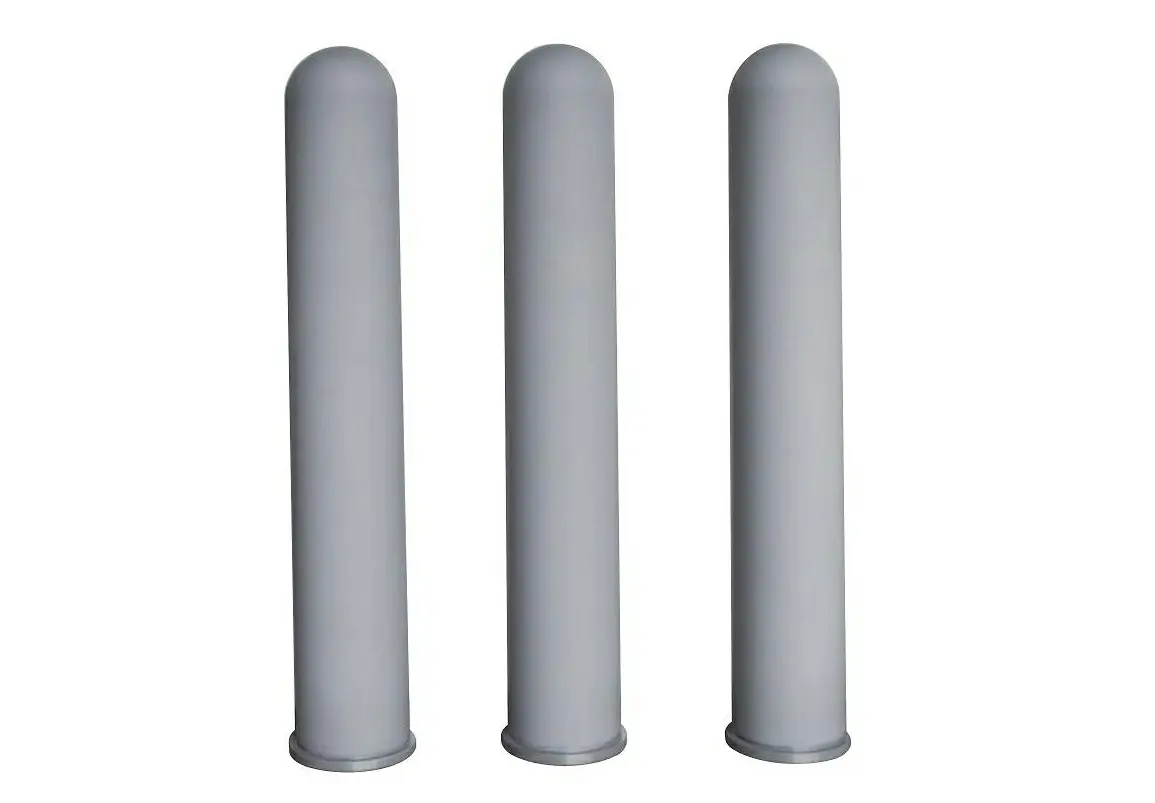
Step 2: Evaluate the Ceramic Material Options
The material is the heart of performance and longevity. Here is a breakdown of the most common options, with a focus on performance in aggressive environments.
Alumina (Al₂O₃)
Profile: The most common and economical ceramic. Good hardness and general corrosion resistance.
Key Limitation for Molten Metal: Poor thermal shock resistance and susceptibility to wetting/corrosion by molten aluminum. In reactive metals, it suffers from grain boundary attack, leading to gradual erosion and failure.
Best For: Lower-temperature applications, less aggressive metals (e.g., some irons), or situations where initial cost is the absolute overriding concern and frequent replacement is acceptable.
Reaction-Bonded Silicon Nitride (RBSN)
-
Profile: Contains residual silicon metal, which offers some toughness but at a cost to high-temperature stability and corrosion resistance.
-
Key Limitation: Porosity and the presence of free silicon can make it vulnerable to penetration and attack by certain molten metals over time.
-
Best For: Applications requiring good mechanical shock resistance but where extreme temperature and long-term corrosion are secondary.
Gas Pressure Sintered Silicon Nitride (GPS-Si₃N₄)
Profile: The premium engineering ceramic for severe service. Manufactured under high pressure and temperature to achieve near-theoretical density.
Key Advantages for Molten Metal:
- Exceptional Thermal Shock Resistance: Withstands rapid temperature cycling without cracking.
- Non-Wetting Surface: Molten aluminum beads up and rolls off, minimizing adhesion and corrosion.
- High Fracture Toughness: Resists chipping and crack propagation from mechanical impact.
- Excellent Long-Term Stability: Maintains integrity in corrosive atmospheres.
Best For: Demanding applications in aluminum, zinc, and magnesium processing; die casting; and any high-cycling furnace. It delivers the lowest total cost of ownership despite a higher initial price.
Quick-Reference Material Comparison Table:
| Property / Metal | Alumina (Al₂O₃) | RBSN (Si₃N₄) | GPS-Si₃N₄ (Premium Grade) |
|---|---|---|---|
| Thermal Shock Resistance | Fair | Good | Excellent |
| Fracture Toughness | Low | Moderate | High |
| Corrosion in Molten Al | Poor | Moderate | Excellent |
| Wetting by Molten Al | High | Low | Extremely Low |
| Typical Service Life in Al* | 3-6 months | 6-12 months | 18-36+ months |
| *Life varies significantly with specific conditions. |
Step 3: Understand Key Technical Specifications
Once the material is chosen, scrutinize these specifications:
-
Density & Microstructure: For silicon nitride, density > 3.2 g/cm³ is a good indicator of quality. Ask for a microstructure analysis—a fine, uniform grain structure signifies superior strength and corrosion resistance.
-
Dimensions & Tolerances: Ensure the OD, ID, and length match your thermocouple assembly and furnace fittings. Consistent wall thickness is critical for even thermal stress distribution.
-
Surface Finish: A smooth, machined surface (Ra < 0.8 µm) reduces metal adhesion and makes cleaning easier.
-
Certifications & Data Sheets: Reputable suppliers provide material property data sheets (flexural strength, thermal conductivity) and relevant quality certifications (e.g., ISO 9001).
Step 4: Procurement and Supplier Evaluation
-
Request Samples for Testing: The most reliable method. Run a sample sheath in your actual process for a set period and evaluate its performance compared to your baseline.
-
Assess Technical Support: A good supplier will ask detailed questions about your application and provide clear, technically sound recommendations, not just a sales pitch.
-
Calculate Total Cost of Ownership (TCO): Factor in the unit price, expected service life, cost of downtime for replacement, and risk of process upset or contamination. The cheapest part per piece is often the most expensive in the long run.
-
Consider System Compatibility: For optimal results, evaluate other ceramic components in the metal path (e.g., riser tubes, transfer tubes). Using a compatible high-performance material like silicon nitride across the system (SF-Foundry supplies a full range of Si₃N₄ components) can synchronize maintenance schedules and improve overall reliability.
Conclusion and Final Recommendation
For molten metal applications—especially aluminum, zinc, and magnesium—investing in Gas Pressure Sintered Silicon Nitride (GPS-Si₃N₄) sheaths is the strategic choice that maximizes uptime, ensures measurement accuracy, and minimizes long-term operational costs.
Your Action Plan:
-
Audit: Review your current failure modes and associated costs.
-
Specify: Use this guide to define your requirements for material and dimensions.
-
Test: Engage with a specialized supplier like SF-Foundry to request samples of high-performance silicon nitride sheaths for a side-by-side trial in your furnace.
-
Optimize: Based on test results, implement a proactive replacement program and consider standardizing on high-performance ceramics for related components.
Making an informed selection transforms your thermocouple sheath from a fragile consumable into a robust, reliable component of your production process.
Keywords for SEO: Ceramic thermocouple sheath selection, molten metal thermocouple protection, silicon nitride vs alumina sheath, buyer guide thermocouple tube, selecting thermocouple for aluminum, high temperature ceramic sheath, corrosion resistant thermocouple, die casting thermocouple protection, GPS silicon nitride properties, total cost of ownership furnace parts.