


Your thermocouple is the vital “eye” of your molten metal operation, and its protection tube is the first line of defense. A compromised tube doesn’t just fail—it fails expensively, leading to inaccurate readings, damaged sensors, and uncontrolled process costs. Waiting for a catastrophic breakdown is not a strategy.
Watch for these five critical signs that your protection tube needs immediate replacement, and learn how choosing the right material can transform your maintenance from reactive to predictive.
Sign 1: Erratic or Drifting Temperature Readings
What to Watch For: Unexplained fluctuations, a consistent downward or upward drift in temperature readings over time, or readings that no longer align with process expectations (e.g., metal fluidity).
The Root Cause: Cracks, thinning walls, or deep pitting in the tube allow molten metal, fumes, or atmosphere to seep in. This directly attacks the thermocouple sheath or wire, altering its electrochemical properties and causing calibration drift. The tube is no longer providing a stable, isolated environment.
Immediate Action: Cross-check the reading with a trusted portable sensor if possible. Log the instability and inspect the tube upon the next scheduled furnace downtime.
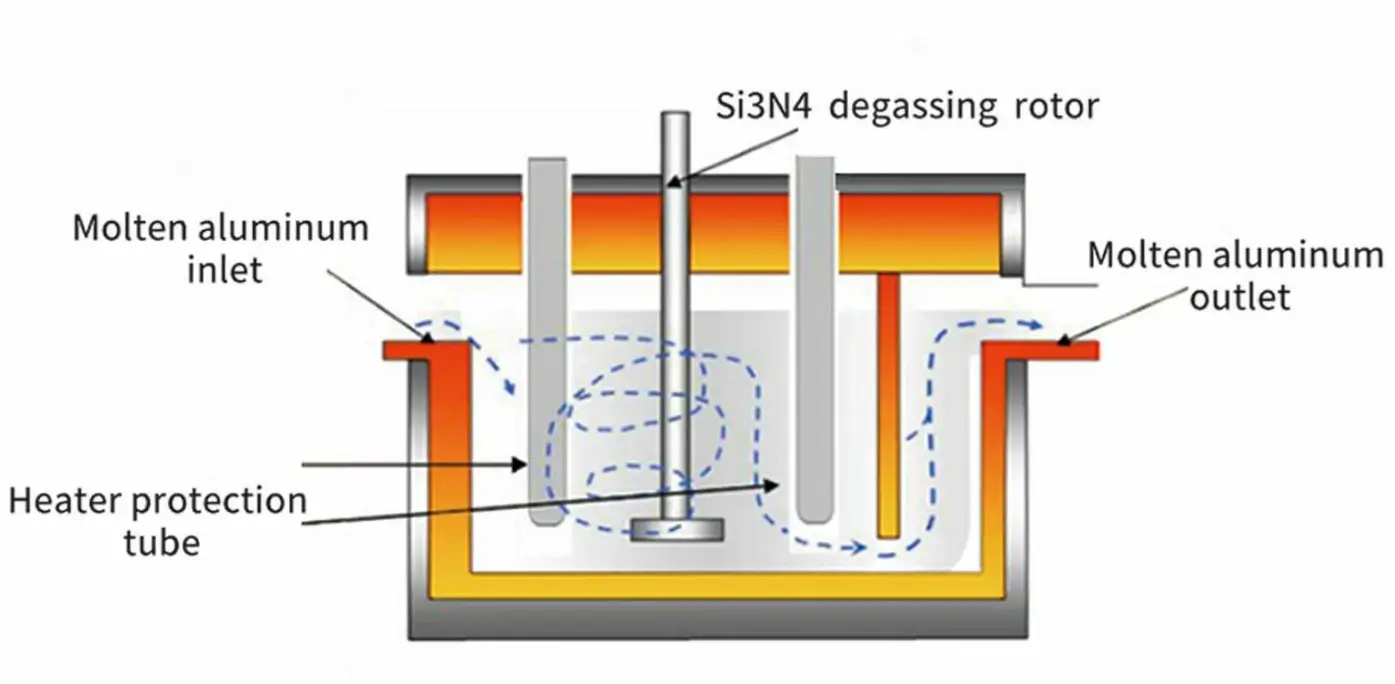
Sign 2: Visible Physical Damage – Cracks, Chips, or Severe Erosion
What to Watch For: This is the most obvious sign. Perform regular visual inspections for:
-
Hairline cracks (often starting near the flange or submerged tip).
-
Material spalling or chipping.
-
A thinned, uneven, or “worn” appearance on the section submerged in the melt, especially at the metal-air interface line.
The Root Cause: Thermal shock from rapid temperature changes, direct mechanical impact during charging or stirring, or advanced chemical/erosive wear. A crack is a direct pathway for failure.
Immediate Action: Replace immediately. A visibly cracked tube is actively failing and poses a high risk of thermocouple loss and metal contamination.
Sign 3: Excessive Buildup of Dross or Metal Adhesion
What to Watch For: A thick, tenacious crust of dross or solidified metal welded to the tube’s surface, particularly near the melt line. This is more than normal light filming.
The Root Cause: Surface degradation. As the protective, smooth surface of the ceramic erodes, it becomes microscopically rougher. This rough surface provides nucleation sites for dross and increases the wettability of the metal, causing it to stick rather than flow off.
The Root Cause: Surface degradation. As the protective, smooth surface of the ceramic erodes, it becomes microscopically rougher. This rough surface provides nucleation sites for dross and increases the wettability of the metal, causing it to stick rather than flow off.
Immediate Action: Note the rate of buildup. If cleaning cycles become frequent and the adhesion is severe, the tube’s surface integrity is gone, and its insulating properties are compromised.
Sign 4: Frequent Thermocouple Failures
What to Watch For: You’re replacing the thermocouple itself far more often than the manufacturer’s specified lifespan, even if the outer protection tube looks intact.
The Root Cause: The tube has likely failed internally. Permeability has increased, allowing corrosive vapors (e.g., from Mg treatments or salts) to attack the thermocouple’s metal sheath without leaving major external marks. The tube is no longer performing its primary duty.
Immediate Action: Track thermocouple lifespan against the protection tube’s service hours. A pattern of short thermocouple life is a definitive sign the tube needs to be changed.
Sign 5: It’s Been Over a Year in Aggressive Service
What to Watch For: Even without glaring signs, if the tube has been in continuous service in aluminum, zinc, or alloy melting for 12-18 months, it is living on borrowed time.
The Root Cause: Cumulative damage. High-temperature ceramics undergo slow, continuous degradation in molten metal. Performance decline is often gradual. Proactive replacement based on documented service life in your specific application is the hallmark of world-class maintenance, preventing unplanned downtime.
Immediate Action: Implement a scheduled replacement program based on your historical data and material performance.
Why Standard Tubes Fail & The Silicon Nitride Solution
Standard alumina or mullite tubes often succumb to the signs above due to inherent vulnerabilities:
-
Susceptibility to Thermal Shock: Cracking from rapid temperature changes (Sign 2).
-
Reactivity with Molten Al: Gradual chemical wear leading to erosion and buildup (Sign 3).
-
Permeability: Allowing corrosive agents to pass through and attack the sensor (Signs 1 & 4).
The Upgrade Path: Silicon Nitride (Si₃N₄) Tubes
Upgrading to Gas Pressure Sintered Silicon Nitride directly addresses these failure modes:
-
Superior Thermal Shock Resistance: Withstands drastic temperature cycles, virtually eliminating thermal crack failures.
-
Non-Wettability: Molten metal beads up and rolls off its ultra-smooth, inert surface, preventing adhesion and dramatically reducing dross buildup.
-
Near-Zero Porosity: Its ultra-dense microstructure acts as an impermeable barrier, protecting the thermocouple from corrosive vapors and extending both tube and sensor life.
-
Proven Longevity: In aluminum applications, quality Si₃N₄ tubes regularly achieve service lives 3-5 times longer than standard ceramics, turning the “over one year” rule (Sign 5) into a baseline expectation.
Case Example: From Cost Center to Controlled Variable
A zinc alloy die-caster was experiencing Sign 4 (frequent TC failure) every 6-8 weeks, with associated unplanned downtime. After switching to SF-Foundry’s silicon nitride protection tubes, they documented:
-
Thermocouple lifespan extended to match scheduled furnace maintenance cycles (6+ months).
-
The elimination of erratic readings (Sign 1), improving process control.
-
A reduction in annual costs for replacement parts and labor by over 60%.
Your Action Plan
-
Inspect: On your next downtime, actively look for these 5 signs on your current tubes.
-
Evaluate: Calculate your true total cost—including tube changes, sensor losses, downtime, and quality risks.
-
Upgrade: Test a high-performance silicon nitride protection tube in your most aggressive application. The difference in performance and total cost of ownership is measurable.
Don’t wait for the failure. Predict it, prevent it, and upgrade your process reliability.
About SF-Foundry
SF-Foundry is a specialist manufacturer of advanced ceramic components for severe-service industrial applications. Our core product line includes high-density Silicon Nitride (Si₃N₄) Thermocouple Protection Tubes and Riser Tubes, engineered via Gas Pressure Sintering to deliver unmatched longevity and reliability in molten aluminum, zinc, and other non-ferrous metals. We help foundries and die-casters convert maintenance from a reactive cost into a competitive advantage.
Email: info@sf-foundry.com
WhatsApp: +8618636913699