


In my years working with advanced materials, I’ve seen a quiet revolution. As electronics shrink and power densities soar, the question is no longer just how to generate power, but how to survive the heat it creates. This is where a special class of ceramic materials comes in, silently enabling the technologies of tomorrow.
Forget the old notion that ceramics are just fragile, heat-resistant insulators. While your coffee mug is a great thermal insulator, advanced technical ceramics can be thermal superhighways, rivaling and even surpassing many metals in their ability to conduct heat. This unique combination—excellent heat dissipation with superior electrical insulation—makes them irreplaceable in high-tech applications.
Let’s explore the key materials that are solving the world’s toughest thermal challenges.
The Top High Thermal Conductivity Ceramics
Here is a comparative look at the most important high-thermal-conductivity ceramics.
| Material | Thermal Conductivity (W/m·K) | The Sweet Spot: Why You’d Choose It |
|---|---|---|
| Aluminum Nitride (AlN) | 70 – 200+ | The electronics champion. Perfect when you need top-tier thermal conductivity paired with excellent electrical insulation and a thermal expansion that matches silicon. |
| Silicon Carbide (SiC) | 120 – 270 | The robust workhorse. Ideal for extreme environments requiring a combo of high thermal conductivity, mechanical strength, and corrosion resistance. |
| Beryllium Oxide (BeO) | 250 – 330 | The high-performance specialist. Offers phenomenal heat dissipation but is reserved for niche applications due to toxicity concerns in its powder form. |
| Silicon Nitride (Si₃N₄) | 30 – 90+ | The tough and resilient. Don’t let its moderate conductivity fool you; its supreme fracture toughness and thermal shock resistance make it perfect for mechanically demanding, high-temperature applications. |
| Polycrystalline Diamond (PCD) | 500 – 2000 | The ultimate performer. Unmatched thermal conductivity for cutting-edge thermal management in high-power lasers, RF systems, and advanced semiconductors. |
Why These Ceramics Excel (And Why It’s Not Simple)
Unlike metals, where free electrons carry heat, heat travels through most of these ceramics via lattice vibrations called phonons. Think of it like a crowd passing a message person-to-person versus a single messenger running the entire way. The clarity of the message depends on a clear path.
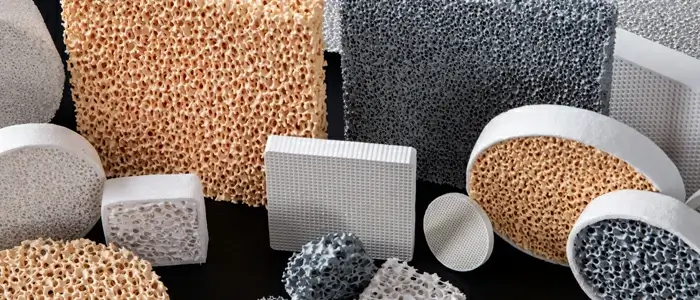
This is why purity and microstructure are everything. Oxygen impurities, tiny defects, and even grain boundaries can scatter these phonons, drastically reducing thermal conductivity. From my experience, this is the core challenge in manufacturing: achieving a pure, dense, and large-grained structure to let the heat flow freely.
Real-World Applications: Where Theory Meets Reality
This isn’t just lab talk. These materials are at work today in the most demanding fields.
-
In Your Pocket & Data Center: The 5G transceiver in your phone and the power amplifiers that drive our global internet rely on Aluminum Nitride. It pulls heat away from sensitive semiconductor chips while keeping them electrically isolated. It’s also the material of choice for electrostatic chucks, which hold silicon wafers during the chip manufacturing process itself.
-
Powering the Green Revolution: Electric vehicles and renewable energy systems depend on Silicon Carbide power electronics. SiC handles higher voltages and temperatures more efficiently than silicon, and the ceramic substrate itself must manage the intense heat generated.
-
Surviving Extreme Environments: When NASA sends a rover to another planet or a turbine engine runs at blistering temperatures, Silicon Nitride is often there. Its incredible strength and resistance to thermal shock make it ideal for bearing balls and other components where failure is not an option.
A Practical Perspective on Choosing a Material
So, how do you choose? In practice, it’s never about picking the material with the highest number on a chart. It’s a balancing act.
-
Start with the Non-Negotiables: Is electrical insulation critical? (Rule out metals). Is the part under high mechanical load? (Si₃N₄ shines). Will it face corrosive chemicals or extreme temperatures? (SiC is a safe bet).
-
Consider the Total Cost of Ownership: Beryllium Oxide (BeO) is a performance king, but its toxic powder creates handling and disposal costs that often make AlN a more economical and safer choice. Diamond is unparalleled but comes with a premium price tag reserved for the most critical applications.
-
Think About Manufacturability: Can you sinter the part to the required shape and tolerance? Each of these ceramics has its own complex fabrication process, which directly impacts lead time and cost.
The next time you hold a powerful smartphone or read about a new electric vehicle, remember the unsung heroes inside—the advanced ceramics that keep the heat in check, ensuring performance, reliability, and safety. By understanding their unique strengths, you can make an informed choice that pushes your own technology forward.