


As specialists in the field of industrial ceramic materials, we often engage with clients who are curious about the full spectrum of what ceramics can achieve beyond everyday tableware. In our world, ceramics are high-tech enablers, broadly categorized by their primary function: structural ceramics and functional ceramics. Understanding this distinction is key to selecting the right material for your application.
The Two Pillars of Advanced Ceramics: Structural and Functional
At its core, the division is simple:
-
Structural Ceramics are valued for what they can withstand—their mechanical, thermal, and chemical robustness.
-
Functional Ceramics are valued for what they can do—their specialized electrical, magnetic, or optical properties.
This framework forms the bedrock of the entire advanced ceramics industry.
Structural Ceramics: The Backbone of Extreme Engineering
In our work, especially in developing ceramic foam filters for demanding foundries, we rely daily on the principles of structural ceramics. These materials are the workhorses, chosen for their ability to maintain integrity under severe stress.
Core Characteristics:
-
High Mechanical Strength & Hardness
-
Exceptional Wear & Corrosion Resistance
-
Outstanding Thermal Stability & Shock Resistance
Key Types and Applications in Metal Casting and Beyond:
| Material | Why It’s a Structural Champion | Common Industrial Applications |
|---|---|---|
| Alumina (Al₂O₃) | A great all-rounder: strong, hard, highly wear-resistant, and an excellent electrical insulator. | Wear-resistant liners, cutting tools, electrical insulators, and as a base material for many ceramic foam filters. |
| Zirconia (ZrO₂) | Unmatched fracture toughness thanks to “transformation toughening,” making it incredibly resistant to chipping and impact. | Precision bearings, medical implants, cutting blades, and high-performance molten metal filters for reactive alloys. |
| Silicon Carbide (SiC) | Exceptional thermal conductivity and resistance to thermal shock, maintaining strength at extreme temperatures. | Heat exchangers, seal rings, abrasives, and kiln furniture in high-temperature furnaces. |
| Silicon Nitride (Si₃N₄) | Combines high strength at temperature with excellent thermal shock resistance and low density. | Turbine blades, automotive engine components, and high-performance bearings. |
A Manufacturer’s Insight: Where Our Filters Fit In
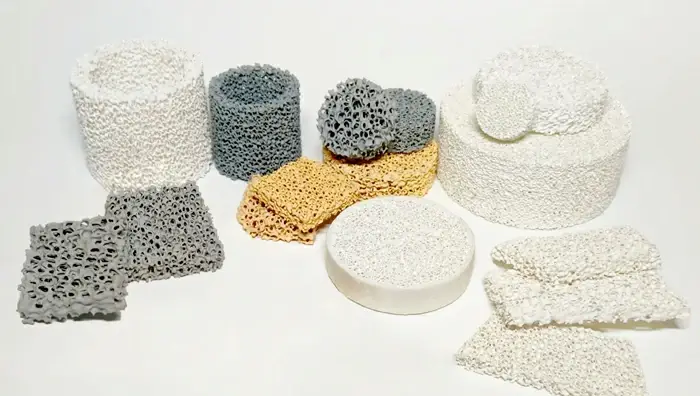
Our ceramic foam filters are a quintessential application of structural ceramic principles. They are not passive sieves; they are 3D structural scaffolds engineered to survive the brutal environment of molten metal.
-
The Structural Challenge: The filter must withstand immense thermal shock when 700°C+ molten aluminum hits it, resist chemical corrosion from the metal, and possess enough mechanical strength to handle the metal flow pressure.
-
Our Material Solution: We primarily use alumina and zirconia-based compositions. Alumina offers a superb balance of performance and cost-effectiveness for most non-ferrous applications. When dealing with higher temperatures or more reactive metals, we leverage zirconia’s superior thermal shock resistance and toughness.
-
The Result: This robust structural integrity enables deep-bed filtration, mechanically trapping and adsorbing inclusions, which dramatically improves metal quality and reduces casting defects.

Functional Ceramics: The Smart Materials Powering Modern Technology
While our filters are structural, we have immense respect for functional ceramics—the “brains” of the operation. These materials enable the electronics and smart systems we rely on.
Core Characteristics:
-
Specialized Electrical (e.g., piezoelectric, dielectric) & Magnetic Properties
-
Unique Optical or Ionic Conductive Behaviors
Key Types and Applications:
-
Piezoelectric Ceramics (e.g., PZT): Generate electricity under mechanical stress (sensors) or change shape under an electric field (actuators). Used in ultrasonic cleaners, medical imaging, and precision motors.
-
Dielectric Ceramics (e.g., BaTiO₃): Store and manage electrical energy. They are the foundation of multi-layer ceramic capacitors (MLCCs) in every electronic device.
-
Ionic Conductive Ceramics (e.g., Yttria-Stabilized Zirconia): Allow specific ions to pass through. This is critical for automotive oxygen sensors and solid oxide fuel cells.
The Convergence: Advanced & Specialized Ceramics
The line between structural and functional is blurring in the realm of advanced ceramics. This includes materials engineered for the most extreme environments.
-
Ultra-High-Temperature Ceramics (UHTCs): Materials like zirconium diboride (ZrB₂) that can withstand temperatures over 2000°C, used in aerospace for hypersonic vehicle components.
-
Self-Healing Ceramic Coatings: An emerging field where coatings can autonomously repair micro-cracks, extending the life of turbine blades and other high-temperature components.
Conclusion: Partnering with the Right Ceramic Expert
The world of industrial ceramic materials is vast and specialized. Whether your project demands the brute strength of structural ceramics or the smart functionality of functional ceramics, choosing a supplier with deep material science knowledge is crucial.
From our perspective as a ceramic foam filter manufacturer, this expertise translates directly into product performance. Understanding the granular differences between alumina and zirconia allows us to recommend the perfect filter for your specific metal casting process, ultimately saving you time, cost, and quality headaches.
Are you tackling a challenge that involves high temperatures, corrosive environments, or the need for precise material properties? Let’s discuss how the right advanced ceramic solution can make all the difference. Contact us today for a technical consultation.