


In my years working in manufacturing and engineering, I’ve seen few processes as fundamental and versatile as metal casting. It’s the art of shaping metal by pouring it into a mold—a practice thousands of years old that remains the backbone of modern industry. But with so many different casting methods available, a common question I get is: “Which type of casting is right for my part?”
Choosing the wrong process can lead to cost overruns, production delays, and parts that don’t meet specifications. That’s why I’ve put together this practical guide to the six most common types of metal casting processes. We’ll look at how they work, what they’re best for, and key considerations to help you navigate this critical decision.
Sand Casting: The Versatile Workhorse
Sand casting is perhaps the most widely used casting process, and it’s often where many of us, including myself, first learn the craft. It involves creating a mold from compacted sand formed around a pattern of the desired part.
-
How it works: A sand mixture is packed into a two-part flask around a pattern. The pattern is removed, leaving a cavity. Molten metal is poured in, and once it solidifies, the sand mold is broken away.
-
Best for: Low to medium volume production, very large parts (like engine blocks), and when you need to cast ferrous metals like steel and iron.
-
Key Takeaway: Think of sand casting as your go-to for flexibility and low tooling costs, especially for prototyping and large components. The trade-off is a rougher surface finish and lower dimensional accuracy compared to other methods.
Investment Casting: For Unmatched Detail
Also known as lost-wax casting, this is the process I specify when we need complex geometry and an excellent surface finish. I’m always impressed by the intricate details it can capture, from turbine blades to artistic sculptures.
-
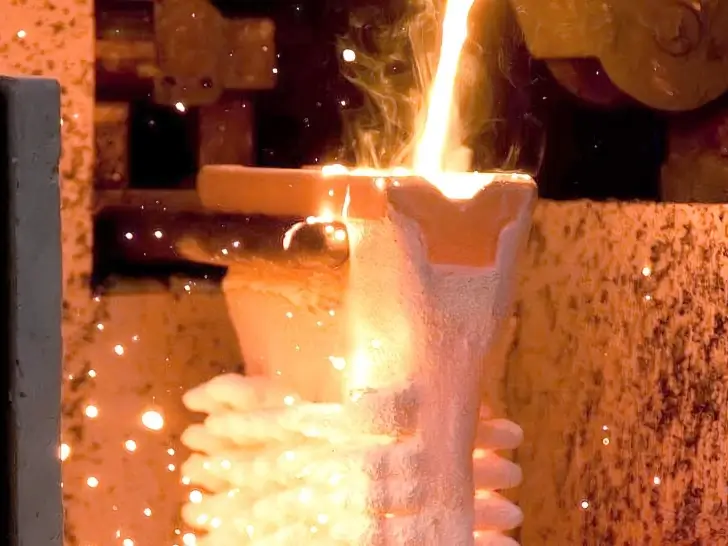
How it works: A wax pattern is coated in a ceramic slurry to create a hard shell. The wax is melted out, and molten metal is poured into the resulting cavity.
-
Best for: Complex parts that would be difficult or expensive to machine, and for materials that are hard to machine, like stainless steel alloys and superalloys.
-
Key Takeaway: If your component has intricate internal passages or fine details and you want to minimize post-casting machining, investment casting is often the answer. The per-part cost is higher, but you save on secondary operations.
Die Casting: The High-Speed Champion
When I’m working on a high-volume project for the automotive or consumer electronics industry, die casting is frequently the star player. It’s all about speed, precision, and repeatability.
-
How it works: Molten metal is forced under high pressure into a reusable steel mold, called a die. This allows for very fast cycle times.
-
Best for: High-volume production of non-ferrous parts (like zinc, aluminum, and magnesium) with thin walls and excellent as-cast surface quality.
-
Key Takeaway: The initial die casting mold cost is significant, but the per-part cost becomes very low at high volumes. It’s ideal for mass-producing components like aluminum die cast housings and brackets.
Permanent Mold Casting: A Balance of Quality and Rate
This process sits between sand casting and die casting. I see it as a fantastic option when you need better quality and faster production than sand casting can offer, but your volumes don’t justify the high cost of die casting tooling.
-
How it works: Reusable metal molds (typically iron or steel) are filled with molten metal by gravity or low pressure.
-
Best for: Medium-volume runs of non-ferrous metals like aluminum and copper alloys. It produces parts with a finer grain structure and better mechanical properties than sand casting.
-
Key Takeaway: If you need good dimensional accuracy and a superior surface finish for a series of parts, permanent mold casting offers an excellent middle ground.
Lost-Foam Casting: Simplicity for Complex Shapes
This is a relatively modern process that continues to fascinate me with its elegance. It eliminates the need for cores and parting lines, simplifying the mold-making process for complex shapes.
-
How it works: A pattern is made from expandable polystyrene (EPS) foam and is placed in sand. Molten metal is poured in, vaporizing the foam and perfectly filling the cavity.
-
Best for: Complex engine components like cylinder heads and intake manifolds where internal passages are critical.
-
Key Takeaway: The main advantage is design freedom. Without traditional cores, you can achieve geometries that are impossible with other metal forming processes.
Centrifugal Casting: For Superior Cylinders
When the project calls for a symmetrical, cylindrical part, I immediately consider centrifugal casting. It uses centrifugal force to create a part with exceptional integrity.
-
How it works: A mold is spun at high speeds while molten metal is poured in. The centrifugal force pushes the metal against the mold walls, creating a dense, void-free structure.
-
Best for: Manufacturing pipes, tubes, rings, and bushings.
-
Key Takeaway: This is the premier casting method for creating seamless, high-integrity cylindrical shapes with excellent mechanical properties.
Choosing the Right Casting Process: A Final Thought
From my experience, there’s no single “best” casting process. The right choice is a balance of:
-
Part Complexity & Size
-
Material Selection
-
Production Volume
-
Dimensional Accuracy Requirements
-
Your Total Budget
I hope this guide has shed some light on the diverse world of types of casting processes. By understanding these core methods, you’re better equipped to have a productive conversation with your manufacturing partner and select the most efficient and cost-effective path for your next project.
Looking for a professional opinion on your specific component? Contact us today for a free engineering consultation to discuss the best metal fabrication techniques for your needs.